
GST-Ready Financial
Accounting that
CFOs Trust
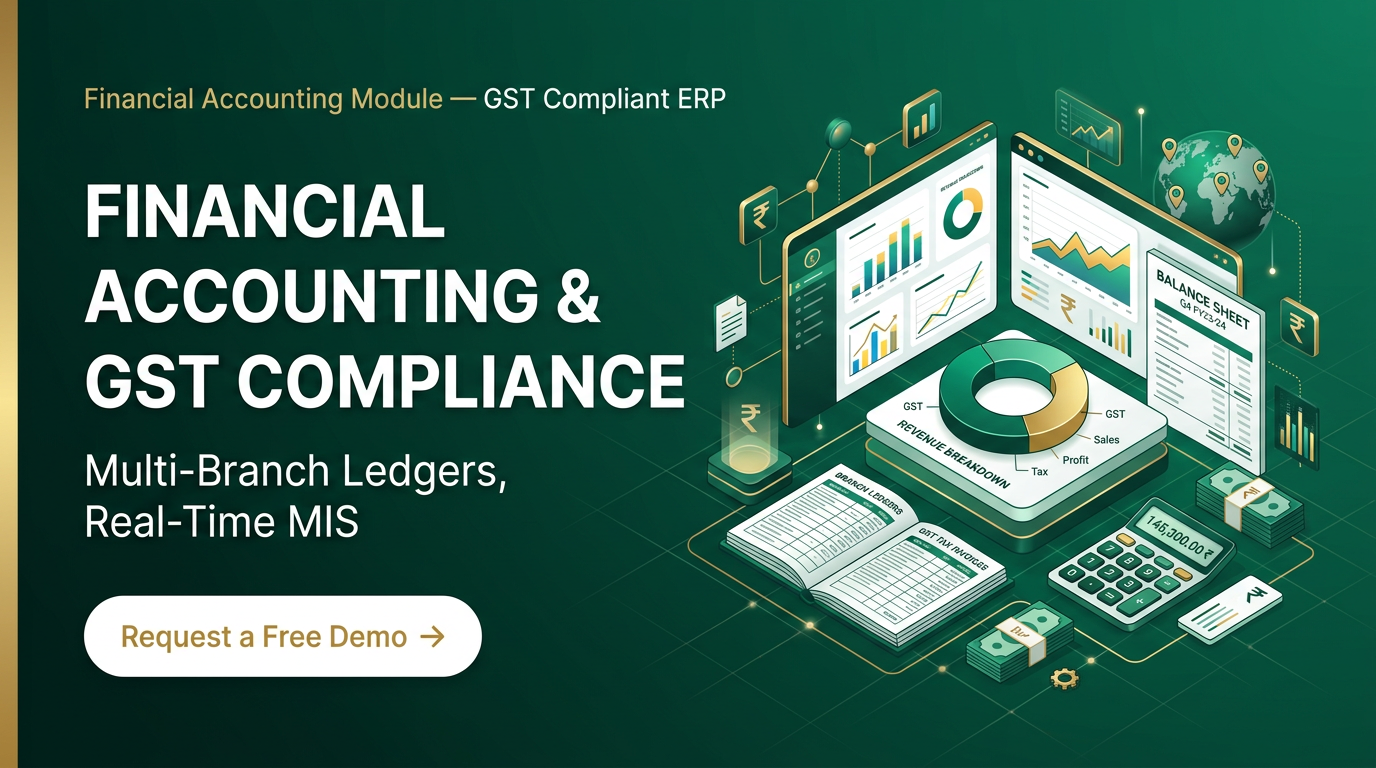
Multi-company books, branch P&L, e-Invoice, TDS & real-time cash visibility — engineered for Indian compliance.
Used by CA-led finance teams at 80+ manufacturing units.
Why manufacturers choose ARC ERP Financial
Accounting
Outcomes you can measure in the first quarter.
Close Books 4× Faster
Automated journals, reconciliations & branch consolidation.
100% GST + e-Invoice Compliant
Real-time IRN, GSTR-1/3B & TDS filings.
Audit-Ready Always
Full audit trail, role-based approvals & document linking.
Why finance is the heart of a manufacturing ERP
Related: Sales & CRM module — ARC ERP
Ask any manufacturing CFO in Chennai what keeps them up at night, and the answers cluster around the same themes: cash flow visibility, GST compliance, audit-readiness, and the painful reconciliation between what the shop floor produced, what the warehouse shipped, and what the books actually show. ARC ERP’s Financial Accounting module is built to dissolve those anxieties. It is not a bolt-on accounting package wired to a manufacturing system; it is the same database, the same ledger, and the same audit trail as production, sales and inventory. When a GRN is posted at the gate, the inventory ledger, the supplier’s payable, the GST input credit and the asset-in-transit all move together, in the same transaction, in real time.
This integration is what separates a true manufacturing ERP from a generic business software. It is also what allows our customers to close their books in three to four days instead of two weeks, and to walk into a statutory audit with confidence rather than dread.
What the Financial Accounting module includes
Chart of Accounts that thinks like a manufacturer
The chart of accounts in ARC ERP is built on standard Indian accounting principles but extended for manufacturing realities. You get separate ledger groups for raw material inventory, work-in-progress, finished goods, consumables, tooling, and capital work-in-progress. Cost centres can be mapped to plants, lines, departments or even individual machines, so a CFO sitting in Anna Nagar can see exactly which cell in Sriperumbudur is consuming the most power or generating the most scrap. The structure is hierarchical, multi-level, and fully configurable; it can mirror Schedule III of the Companies Act for statutory reporting while simultaneously rolling up to a custom internal MIS view for the management.
Tax Configuration for GST and beyond
Indian indirect tax is not for the faint-hearted. CGST, SGST, IGST, UTGST, RCM, TCS under 206C(1H), TDS under 194Q, e-invoicing thresholds, e-way bill triggers — every one of these has business logic that must be enforced at the document level, not after the fact. ARC ERP ships with a tax engine that handles all of this declaratively. You configure HSN/SAC codes, tax rates and place-of-supply rules once; every sales order, purchase order, invoice and credit note then computes taxes correctly, generates IRN-ready JSON for the IRP, and creates GSTR-1 and GSTR-3B working files automatically. For exporters in MEPZ and SEZ units, LUT-based zero-rated supplies and ICEGATE shipping bill linkage are native.
Journal Entries with manufacturing context
Most journal entries in a factory should never be manual — they should be the byproduct of operational events. ARC ERP automates depreciation runs, period-end provisions, prepaid expense amortisation, foreign exchange revaluation, and inter-branch transfers. When a manual journal is genuinely needed (say, to record a board-approved write-off), the entry is captured with full narration, supporting documents, and an approval workflow. Every journal carries a complete audit trail: who created, who approved, what changed, and when.
Incoming Payments
Receivables are where most Indian manufacturers leak working capital. ARC ERP’s incoming payments screen lets the accounts team apply a single bank receipt against multiple invoices, claim TDS, account for bank charges and exchange differences, and reconcile bank statements through a CSV or BAI2 import. Customer ageing is live, not a Friday evening report. Credit limits and credit periods are enforced at the sales order stage — the system warns or blocks new orders for customers exceeding limits, which means the conversation about overdue payments happens before the next dispatch, not after.
Outgoing Payments
On the payables side, three-way matching between PO, GRN and invoice is automatic. Vendor invoices that match within tolerance flow straight to a payment batch; exceptions are routed to the relevant buyer or stores in-charge for resolution. The MSMED Act 45-day rule for MSME suppliers is tracked automatically, with alerts to the CFO before any liability for interest is triggered. Payment runs can be exported as NEFT/RTGS files for Tally-style upload to internet banking, or pushed directly via integrations with major Indian banks.
Credit and Debit Notes
Sales returns generate credit notes, with proper GST reversal and inventory put-back, all in one click from the sales return document. Purchase returns generate debit notes with corresponding ITC reversal. Price revisions, post-dispatch discounts, quality rejection adjustments — every commercial reality of a manufacturing business is supported with the right document type, the right tax treatment, and the right ledger impact.
Branch Expenses
Multi-branch manufacturers typically struggle to control branch-level spending. ARC ERP gives each branch its own expense module with category-wise budgets, approval matrices and bill-wise tracking. Expenses are tagged to cost centres and projects, so when the CFO asks ‘what did we spend on contract labour in the Hosur plant last quarter,’ the answer is one click away, broken down by week and by vendor.
How it works in practice — a day in the life
Related: Purchase & Procurement module — ARC ERP
Picture a typical Tuesday at a 200-crore auto-component manufacturer in Ambattur. At 9:15 am, the stores team posts a GRN for steel coils received from a Chennai-based supplier. The system instantly debits raw material inventory, credits supplier payable, captures the GST input credit, and matches the GRN to the open PO. At 11:30, a customer in Pune transfers Rs. 18 lakh against three pending invoices; the receipt is auto-matched, TDS of Rs. 18,000 is recognised, and the customer’s credit utilisation drops, freeing capacity for a new order being keyed in by the sales team. At 3 pm, the production manager confirms the day’s output of 4,200 units; standard cost accounting moves the value from WIP to finished goods, and any variance against standard cost is posted to a manufacturing variance account that the cost accountant reviews weekly.
By 6 pm, the CFO opens the dashboard on her phone in a meeting in Guindy. She sees today’s revenue, today’s collections, today’s MSME payable position, the running GSTR-1 working, and a real-time profit estimate. None of this required a single manual journal.
Compliance, audit and security
- Indian GAAP and Ind AS ready: with statutory schedules, depreciation as per Companies Act and Income Tax Act, and disclosures aligned to Schedule III.
- Immutable audit trail: every create, update, approve and reverse is logged with user, timestamp, IP and old-vs-new values, satisfying CARO 2020 and statutory auditor expectations.
- Role-based access: with maker-checker workflows on payments, journals and master data changes.
- Data residency in India: with daily encrypted backups and disaster recovery, important for manufacturers handling ITAR or defence-related work in Chennai.
Outcomes our customers see
- Month-end close compressed from 12-15 days to 3-4 days.
- DSO reduced by 8 to 20 days through credit control and automated reminders.
- 100% on-time GST filing with zero notices since go-live, in most cases.
- MSME interest liabilities under MSMED Act eliminated through automated tracking.
- Audit fees reduced because auditors can self-serve from the system instead of asking for schedules.
Why a Chennai-built finance module matters
Related: Maintenance (CMMS) module — ARC ERP
Indian accounting and tax compliance is a moving target. New e-invoice thresholds, GST rate changes, TDS section additions, MCA filings — each year brings dozens of changes. Because ARC ERP is built and supported in Chennai by a team that lives this regulatory environment daily, updates are released on time and tested against real Indian use cases. As one of the dedicated manufacturing ERP software development companies in Chennai, we treat compliance not as a feature, but as a contract with our customers. When the CBIC issues a notification, your finance module is ready before the deadline — without an additional invoice.
If your finance team is still spending Saturday mornings reconciling GSTR-2B with the purchase register, or if your auditor still asks for trial balances exported to Excel, it is time to look at a modern, integrated, Chennai-built alternative. ARC ERP’s Financial Accounting module is that alternative.
Frequently Asked Questions
Answers from our Chennai-based ARC ERP implementation team.
Yes. ARC ERP generates IRN-backed e-Invoices, e-Way Bills, GSTR-1, GSTR-3B and TDS reports natively. It is built for Indian statutory compliance.
Yes. ARC ERP supports unlimited companies and branches with separate GSTIN, PAN and books — and one-click consolidated P&L and Balance Sheet for the group.
Yes. CAs love ARC ERP because of its full audit trail, role-based approvals, and direct GSTR / TDS export. Many Chennai-based CA firms recommend it to their manufacturing clients.
For a single-company rollout, typically 30–45 days including chart of accounts setup, opening balances, GST configuration and user training.
Ready to modernize your factory?
Talk to a manufacturing ERP specialist in Chennai. We’ll map your workflow and show ARC ERP live in 30 minutes.
Explore other ARC ERP manufacturing ERP modules
Sales & CRM
Enquiry → Quote → Order → Invoice → Collection — one connected pipeline with WhatsApp & full visibility.
Purchase & Procurement
RFQ, multi-vendor comparison, PO approvals, GRN & supplier scoring — all in one disciplined workflow.
Inventory & Warehouse
Multi-location stock, bin tracking, GRN, DC, batch & serial — accurate inventory you can finally trust.
Maintenance (CMMS)
Preventive, reactive & predictive maintenance with checklists, work orders, spares & equipment history.