
Your Factory — Mirrored in Real Time
IoT-connected assets, live monitoring, predictive failure alerts & process simulation. The future of manufacturing.
Deployed at smart factories across Sriperumbudur & Oragadam.
Why manufacturers choose ARC ERP Digital Twin
Outcomes you can measure in the first quarter.
Predict Failures Before They Happen
ML-based anomaly detection on live sensor data.
Simulate Before You Build
Process & capacity what-if scenarios in a sandbox.
True Industry 4.0
OPC-UA, MQTT & Modbus connectivity included.
A real-time virtual replica of your factory — built for Indian manufacturers
Industry 4.0, finally affordable for Indian manufacturers
Related: Financial Accounting module — ARC ERP
For nearly a decade, ‘digital twin’ has been a phrase Indian manufacturers heard at conferences and read in McKinsey reports, but few outside Tata, L&T, Mahindra or the global MNC plants in Chennai had any practical access to it. The technology stack — sensors, edge gateways, OPC-UA brokers, time-series databases, ML models, 3D visualisations — was complex and the consulting bills to integrate it all ran into crores. ARC ERP’s Digital Twin module changes that equation. We have packaged the entire stack into a configurable, ERP-integrated module that a mid-sized manufacturer in Sriperumbudur can deploy in months, not years, at a price point that justifies itself within a single financial year.
This is not a buzzword module. It is a real, working capability that takes data from your existing PLCs, SCADA systems and IoT sensors, builds a live virtual model of your plant, and uses that model for monitoring, prediction, simulation and optimisation.
What a digital twin actually does
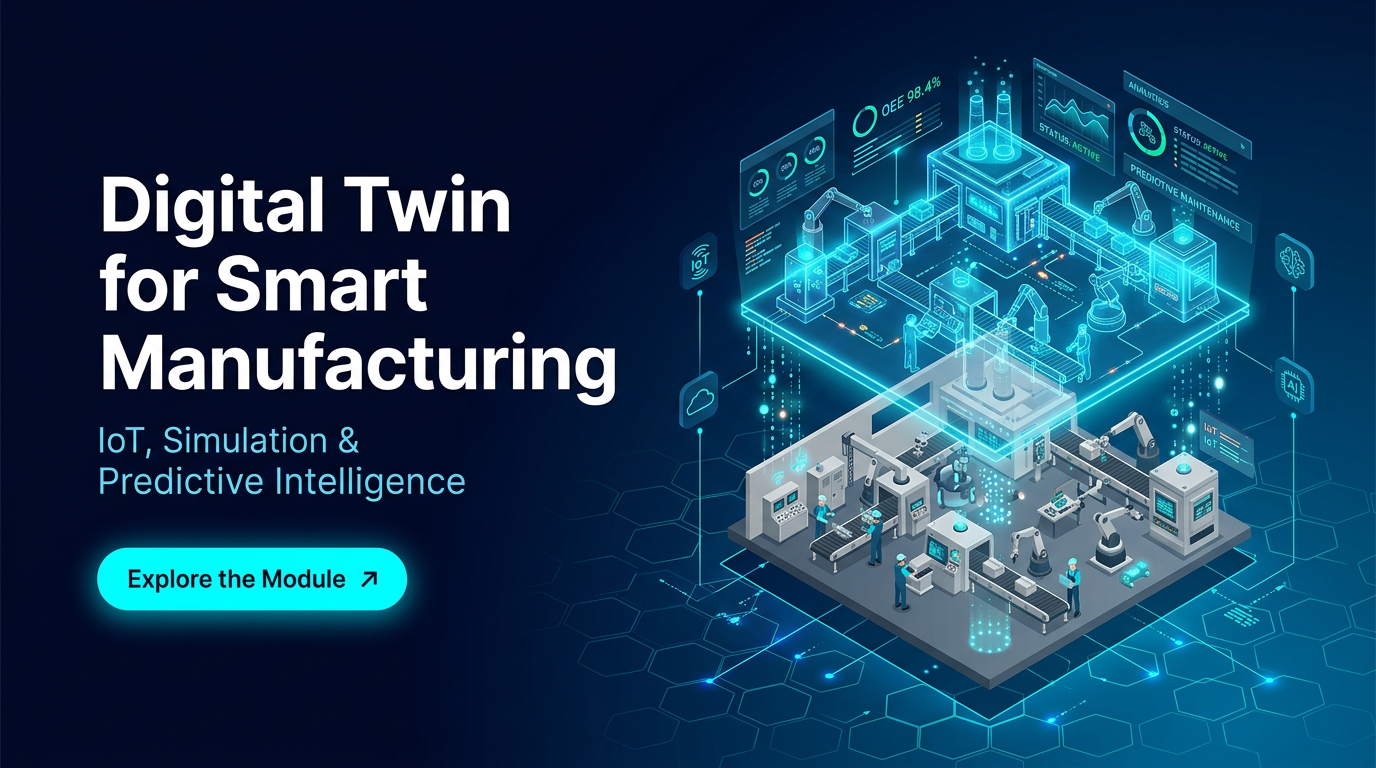
A digital twin is a software replica of a physical asset — a machine, a line, a plant — that updates in real time from sensor data and reflects the current state, history and predicted future of that asset. Where a traditional ERP records what already happened, a digital twin tells you what is happening right now and, more importantly, what will happen next. This shift — from rear-view mirror to windshield — is the foundation of Industry 4.0.
ARC ERP’s Digital Twin module delivers this shift through six tightly integrated sub-modules.
The six sub-modules of ARC ERP Digital Twin
Related: Sales & CRM module — ARC ERP
1. Asset Digital Twin
Every physical asset of importance gets a virtual counterpart organised in a hierarchical tree: Plant → Line → Machine → Component. The twin holds the asset’s static data (specifications, OEM, drawings) and its dynamic data (live sensor readings, current state, recent events). Health percentage, MTBF and MTTR are computed continuously. Maintenance history, work orders, and quality events linked to the asset are visible in one consolidated view. For a plant manager in Oragadam, this is the single screen that answers ‘what is the truth about Machine 47.’
2. IoT Integration
Connecting the physical world to the digital twin is the hardest engineering challenge, and ARC ERP solves it with a unified IoT integration layer. Out-of-the-box connectors support MQTT (most modern IoT sensors), OPC-UA (industrial PLCs and SCADA), Modbus (legacy industrial equipment, common in older Tamil Nadu factories), HTTP REST (cloud-connected meters and gateways), and WebSocket (real-time streams). A live data pipeline visualises the flow from sensor to gateway to cloud, with buffer utilisation, data quality scores, and auto-reconnect monitoring. Configuration is point-and-click, not programming.
3. Real-Time Monitoring
This is the live mission control screen. A grid view shows the status of every monitored machine — running green, idle yellow, breakdown red — across selectable plants. OEE by shift, throughput vs target charts, downtime breakdown by reason, and an active alerts panel keep the plant manager informed without having to walk the floor. Threshold-based alerts on temperature, vibration, current and any other monitored parameter notify the right person via email, SMS or WhatsApp before a problem becomes a breakdown.
4. Predictive Maintenance
Machine learning models trained on your historical sensor and failure data predict component failures before they happen. Each prediction shows the probability of failure, the predicted failure mode, the remaining useful life (RUL), and a confidence score. High-confidence, high-severity predictions automatically generate work orders that the maintenance team can schedule during planned downtime, converting an unplanned three-hour breakdown into a planned thirty-minute intervention. Anomaly detection identifies subtle changes in sensor patterns that humans cannot see, often weeks before failure. Failure pattern analysis helps reliability engineers understand systemic issues rather than chasing one-off fixes.
5. Process Simulation
Before you change a real production schedule, an investment plan, or a shop floor layout, simulate it. The interactive what-if simulator lets the planner adjust sliders for line speed, batch size, shift pattern, manning, and machine availability, and see the predicted effect on throughput, cycle time, utilisation and energy consumption. Bottleneck analysis identifies the constraint in any proposed configuration. Capacity planning charts show whether a forecast demand pattern can be served without new investment. For a CXO considering a capital expansion, this is the ability to test the decision before committing the cash.
6. Quality Management Digital Twin
Quality data — in-process measurements, final inspection results, customer complaints, supplier defects — feeds a quality twin that monitors defects per million (DPM), tracks defect Pareto by product and process, runs root cause analysis, and predicts quality issues based on process parameter drift. Compliance reporting for ISO 9001, IATF 16949, ISO 14001 and OHSAS 18001 is generated from the same data, eliminating the typical end-of-month scramble before customer audits. For Chennai-based suppliers serving global OEMs, this compliance layer is often the difference between winning and losing a contract.
Architecture: built for the Indian factory environment
Indian shop floors are not greenfield Industry 4.0 showcases. They are mixtures of new IoT-ready machines and 20-year-old workhorses with no native connectivity. ARC ERP’s IoT layer is designed for this reality. Edge gateways can be deployed at the plant to bridge legacy serial-protocol equipment to modern protocols. Local buffering means the system continues to work during internet outages, syncing when connectivity returns — essential for Tier-2 cities where connectivity is improving but not yet enterprise-grade. Data security and access control follow industry best practices, with role-based dashboards ensuring sensor data is visible only to those who need it.
From data to decision: the value path
Collecting sensor data is necessary but not sufficient. The value is in the decisions the data enables. ARC ERP closes this loop by integrating the digital twin with the rest of the ERP. A predictive maintenance alert generates a work order in the maintenance module, which reserves spares from the inventory module, which raises a PR if the spare is short. A simulation run that recommends a schedule change updates the production module’s MPS. A quality twin alert about process parameter drift triggers an inspection workflow in the quality module. The data finds the action, automatically.
The CXO view: what changes when you have a digital twin
- Visibility: from monthly MIS to real-time. The MD on a flight from Chennai to
Singapore can open her phone and see how today's production is going. - Predictability: from reactive firefighting to anticipatory action. Failures that used to
surprise the plant now appear on a forecast two weeks in advance. - Optimisation: from gut feel to data-driven. Every operational decision
can be tested in simulation before being committed in reality. - Compliance: from periodic scramble to always-on. Customer audits and
ISO surveillance audits stop being events and become non-events. -
Differentiation: from cost-based to capability-based competition. Manufacturers with a digital
twin are visibly more reliable to OEM customers, which translates into share-of-wallet gains.
Outcomes our customers measure
- Unplanned downtime reduced by 30 to 50% through predictive maintenance.
- Energy cost reduced by 8 to 15% through real-time monitoring of consumption hotspots.
- Quality defect rates reduced by 20 to 40% through process parameter monitoring.
- Capital expenditure decisions de-risked through simulation, often deferring or eliminating unnecessary purchases.
- Customer audit pass rates improved, opening doors to higher-tier OEM business.
Why ARC ERP for digital twin
Building a digital twin in-house is a multi-year, multi-crore engineering exercise. Buying it from a global vendor often means committing to a closed ecosystem and recurring licensing that grows with every sensor. ARC ERP offers a third path: a fully integrated, open, ERP-native digital twin that scales with your operation, costs a fraction of bespoke or global alternatives, and is supported by a team of engineers in Chennai who can be on your shop floor when you need them.
As one of the manufacturing ERP software development companies in Chennai actively investing in Industry 4.0 capabilities, we believe the digital twin is no longer a luxury for large enterprises — it is the new floor for serious manufacturers. ARC ERP makes that floor accessible. If your competitors are still managing by monthly reports while you can manage by real-time twin, the gap will widen month by month. The Digital Twin module is how you open it.
Frequently Asked Questions
Answers from our Chennai-based ARC ERP implementation team.
A digital twin is a real-time virtual replica of your physical factory — its machines, processes and material flow — fed by live IoT sensor data. It enables real-time monitoring, predictive maintenance and process simulation.
ARC ERP Digital Twin connects to OPC-UA, MQTT, Modbus and REST/HTTP devices, so it works with virtually every modern PLC, SCADA and edge device.
Yes. ARC ERP Digital Twin is built around the Industry 4.0 reference architecture — IoT integration, real-time analytics, predictive maintenance and process simulation are all native.
Book a CMMS walkthrough
See how ARC ERP fits your manufacturing operation. Free 30-minute consultation with our Chennai-based ERP specialists.