
What It Costs to Add UPI and Split Payments for Food App Builds That Pay Vendors and Riders
An honest 2026 cost and decision guide for a multi-vendor food delivery app in India: what UPI integration involves, how automatic money-splitting works, and what the build runs in rupees.
The Short Answer on UPI and Split Payments for Food App Builds
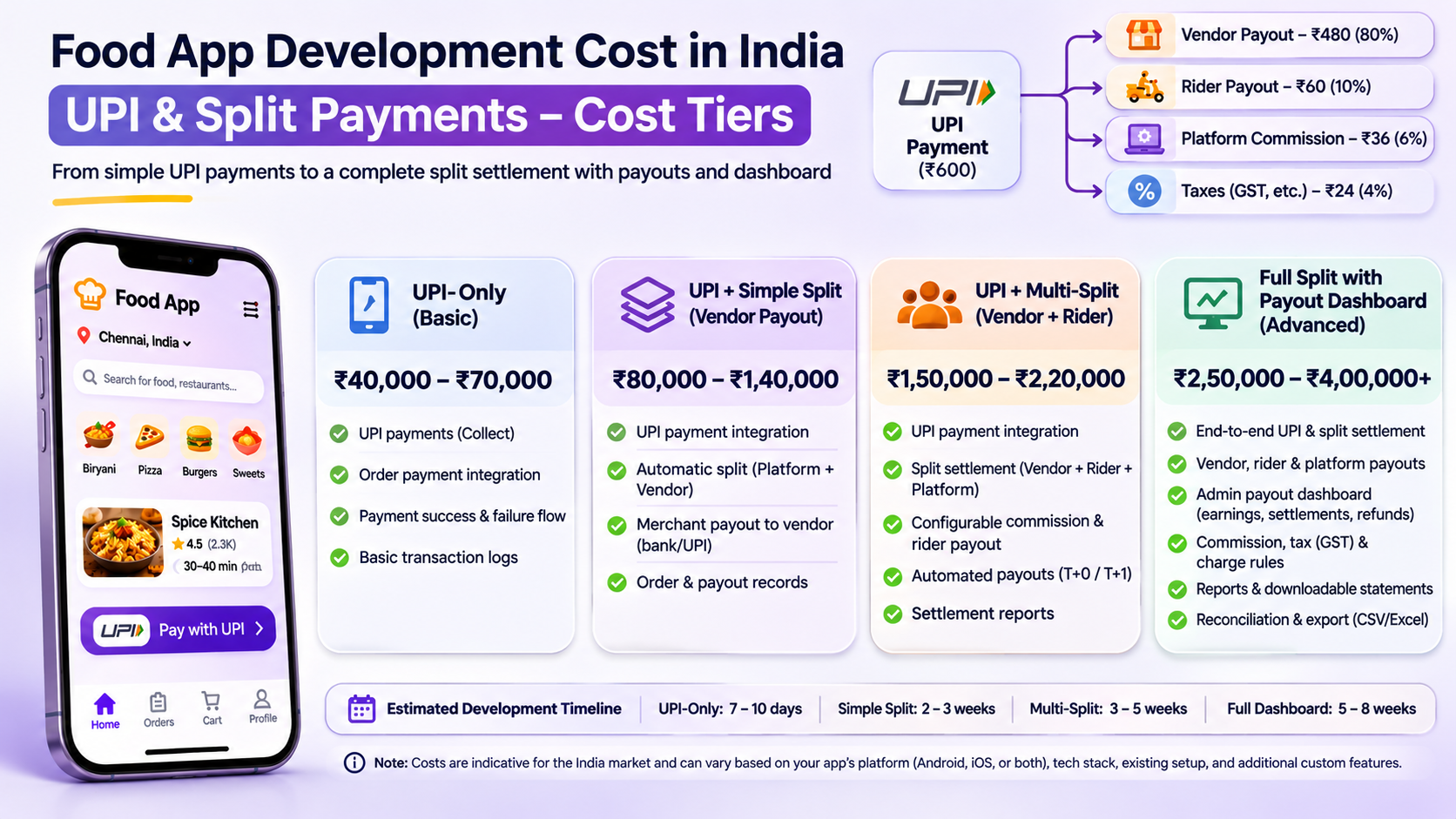
Adding basic UPI checkout to an app is cheap. Making one customer payment split itself automatically between your platform, each restaurant, and the rider is the part that costs real money. For a multi-vendor marketplace in India, a sensible 2026 budget for UPI and split payments for food app projects is around ₹2 lakh to ₹6 lakh for UPI-only, and ₹8 lakh to ₹20 lakh once you add multi-party split settlement, reconciliation, and a payout dashboard.
Here is the trap. A plain payment gateway can take a UPI payment and drop the whole amount into one bank account, yours. It cannot, on its own, carve that payment into a vendor payout, a rider payout, and your commission, then settle each party on the right cycle. For that you need a payment aggregator or marketplace-settlement product that supports split settlements and a sub-merchant or linked-account model. That gap is where most first-time food-app owners get the budget wrong.
Want the number for your exact app? Message our Chennai team on WhatsApp or call +91 88070 03902 with your vendor count and payout rules, and we will put a fixed figure in writing instead of a vague range.
What UPI Integration Actually Involves for a Multi-Vendor Food App
People say "add UPI" as if it were a single switch. It is a set of flows, and the one you pick changes the build effort and the checkout your diners get. Planning UPI and split payments for food app projects starts here, because the money has to come in cleanly before you can split it.
UPI Collect vs UPI Intent (and the In-App Flow)
UPI Collect is a pull. Your app sends a collect request to the customer's virtual payment address, the VPA, and they approve it inside their own UPI app. It is simple to build but slower, and collect requests get ignored or time out, hurting conversion during a hungry 9pm rush.
UPI Intent is a push. The customer taps a UPI app icon in your checkout, the app opens pre-filled, and they approve. It converts better on mobile, where almost all food orders happen, so most teams prioritise Intent and keep Collect as a fallback. Supporting both well costs more than one, and that shows up in the quote.
UPI Autopay and Mandates
If you plan subscriptions, a membership that waives delivery fees, or auto-top-up wallets, you are into UPI Autopay and recurring mandates. A mandate is a standing permission the customer approves once, letting you pull an agreed amount later. It adds mandate creation, pause, and revoke handling to the build, so treat it as a phase-two item unless subscriptions are core from day one.
PSP Route vs Payment Aggregator Route
There are two broad ways to accept UPI. One is going closer to a bank or payment service provider directly. The other, common one for apps, is a payment aggregator that gives you a single integration across UPI, cards, and netbanking and handles settlement to you. The route matters enormously for a marketplace, because only an aggregator or marketplace-settlement product set up for split settlements can pay many vendors out of one collected payment. A straight gateway that just confirms "paid or not paid" leaves all the splitting for you to build by hand. This is the biggest reason the cost to add UPI to a food delivery app jumps once vendors enter the picture.
What "Split Payments" Really Mean in a Multi-Vendor Marketplace
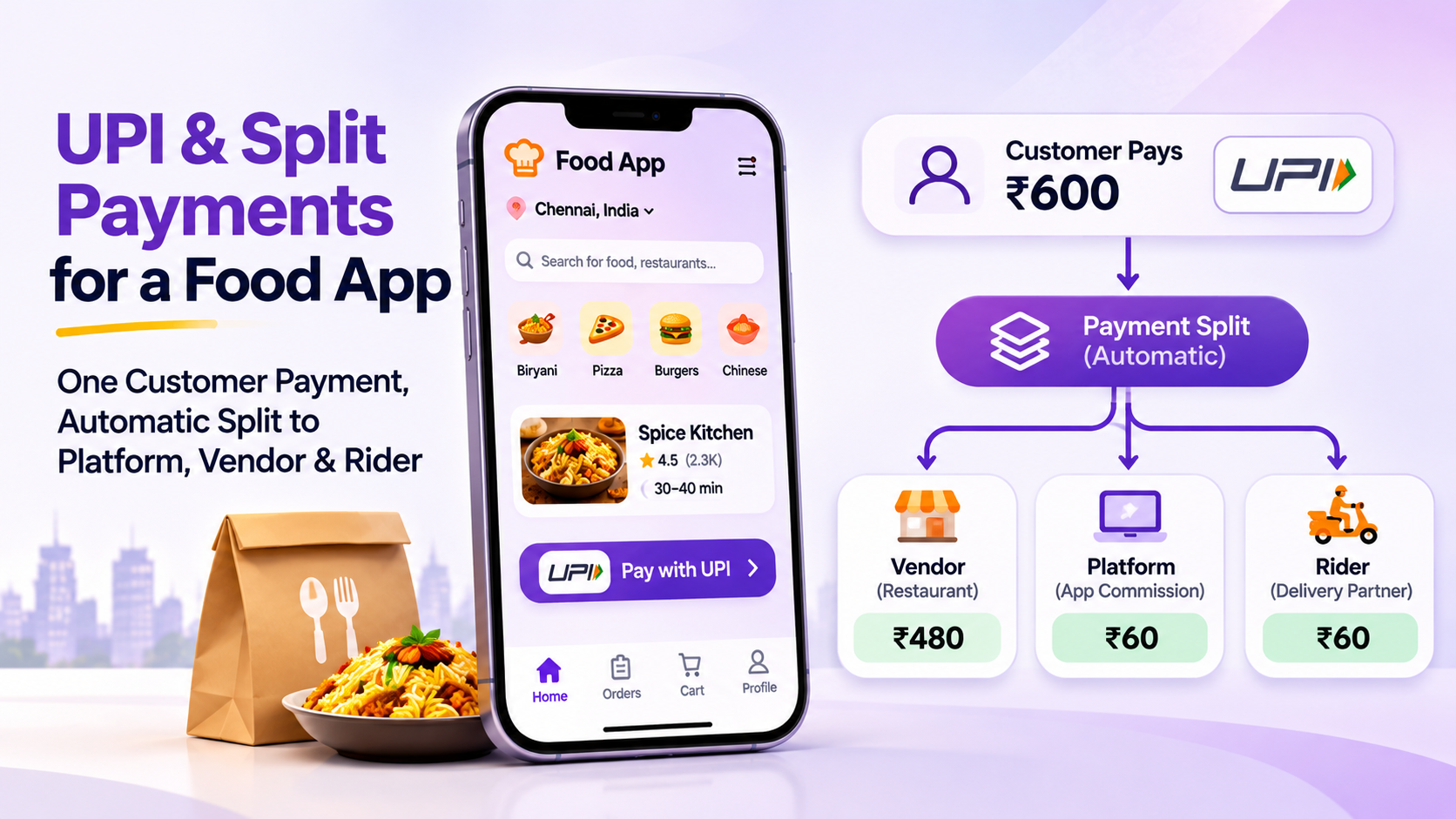
In a single-restaurant app the money is easy: the customer pays, you keep it. A multi-vendor food delivery app payment is a different machine. One checkout can hold items from more than one kitchen, and every order has at least three parties with a claim on it.
The Three-Way Split: Platform, Vendor, Rider
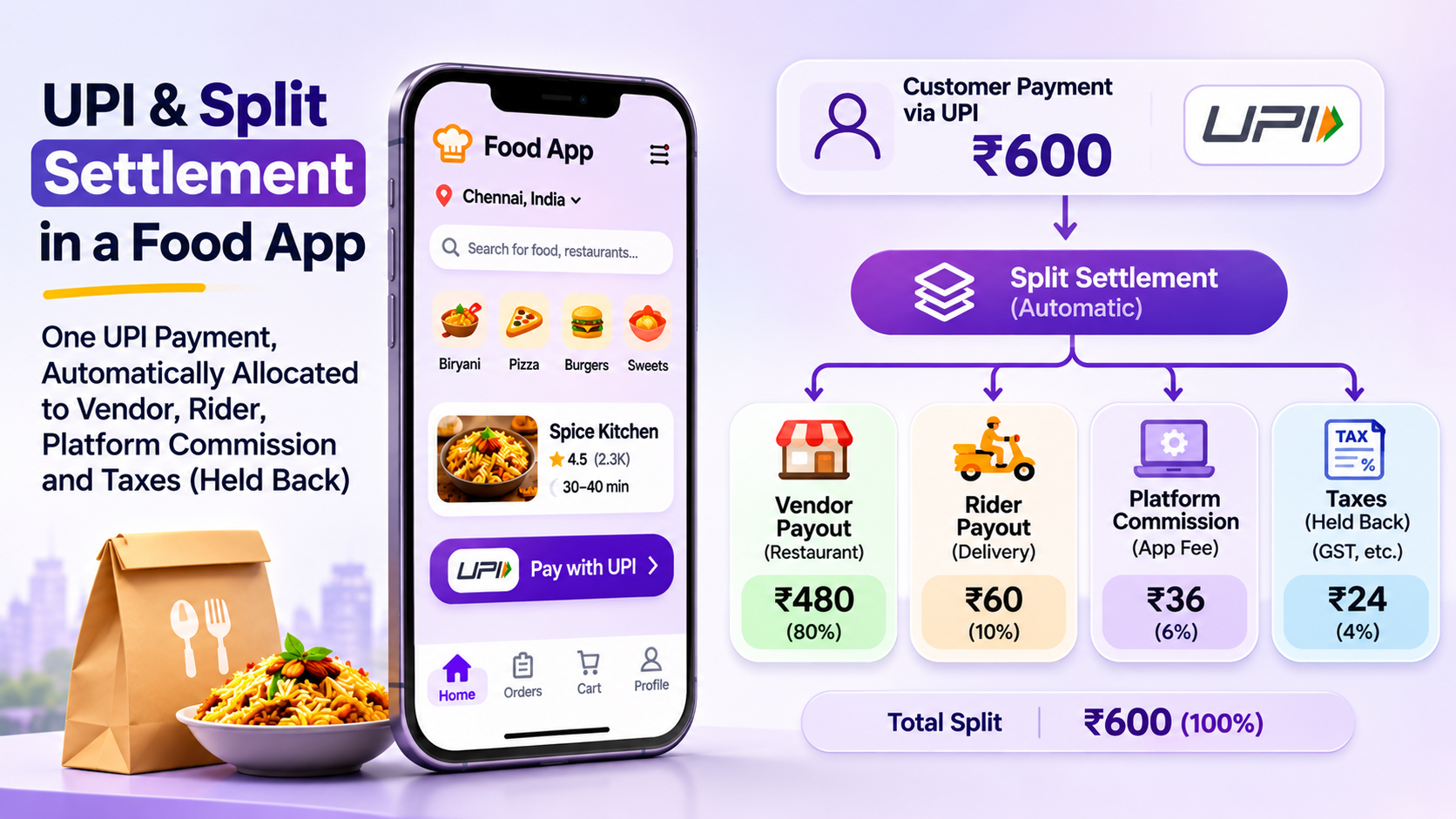
A typical order splits like this. The restaurant earns the food value minus your commission. The rider earns a delivery fee, sometimes plus a customer tip. Your platform keeps its commission and any platform fee. Split settlement for a multi-vendor marketplace means the system computes those shares per order and routes each to the right linked account, rather than you receiving a lump sum and paying everyone later from a spreadsheet. Done properly, a split payment gateway for a marketplace does this at settlement, with an auditable record of who got what.
What Gets Held Back: Commission, Taxes, TDS and TCS
Splitting is also about holding the right amounts back. Your commission comes off the vendor's share, and marketplaces in India can fall under TDS and TCS obligations on seller payouts, alongside GST on your own commission and fees. The exact rates, thresholds, and who is responsible shift with the finance rules, so treat any percentage you read as a starting point and verify the current TDS, TCS, and GST position on the official income-tax and GST portals, or with your tax advisor, before you wire the logic into code.
Why a Plain Payment Gateway Is Not Enough
Here is the mechanism that makes a plain gateway fall short. To pay many vendors cleanly, each is onboarded as a sub-merchant or linked account under your platform, with their own KYC and bank details. When an order is paid, the aggregator's split-settlement product allocates the money across those accounts by rules you define. A basic payment gateway integration has no concept of sub-merchants or per-order allocation, so it hands you the whole amount and you become an unlicensed middleman moving other people's money. A payment aggregator for a food app, with a route or marketplace-settlement feature, closes that gap.
The Compliance Reality: RBI, NPCI and Sub-Merchant KYC
Money movement in India is regulated, and a marketplace that collects from diners and pays out to vendors sits squarely inside those rules. You do not need to become a bank, but you do need to build on top of a licensed partner and respect how they operate.
The Reserve Bank of India regulates payment aggregators, and in September 2025 it consolidated the earlier guidance into a single Master Direction on the regulation of payment aggregators, as reported by ET BFSI. In practice the aggregator you integrate with holds collected funds in an escrow or nodal arrangement, keeps merchant money segregated, runs KYC on merchants, and settles on defined cycles. The knock-on effects for your app are concrete: every vendor you onboard as a sub-merchant needs KYC and bank verification before they can be paid, settlements land on a cycle such as T+1 rather than instantly, and you cannot route money in ways the escrow rules do not permit. These rules get revised, so before you design UPI and split payments for food app flows, confirm the current RBI payment-aggregator requirements and your aggregator's policy, rather than trusting a blog, including this one.
Rule of thumb. Anything in this guide about RBI licensing, escrow, settlement timing, UPI charges, or TDS and TCS is written for where things stand now and will drift. Verify the current rule and threshold on the official NPCI, RBI, and GST portals, or with your aggregator and tax advisor, before you build or price against it.
Cost to Add UPI to a Food Delivery App: The 2026 INR Ranges
Here is the part you came for, in rupees. The cost to add UPI to a food delivery app splits cleanly into a one-time build and the ongoing fees you pay forever after. Treat the ongoing fees with extra caution, because UPI charging rules move.
One-Time Build Cost
These bands cover design, development, integration, and testing to wire payments into the app and backend, assuming you integrate a licensed aggregator rather than build payment rails from scratch. Scope, not geography, sets the price.
| Scope | Typical INR range (2026) | What you get |
|---|---|---|
| Basic UPI-only checkout | ₹2 lakh to ₹6 lakh | UPI Collect and Intent, payment confirmation, single settlement account, basic webhook handling |
| UPI + simple two-way split | ₹6 lakh to ₹10 lakh | Sub-merchant onboarding, platform-and-vendor split, basic payout records |
| Full UPI + multi-party split + reconciliation | ₹10 lakh to ₹16 lakh | Three-way platform-vendor-rider split, tax hold-back logic, ledger, reconciliation, refund handling |
| Split + reconciliation + payout dashboard | ₹14 lakh to ₹20 lakh and up | All of the above plus a vendor and rider payout dashboard, statements, and admin controls |
The upi integration cost for an app in India rises step by step down that table, and the jump is not the UPI part, it is the split, the reconciliation, and the dashboard. A food app payment gateway integration in Chennai follows the same curve as the rest of the country, because the work is the work wherever the team sits.
Ongoing Per-Transaction Fees
Beyond the build you pay fees on every transaction, and this is where you must be careful with numbers. There is a merchant discount rate, the MDR, that can apply to person-to-merchant UPI payments depending on the transaction and the current framework set around NPCI, as covered by The Economic Times. On top of any such charge, your aggregator typically takes a platform or transaction fee, and there can be a separate payout fee each time money is pushed to a vendor or rider. Those payout fees matter, because one order can trigger several payouts.
Deliberately, this guide states no permanent fee percentage, because UPI MDR, interchange, and aggregator pricing all change and vary by transaction size, merchant category, and your commercial terms. Model your real economics using current, confirmed numbers from NPCI, your bank, and your aggregator. A fee assumption that ages badly can quietly turn a profitable order into a loss.
Want a fixed-scope quote for UPI and split settlement in your app? Tell us your vendor count and payout rules.
WhatsApp +91 88070 03902What Changes the Price (the Real Cost Drivers)
Two apps that both "take UPI and split the money" can be quoted lakhs apart. Here is what moves the figure.
How Many Parties Split, and How Complex the Rules Are
A flat platform-and-vendor split is simple. Add a rider share, tips, surge or distance-based delivery fees, per-vendor commission tiers, and promotions funded partly by the platform and partly by the vendor, and the allocation logic grows fast. Complex split rules are the biggest single driver of cost in UPI and split payments for food app marketplaces.
Sub-Merchant Onboarding and KYC Flows
If vendors self-onboard, you need screens and backend to collect KYC and bank details, submit them to the aggregator, and track approval status. Manual, admin-only onboarding is cheaper but does not scale past a handful of vendors.
Reconciliation Depth and the Payout Dashboard
Matching every collected payment against every payout, settlement, fee, and refund is reconciliation, and it is where quiet bugs hide. A light version just stores records; a proper one flags mismatches, handles aggregator settlement reports, and gives finance a trustworthy ledger. Add the payout dashboard vendors and riders want, with statements and export, and you have the module that usually separates the top cost tier from the one below.
Refunds, Failed Payments and Reconciliation on a Split Order
Happy-path payments are the easy 80 percent. The money and the maintenance live in the messy 20 percent, so scope it from the start rather than in production.
Failed and Pending UPI Payments
UPI payments can fail, stay pending, or succeed after your app gave up waiting. Your backend needs idempotent handling and webhook reconciliation so a customer is never charged twice and an order is never marked paid when it is not. This is boring, critical plumbing, and skimping on it produces the worst support tickets.
Partial and Full Refunds on a Split Order
Refunds are where split settlement earns its cost. If one item from one vendor is cancelled, you may owe a partial refund, which has to claw back the right share from the right vendor and adjust your commission and the rider fee. A refund after the money has settled to a vendor is harder than one before it, and the logic differs by aggregator. Map every refund case, partial, full, pre-settlement, and post-settlement, during design.
Chargebacks and Disputes
Chargebacks need an owner and a workflow: who absorbs the cost, how it reverses across the split, and how it shows in the ledger. Define this early so finance is not reverse-engineering it mid-dispute.
Why Build UPI and Split Payments for Food App Projects With a Chennai Team
You can hire a payments developer from anywhere. Here is the honest case for building this piece with a local in-house team.
Payments Work Rewards Being in the Same Room
Split settlement touches money, tax, and compliance at once, and the requirements come from your finance and operations people as much as your product owner. Scoping that face to face, whether your office is in Adyar, Anna Nagar, T. Nagar, or out along OMR, catches edge cases a remote spec misses. When a settlement report does not reconcile on a Monday morning, a local team is on it.
How iStudio Technologies Approaches a Split-Payment Build
We are iStudio Technologies, a software and mobile app company in Valasaravakkam, Chennai, with 17+ years behind us, 500+ projects delivered, and an in-house team that runs discovery, design, development, QA, and support under one roof. For UPI and split payments for food app projects we start with your payout rules and compliance posture, integrate a licensed payment aggregator rather than reinventing settlement, and build the sub-merchant onboarding, reconciliation, and payout dashboard around it. We will tell you which features to defer to phase two, and put the figure for your exact scope in writing. We do not promise specific fees or regulatory outcomes, because those are set by NPCI, RBI, and your aggregator, but we commit to code you own and a team that answers the phone.
Frequently Asked Questions
How much does it cost to add UPI and split payments to a food app?
Why can't a normal payment gateway handle split payments for a food app?
What is the difference between UPI Collect and UPI Intent?
Do I need RBI approval to split payments between vendors in my marketplace?
What ongoing fees apply to UPI and split settlement?
How are refunds handled on a split order in a multi-vendor food app?
Can iStudio Technologies build UPI and split payments for my food app in Chennai?
Related iStudio Services
Where this build lives in our work, if you want to take the next step on your app or your backend.
Mobile App Development
- Mobile app development company in Chennai, the home for every multi-vendor food app we build.
Custom Software and Backend
- Software development company in Chennai, for the settlement backend, reconciliation, and payout dashboard behind the app.
Get a Fixed Quote for UPI and Split Payments
Tell us your vendor count, your payout rules, and whether you need sub-merchant onboarding and a payout dashboard. We will scope it honestly and put the number in writing. No template quote.
WhatsApp or call +91 88070 03902