
What Does a Custom School ERP with Fee + Transport Modules Cost?
An honest 2026 guide to custom school ERP cost in India: rupee ranges by scope, what the fee and transport modules add, ongoing bills, and when custom beats readymade.
The Short Answer on Custom School ERP Cost in India
A custom school ERP with fee and transport modules usually costs between ₹12 lakh and ₹25 lakh in India in 2026. A leaner build with admissions, student records, attendance and fee collection sits near ₹6 lakh to ₹12 lakh. A multi-campus suite with exams, payroll and analytics runs ₹25 lakh to ₹50 lakh and up.
Those numbers are one-time build costs. Add roughly 15 to 20 percent of the build each year for maintenance, plus hosting and messaging. Whether custom is the right choice depends less on the sticker price than on how many students you serve and how unusual your fee and transport rules are. For a single small school, a readymade product often costs less over three years. For a trust running many campuses, custom can cost far less. We show the maths below.
Every figure here is a 2026 market estimate for planning, not an iStudio price list. Quotes vary with scope, so use the ranges to judge whether a proposal is sensible, then ask for a fixed scope in writing.
Want a number for your school? Message our team on WhatsApp or call +91 88070 03902 with your student count, campuses and bus fleet size, and we will scope it with you.
What a School ERP with Fee and Transport Modules Actually Includes
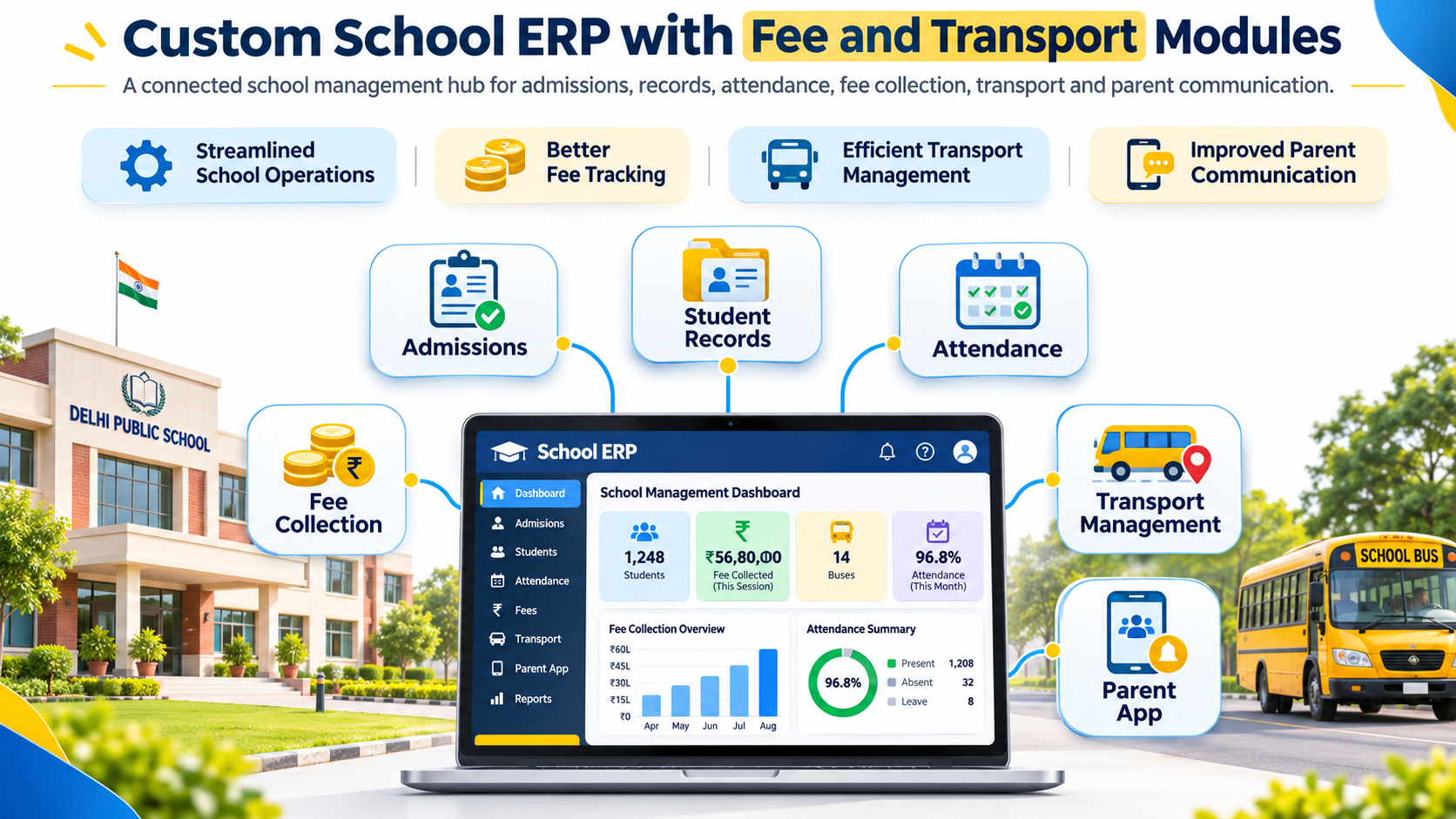
Before you compare prices, be sure you are comparing the same scope. School software ranges from a simple attendance register to a full operating system for a school group. Here is what sits inside a build that includes fee and transport.
Core Records: Admissions, Students, Attendance
The base layer holds admissions and enquiries, student and parent records, class and section setup, daily attendance, timetables and staff records. Everything else hangs off this. It is the least glamorous part and the one that must be right, because fee and transport both read from it.
The Fee Module
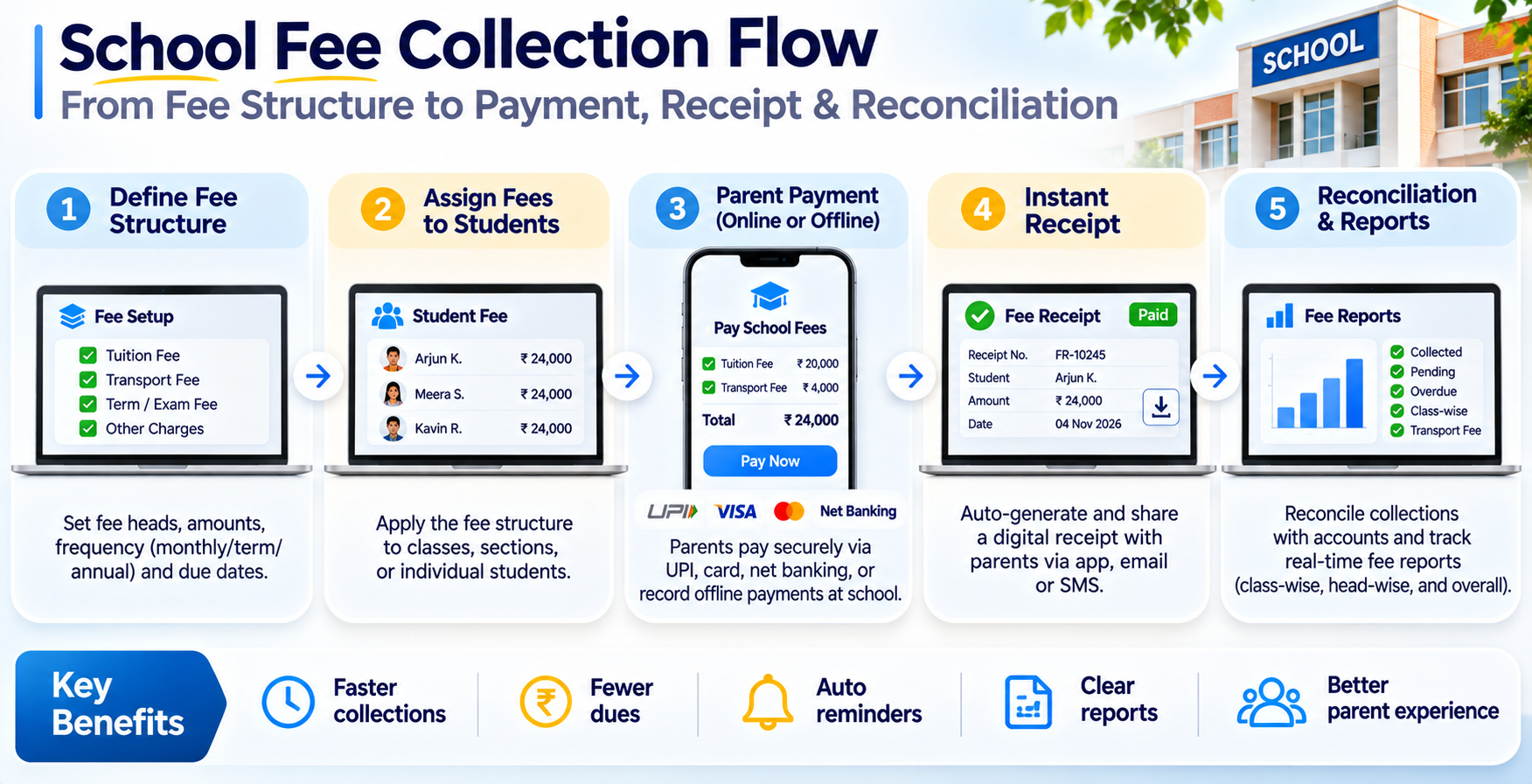
School fee management software turns your fee policy into rules the system can apply. That means fee structures by class and term, concessions and sibling discounts, instalment plans, late fees, receipts, online payment by UPI and card, automatic reminders, defaulter lists and daily collection reports. The accountant should be able to reconcile a day's collection in minutes.
The Transport Module
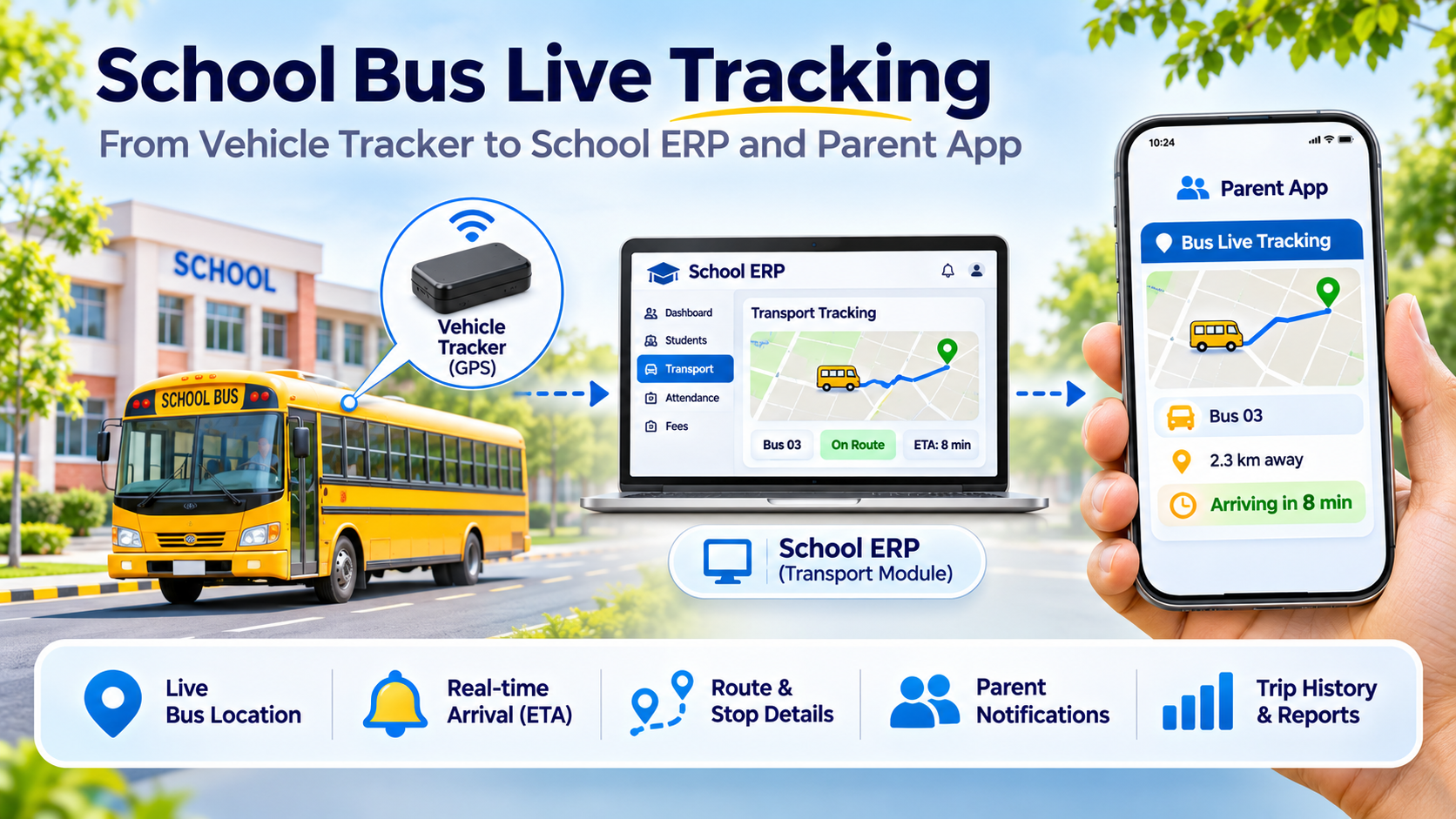
School transport management software covers routes, stops, vehicles, drivers and attendants, and the mapping of each student to a route and stop. It sets transport fees by distance or slab and feeds them into the fee module. With live tracking, parents see the bus on a map and get alerts when it nears the stop. It is also what makes the school bus gps tracking app a feature parents notice.
Parent and Teacher Apps
Most of the daily value reaches parents and teachers through their phones: fee dues and receipts, attendance alerts, notices, homework, bus location. A mobile app for each group is usually a separate line in the quote, and it is where much of the cost sits.
Custom School ERP Cost: 2026 Ranges by Scope
Here is the part you came for. The custom school ERP cost below tracks what Indian software teams commonly quote in 2026 for the same scope, so treat each band as a planning range and not a fixed price.
| Build scope | One-time cost (2026) | Realistic timeline | Who it suits |
|---|---|---|---|
| Core records plus fee module, basic parent app | ₹6 lakh to ₹12 lakh | 8 to 14 weeks | A single school that wants fee control and parent communication first |
| Core, fee and transport with live tracking, parent and teacher apps | ₹12 lakh to ₹25 lakh | 14 to 22 weeks | A school or small group running its own buses |
| Multi-campus suite: exams, payroll, library, analytics | ₹25 lakh to ₹50 lakh and up | 22 to 36 weeks | A trust or chain with several campuses |
Where the Money Goes by Module
| Module | Typical share of cost (2026) |
|---|---|
| Core records, attendance, timetable | ₹4 lakh to ₹8 lakh |
| Fee module with payment gateway | ₹2 lakh to ₹5 lakh |
| Transport module with live tracking | ₹3 lakh to ₹8 lakh |
| Parent and teacher mobile apps | ₹3 lakh to ₹8 lakh |
Bundled, these overlap, because the data model, login and admin screens are built once. The total therefore usually sits below the plain sum, which is why the middle row above reads ₹12 lakh to ₹25 lakh and not ₹12 lakh to ₹29 lakh.
What Changes the Price
- Number of campuses and boards. Each campus, class structure or exam pattern adds configuration and testing.
- Fee rule complexity. A flat annual fee is simple. Concessions, scholarships, sibling discounts and instalments are not.
- Live tracking depth. A driver phone app costs less than integrating hardware trackers fitted to each bus.
- Integrations. Accounting software, biometric attendance, a learning platform and SMS or WhatsApp each add work.
- Migrating old data. Moving years of student and fee history from spreadsheets or an old system is real effort.
- Native or cross-platform apps. One cross-platform codebase usually costs less than separate Android and iOS apps.
Want a fixed-scope quote for your school's ERP with fee and transport modules? Tell us your student and bus numbers.
WhatsApp +91 88070 03902What Drives the Fee Module Cost
The fee module looks simple until you write down your real policy. Most of its cost comes from rules, not screens.
- Fee structure logic. Different fees by class, term, hostel, transport and optional activities, each with its own due date.
- Concessions and discounts. Staff-ward, sibling, merit and need-based rules must apply automatically and leave an audit trail.
- Online payments. Gateway integration, UPI, failed-payment handling, refunds and automatic receipt numbering.
- Reconciliation and accounts. Daily collection reports and, if needed, a clean export or link to your accounting software.
- Reminders. Scheduled messages by SMS, app notification or WhatsApp to parents with dues.
Gateway charges and the rules around payments change over time, so confirm the current fees and terms with your provider before you model the school's collection costs.
What Drives the Transport Module Cost
The transport module has two layers: the records and the live tracking. The records are modest. Live tracking is where cost varies most.
Routes, Stops and Student Mapping
The base build holds vehicles, drivers, attendants, routes and stops, and links each student to a stop. It calculates the transport fee by distance or slab and posts it to the fee module. This part is straightforward and well understood.
Live Tracking: Phone App or Hardware
There are two ways to locate a bus. The cheaper route is a driver app that reports the phone's location. The sturdier route is a GPS tracker fitted to each vehicle, which keeps reporting even if the driver's phone dies. Hardware means integrating with the tracker's data feed, and the devices are bought separately, commonly a few thousand rupees per bus plus a data plan. Check current device prices and any state transport requirements for school buses before you decide.
Alerts, Geofences and Maps
Parents like an alert when the bus is a few minutes away. Geofences around stops and the school trigger these automatically. Map displays and route lines use a mapping service, which can carry usage charges as your volume grows, so factor it into running costs.
Ongoing Yearly Costs to Budget For
The build is the sticker price. A school ERP also costs money every year, and leaving these out is how a good quote turns into a bad surprise.
- Maintenance and support. Roughly 15 to 20 percent of the build cost a year, a common industry range, covering fixes, updates and small changes. On an ₹18 lakh build, that is about ₹2.7 lakh to ₹3.6 lakh.
- Hosting, backups and security. A market estimate of ₹40,000 to ₹1.5 lakh a year, depending on student count, storage and how the school wants backups handled.
- Messaging. SMS and WhatsApp notifications are charged per message, so volume matters. Confirm current rates with your provider.
- Maps and tracker data. Map usage and vehicle tracker data plans, billed by usage or by device.
- Payment gateway fees. A charge on each online fee payment, which varies by method and your terms.
- Training. A day for office staff and teachers at launch, and again each new academic year if staff change.
Custom or Readymade? The Maths for One School and for a Trust
This is the real decision, and the answer depends on scale. Readymade school software is commonly priced per student per year, and advertised prices vary widely between vendors. The numbers below use an illustrative assumption of ₹300 per student per year. Replace it with real quotes. Hosting and messaging are left out because both options carry some of those costs.
One School with 1,200 Students
A readymade product at ₹300 per student is ₹3.6 lakh a year, or ₹10.8 lakh over three years. A custom build at ₹18 lakh plus maintenance at 17 percent a year (about ₹3.06 lakh) comes to roughly ₹27.2 lakh over three years. For a single school with standard needs, readymade is cheaper on cost alone. Custom only makes sense here if your fee or transport rules do not fit any product.
A Trust with 10 Schools and 12,000 Students
The same ₹300 per student becomes ₹36 lakh a year, or ₹108 lakh over three years. A multi-campus custom build at ₹40 lakh plus maintenance at 17 percent (about ₹6.8 lakh a year) comes to roughly ₹60.4 lakh over three years. Here the per-student fee keeps growing with every admission, while the custom cost flattens, so the custom option saves about ₹48 lakh in this example.
The pattern holds in general. Per-student pricing scales with your headcount, a custom build does not. The more students you have, the sooner the custom cost pays back. Beyond price, custom gives you ownership of the code and data, and rules tailored to how your school actually works. Readymade gives you speed and lower risk.
If you are a single school, say so openly to any vendor, including us, and ask for the honest answer. It may well be readymade.
Student Data, Parent Consent and the DPDP Rules
A school ERP holds children's personal data, and that carries legal duties. India's Digital Personal Data Protection Act, 2023 and the DPDP Rules, 2025 were notified in November 2025, as covered in a government press release. The Act treats anyone under 18 as a child. In a reply to Parliament on student data, the Ministry of Electronics and Information Technology said that verifiable consent of the parent must be obtained before processing a student's personal data.
The Rules include limited exemptions for educational institutions, and parts of the regime come into force in phases. Both the exemptions and the timelines matter to how you design consent, notices and data retention. Treat this section as a prompt to take advice, not as legal advice. Verify the current position with the Ministry and your legal counsel before you finalise your design.
What this means for the build is practical. The ERP should record parent consent, limit who can see student data by role, keep an audit trail, support data correction and deletion requests, and avoid tracking children beyond what the school needs. These are design choices that cost less to include from the start than to add later, and they belong in the scope you agree.
How to Scope a Custom School ERP Without Overpaying
- Write your real rules down first. Fee structures, concessions, routes and approvals, as they work today. Most overruns come from rules discovered mid-build.
- Phase the build. Start with core records and fees, then add transport, then exams and the rest. You get value sooner and spread the spend.
- Ask for a fixed scope in writing. List the modules, the apps, the integrations, the data migration and the training, with a price and a timeline for each phase.
- Confirm ownership and exit. You should own the source code and your data, and be able to export it in a usable format.
- Plan for support. Agree the maintenance cost, response times and who handles the academic-year rollover.
- Pilot before full rollout. Run one campus or a few classes first, fix what breaks, then expand.
A good partner will tell you which features to defer. Be careful with a proposal that includes every module on day one at a price that looks too low. It usually means thin builds and expensive change requests later.
Why Work with iStudio Technologies on School ERP
We are iStudio Technologies, a software and mobile app company in Valasaravakkam, Chennai, with 17+ years behind us, 500+ projects delivered and an in-house team that runs discovery, design, development, testing and support under one roof. We build on stacks such as PHP, Java, .NET, Node.js, React and Flutter, and we work with institutions in Chennai and across India.
When a school asks us about custom school ERP cost, we start by listing your real fee and transport rules and asking whether a readymade product would serve you better. If custom is the right call, we scope it in phases, quote each phase, and put the maintenance cost in writing. You own the code and the data. We do not promise savings or timelines we cannot control, but we do commit to honest scoping and a team that answers the phone.
Frequently Asked Questions
How much does a custom school ERP cost in India?
How much do the fee and transport modules add to the cost?
Is a custom school ERP cheaper than a readymade one?
What is the yearly maintenance cost of a school ERP?
Do schools need parental consent under the data protection law?
How long does it take to build a custom school ERP?
Does iStudio Technologies build custom school ERP software?
Related iStudio Technologies Services
More of our work that connects to a school ERP build, grouped by what you need next.
Build the ERP
- Custom software development in Chennai, the home for every ERP we build.
- Web development company in Chennai for the admin portal and school website.
Reach Parents
- Mobile app development company in Chennai for parent and teacher apps.
Track the Buses
- Telematics and GPS fleet solutions in Chennai for live vehicle data feeding the transport module.
Get a Scoped Quote for Your School ERP
Tell us your student count, campuses and bus fleet. We will tell you honestly whether custom or readymade fits, and put the scope and the number in writing.
WhatsApp or call +91 88070 03902