
Must-Have Features of a Pharmacy and Medicine Delivery App in India
The pharmacy delivery app features that actually matter in 2026, grouped by user, plus the compliance features that make the app legal to run.
The Short Answer: The Pharmacy Delivery App Features That Matter
The pharmacy delivery app features that matter most are a clean medicine catalogue with search, prescription upload and verification, a licensed-pharmacy order flow, live delivery tracking, secure payments, refill reminders, and strong handling of health data. Everything else is useful, but those are the parts that make the app both usable and legal in India.
A medicine delivery app is not a grocery app with pills swapped in. Some medicines cannot be sold without a valid prescription, the data is sensitive health data, and the rules around online sale of drugs in India are strict and still evolving. Build for that from the first screen, not as an afterthought.
This guide lists the must-have pharmacy delivery app features by user: the customer, the pharmacist, the rider and the admin. It flags the compliance features that make the difference between a real pharmacy app and a liability, and ends with an honest note on cost and which model to pick.
Planning a pharmacy app? Message our team on WhatsApp or call +91 88070 03902 with your pharmacy setup and the area you serve, and we will help you scope a compliant build.
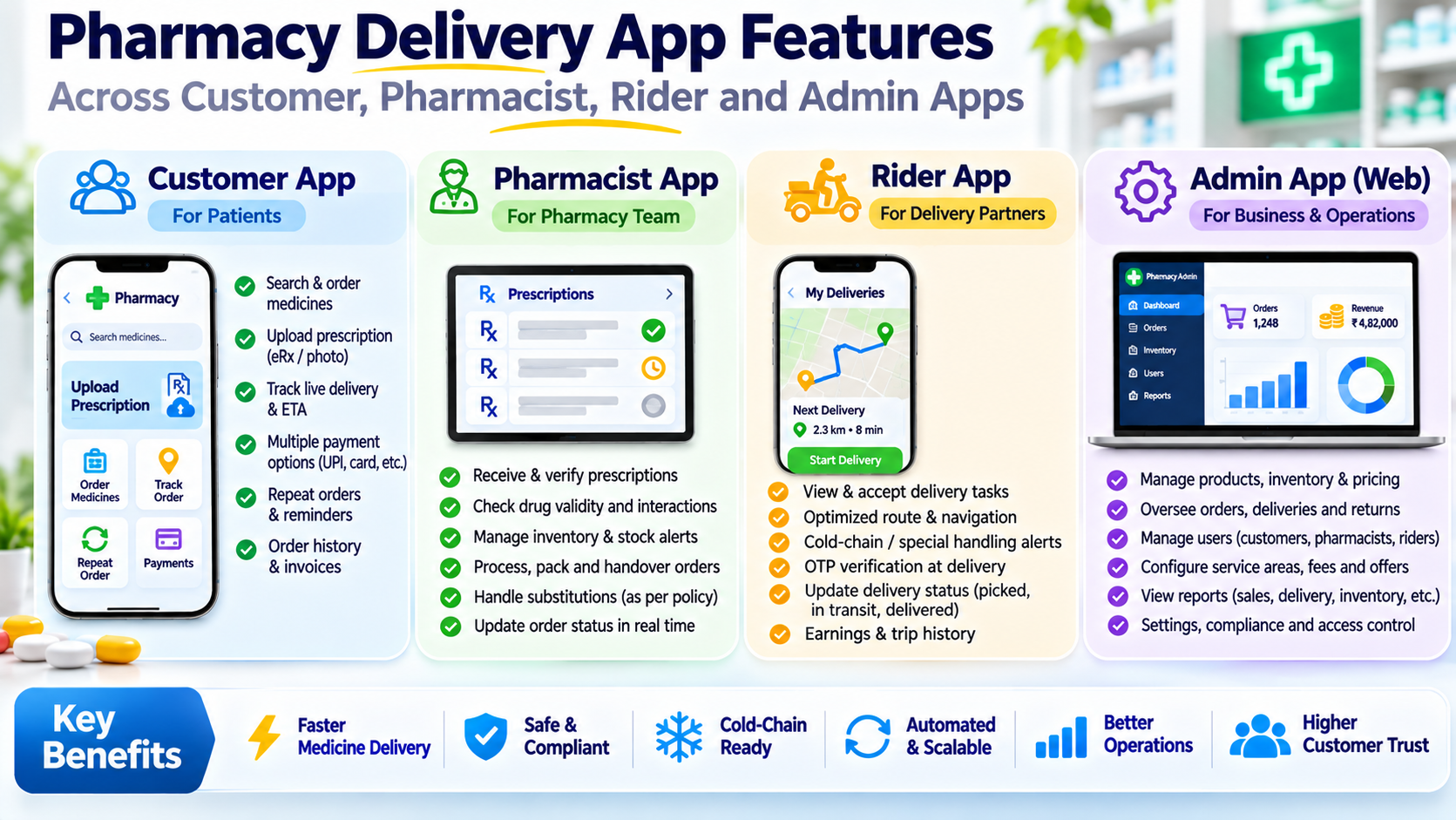
Customer App: The Features Patients Expect
This is the app your patients touch. It has to feel as easy as any shopping app, while quietly doing the safety checks a pharmacy needs.
Search, Catalogue and Substitutes
Fast search by brand or salt name, clear product pages with pack size and price, and a safe way to show generic substitutes where allowed. Patients often know the medicine name but not the brand, so salt-based search matters. Good search also forgives spelling, because people type medicine names the way they hear them, not the way the pack spells them. A patient who cannot find their regular tablet in ten seconds will close the app and call the shop instead, which defeats the point of building it.
Prescription Upload
A simple way to photograph or upload a prescription at the point of ordering, with the order held until a pharmacist checks it. The prescription upload feature is the heart of a compliant pharmacy app, not an optional extra, and we return to it in the compliance section.
Reorder and Refill Reminders
Many medicines are repeat purchases. One-tap reorder from history, and refill reminders timed to a course of medication, drive genuine value and retention. A reminder that a blood-pressure refill is due next week is a feature patients thank you for.
Order Tracking and Teleconsultation Link
Live order status and delivery tracking, as patients expect from any delivery app. Where you offer it, a link to teleconsultation so a patient without a prescription can speak to a doctor is a strong addition, as long as it is built within the rules.
Prescription and Compliance Features (the Part That Makes It Legal)
This is where a pharmacy app stops being a shopping app. In India, many medicines cannot be sold casually. Under the Drugs and Cosmetics Rules, 1945, drugs in Schedules H, H1 and X can be sold only against a valid prescription from a registered medical practitioner, and from licensed premises, as the Ministry of Health has confirmed in a reply in Parliament. The online sale of medicines is an area the government has been framing rules for over several years, so it keeps changing.
Read this first. This section describes the kind of features a compliant app needs, not legal advice. Rules for online medicine sale in India are evolving. Before you build or launch, verify the current requirements with the drug regulator, the CDSCO, your state drugs control authority, and a lawyer who knows pharma.
- Prescription capture and storage. Upload, store securely, and tie each prescription-only order to a valid prescription.
- Pharmacist verification step. A registered pharmacist reviews and approves prescription orders before dispatch. The app must make this a required step, not a skippable one.
- Schedule awareness. The catalogue should know which items are prescription-only and block a normal checkout for them.
- Licence records. Store the pharmacy's drug licence details and the pharmacist's registration, ready for audit.
- Audit trail. A record of who approved what and when, because a regulated business must be able to show its working.
Treat compliance as a core feature set with its own budget, not a checkbox. An app that lets anyone buy a prescription medicine with no check is not a shortcut. It is a risk to the licence the whole business runs on.
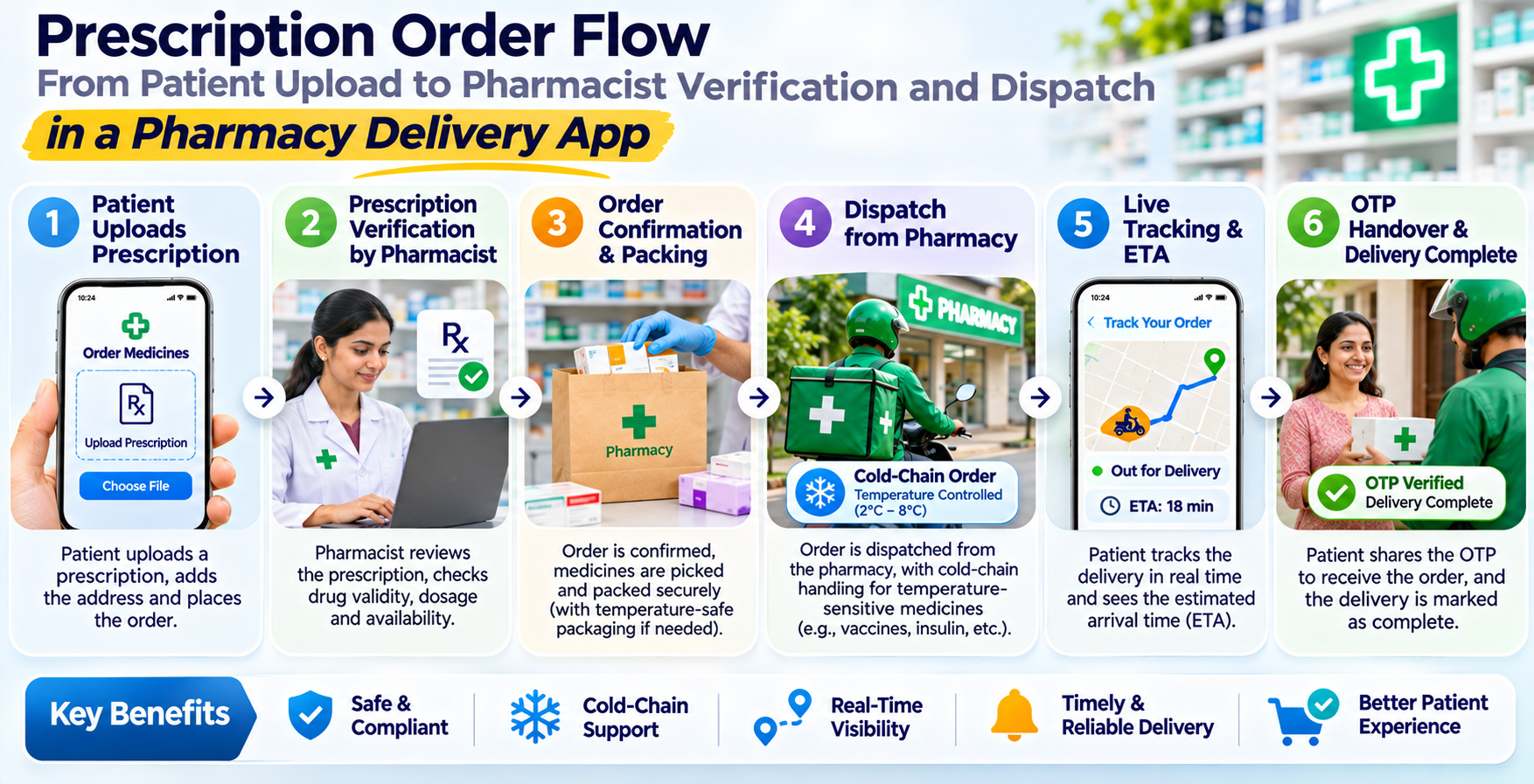
Pharmacist and Pharmacy Admin Features
Behind the patient app sits the pharmacy's own workspace. This is where orders are checked, stock is managed and the business is run.
- Order queue with prescription review. Incoming orders, the attached prescription, and an approve or query action for the pharmacist.
- Inventory and batch management. Stock levels, batch numbers and expiry dates, with alerts before medicines expire.
- Catalogue and pricing control. Add medicines, set prices and offers, and flag prescription-only items.
- Reports. Daily sales, fast and slow movers, and near-expiry stock, so the owner can act on real numbers.
- Role-based access. Owner, pharmacist and counter staff should each see only what their role needs.
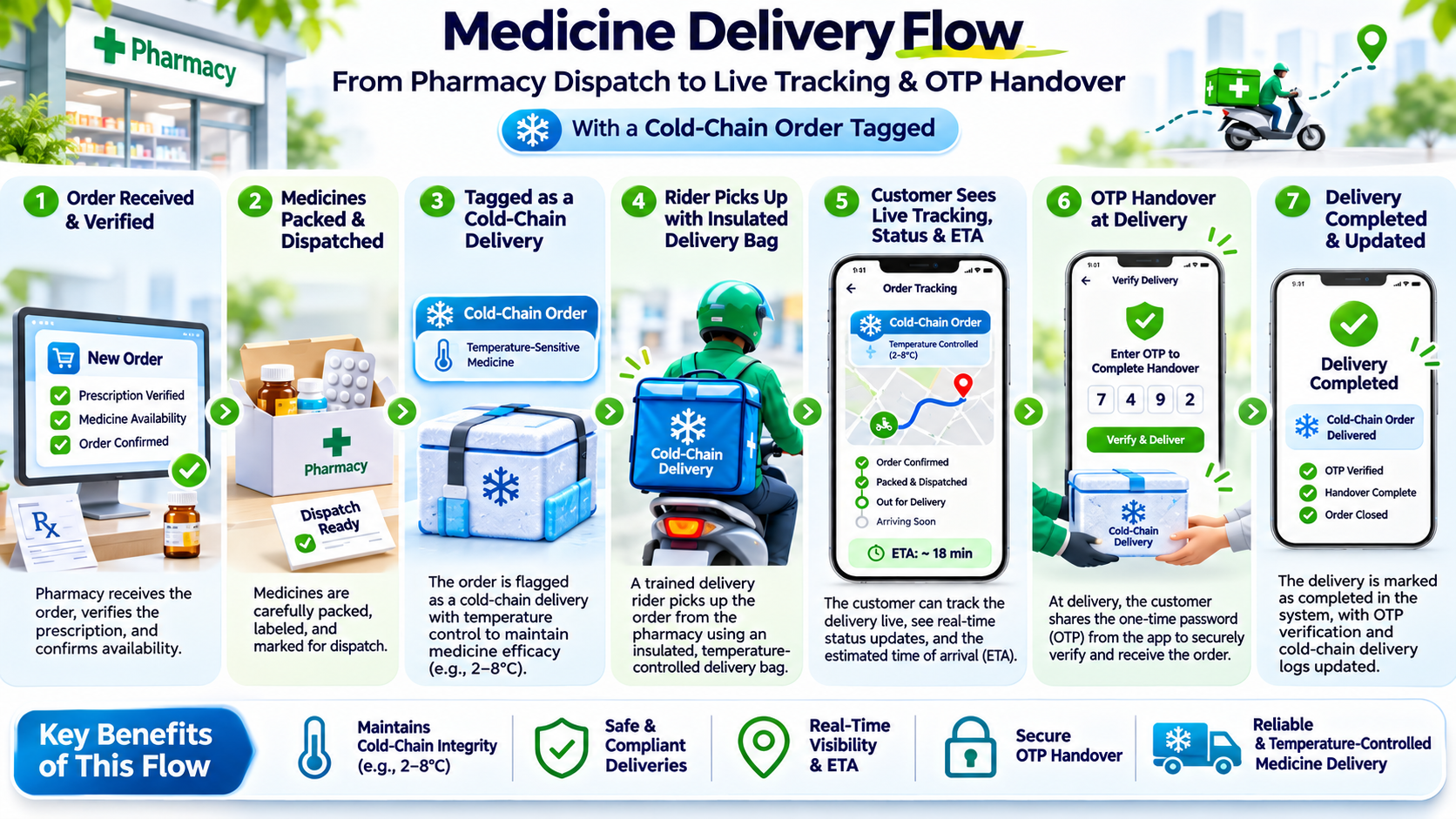
Delivery and Rider Features
Medicine delivery has needs an ordinary parcel does not. The rider app and the delivery flow should respect that.
- Assigned pickups and navigation. Clear order detail, address and turn-by-turn directions for the rider.
- OTP or signature on delivery. Proof that the right person received the medicine, which matters more for medicines than for most parcels.
- Cold chain handling. Some medicines, such as insulin, must stay cold. Flag these orders and route them to riders equipped for them.
- Live tracking for the patient. A map and an arrival estimate, the same comfort any delivery app gives.
- Third-party fleet option. If you do not run your own riders, the app should hand off to a delivery partner cleanly.
Distance and timing matter more for medicine than for most deliveries. A patient waiting on a fever medicine or an insulin refill is not comparing you with a chemist down the road, they are comparing you with walking to that chemist and getting it now. Short, reliable delivery windows and honest estimates, rather than an optimistic promise the rider cannot keep, are what turn a first order into a regular one.
Payments, Returns and Refunds
Payment in a pharmacy app is mostly standard, with a few medicine-specific wrinkles.
Offer UPI, cards, net banking and cash on delivery, since many patients still prefer cash for medicines. Handle partial orders, because a pharmacist may approve some items and not others, and the charge must match what actually ships. This partial-approval case is specific to pharmacy and catches teams that reuse a grocery checkout: the amount is not known until the pharmacist has reviewed the prescription, so the app should authorise and then capture the final sum, not charge the full cart up front.
Returns need care. For safety and legal reasons, opened medicines usually cannot be taken back, so your returns policy and the app flow must state clearly what is returnable and what is not, before the patient pays, not after. Build refunds for cancelled or undelivered orders, and show the patient a clear status at every step, because an unexplained hold on money for a medicine order erodes trust fast. Payment gateway charges and the rules around them change, so confirm current fees and terms with your provider when you plan the economics.
Data Privacy and Security Features
A pharmacy app holds health data, which is among the most sensitive data a business can hold. Privacy is a feature set, and under India's data protection regime it is also a duty.
- Consent and clear notice. Tell patients what you collect and why, and record their consent.
- Encryption. Protect prescriptions and health records in transit and at rest.
- Role-based access and logging. Only staff who need a prescription should see it, and every access should be logged.
- Data rights. Let patients ask for correction or deletion of their data, as the law expects.
India's Digital Personal Data Protection framework sets duties for anyone handling personal data, and the details are phased and evolving. Build privacy in from the start, and verify your obligations with counsel before launch rather than retrofitting them after a complaint.
Nice-to-Have Features That Can Wait
Not everything needs to ship on day one. Launch with the must-haves, then add these once the core works and you have real users.
- Loyalty points and subscription plans for chronic medication.
- Full teleconsultation with in-app doctor booking.
- Lab test booking and report delivery.
- Health content, dosage guides and medicine interaction warnings.
- Multiple language support for a wider patient base.
A lean, compliant first version that does the basics well beats a bloated launch that does ten things poorly and delays the features patients actually use.
What a Pharmacy Delivery App Costs to Build
Features drive cost, so a feature guide owes you an honest word on price. As a 2026 market estimate, a focused customer app plus a pharmacy admin panel with prescription upload and verification commonly starts around ₹6 lakh to ₹10 lakh. Add a rider app, live tracking and deeper compliance and reporting, and a fuller build runs roughly ₹10 lakh to ₹20 lakh. A multi-pharmacy marketplace with many sellers costs more again.
These are planning ranges, not a quoted price. Cross-platform apps usually cost less than separate native Android and iOS builds, and a phased launch spreads the spend. Pricing depends on your exact feature list, which is the whole point of settling the must-haves first.
Want a fixed-scope quote for your pharmacy app, built around a compliant feature list? Tell us your setup.
WhatsApp +91 88070 03902Single Chemist, Chain or Marketplace? Pick the Model First
The right pharmacy delivery app features depend on who is selling. Decide the model before the feature list, because it changes almost everything downstream.
- Single chemist. One licensed pharmacy, its own catalogue and riders or a delivery partner. The simplest and cheapest to build, and a sensible first step.
- Chain. Several branches under one brand, with orders routed to the nearest store. Adds multi-store stock and routing.
- Marketplace. Many independent pharmacies on one platform. The most complex, with seller onboarding, each seller's licence checks and settlement, and the heaviest compliance burden.
Most pharmacy owners reading this are the single chemist or small chain. Build for that, and keep the data model clean enough to grow later. The common mistake is to build for the marketplace dream on day one, which multiplies the cost and the compliance surface before you have a single order. Start where you are. A single-pharmacy app that handles prescriptions properly and delivers reliably teaches you more about real demand than any pitch deck, and the code can be extended to more stores once you know the model works in your area.
The model also decides who carries the compliance weight. In a single-chemist app the licence and the pharmacist are yours, so the responsibility is clear. In a marketplace, you are responsible for checking that every pharmacy you onboard is genuinely licensed and that each prescription order is verified by a registered pharmacist, which is a heavier and ongoing duty. That is a business decision as much as a technical one, and it belongs in the conversation before the first line of code.
Why Work with iStudio Technologies on a Pharmacy App
We are iStudio Technologies, a mobile app and software company in Valasaravakkam, Chennai, with 17+ years behind us, 500+ projects delivered and an in-house team that runs discovery, design, development, QA and support under one roof. We build native and cross-platform apps and the backends behind them, for businesses in Chennai and across India.
For a pharmacy app, we start with your model and the compliance features, because those shape everything else. We scope a lean, compliant first version, build the customer, pharmacist, rider and admin pieces you need, and keep health data secure by design. We will tell you honestly which features to defer and put the scope in writing. We do not give legal advice or promise approvals, so we work alongside your pharma lawyer on anything that touches the rules.
Frequently Asked Questions
What features must a pharmacy delivery app have in India?
Is selling medicines online legal in India?
How does prescription upload and verification work?
How much does a medicine delivery app cost to build?
Can a single chemist have its own delivery app?
What compliance does an online pharmacy app need?
Does iStudio Technologies build pharmacy and medicine delivery apps?
Related iStudio Technologies Services
More of our work that connects to a pharmacy app build, grouped by what you need next.
Build the App
- Mobile app development company in Chennai, the home for every app we build.
Healthcare Systems
- Healthcare software development in Chennai for clinical and pharmacy systems.
Backend and Integration
- Custom software development in Chennai for the backend, inventory and integrations.
Scope a Compliant Pharmacy Delivery App
Tell us whether you are a single chemist, a chain or a marketplace, and the area you serve. We will help you scope a compliant feature list and put the number in writing.
WhatsApp or call +91 88070 03902