
Cost to Build a Taxi App Like Ola for a Single City Fleet Operator
Honest 2026 rupee tiers for a rider app, driver app and admin panel, what pushes the price up, what it costs to run and when a white-label product makes more sense.
Single City Taxi App Development Cost: The Short Answer
A custom taxi booking app for one city usually costs about ₹6 lakh to ₹14 lakh for a launch version with a rider app, a driver app and an admin panel, ₹14 lakh to ₹30 lakh for a standard version on Android and iPhone with wallets, scheduled rides and a dispatch console, and ₹30 lakh to ₹70 lakh or more for an advanced version with smart dispatch and corporate accounts. Maps, payments, messaging and yearly running costs are extra.
We are a Chennai software and mobile company, and this guide is written for a fleet owner or cab operator who works in one city and wants a booking app of their own instead of depending only on the large platforms. It explains what the app includes, what each tier buys, what changes the price, what it costs to run and which rules to check.
All figures are 2026 market estimates for planning, not a quote. A real quote needs your fleet size, city and features. Use the ranges to judge whether a proposal is sensible, then ask for a fixed scope in writing.
Planning a taxi app for your fleet? Message our team on WhatsApp or call +91 88070 03902 with your fleet size, city and the features you need first, and we will scope it with you.
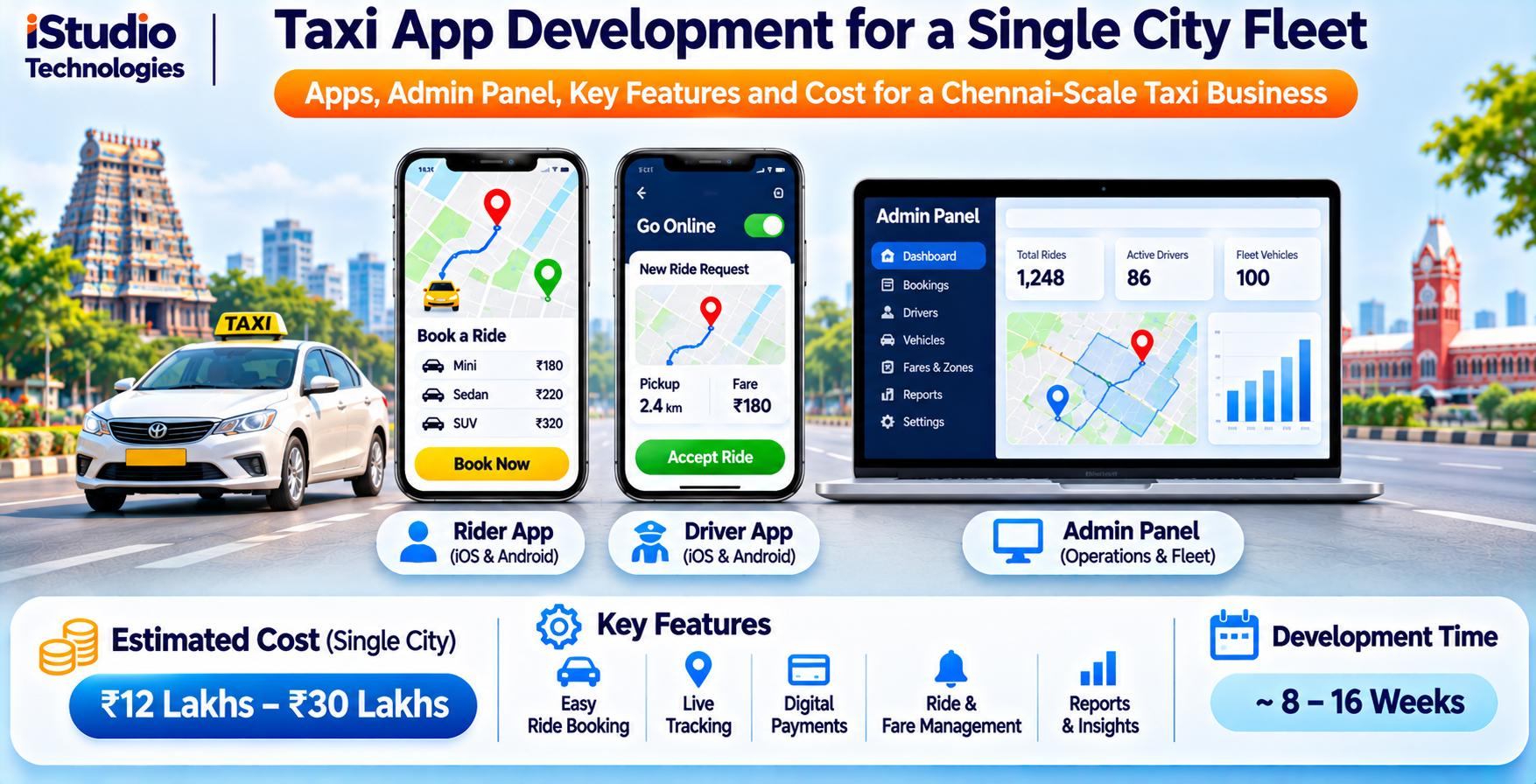
What a Single-City Taxi App Includes
Before you can price single city taxi app development cost, you need to list what you are actually building. "A taxi app like Ola" sounds like one product, but it is three connected products and a set of rules running behind them.
| Part | Main features | Who uses it |
|---|---|---|
| Rider app | Sign-up with OTP, pickup and drop selection, fare estimate, vehicle type, live driver tracking, payment, ratings, ride history, SOS contact sharing | Passengers |
| Driver app | Online and offline toggle, ride requests, accept or reject, navigation, trip start and end, earnings summary, document upload | Drivers |
| Admin panel | Driver and vehicle approval, live map of cars, trip list, fare and zone settings, promo codes, payouts, reports, support tools | Your operations team |
| Dispatch console | Create and assign bookings taken by phone, reassign trips, monitor delays | Control-room staff |
| Backend and rules | Matching logic, fare calculation, wallet and payouts, notifications, logs, security | The system itself |
Why a Fleet Operator's App Is Simpler
A large national platform handles millions of riders across hundreds of cities. A single-city operator needs far less: one set of fares, one service area and a known set of cars and drivers. That narrower scope is the main reason a focused app costs a fraction of what you read about for a full ride-hailing platform. Keep the first version about one city, one or two vehicle types and cash plus one online payment method.
Who Owns the Cars and Drivers?
Your business model changes the app. If you own all the cars and employ the drivers, you need duty rosters, vehicle assignment and driver attendance. If you attach drivers who own their cars, you need commission or subscription handling, driver wallets and settlement. Many operators run both, so decide early, because earnings, payouts and reports depend on it.
Be clear, too, about how bookings arrive. Some operators still take most trips by phone, so the dispatch console and a simple way to send the customer a tracking link may matter more at launch than a polished rider app.
Cost Tiers: What Each Level Buys
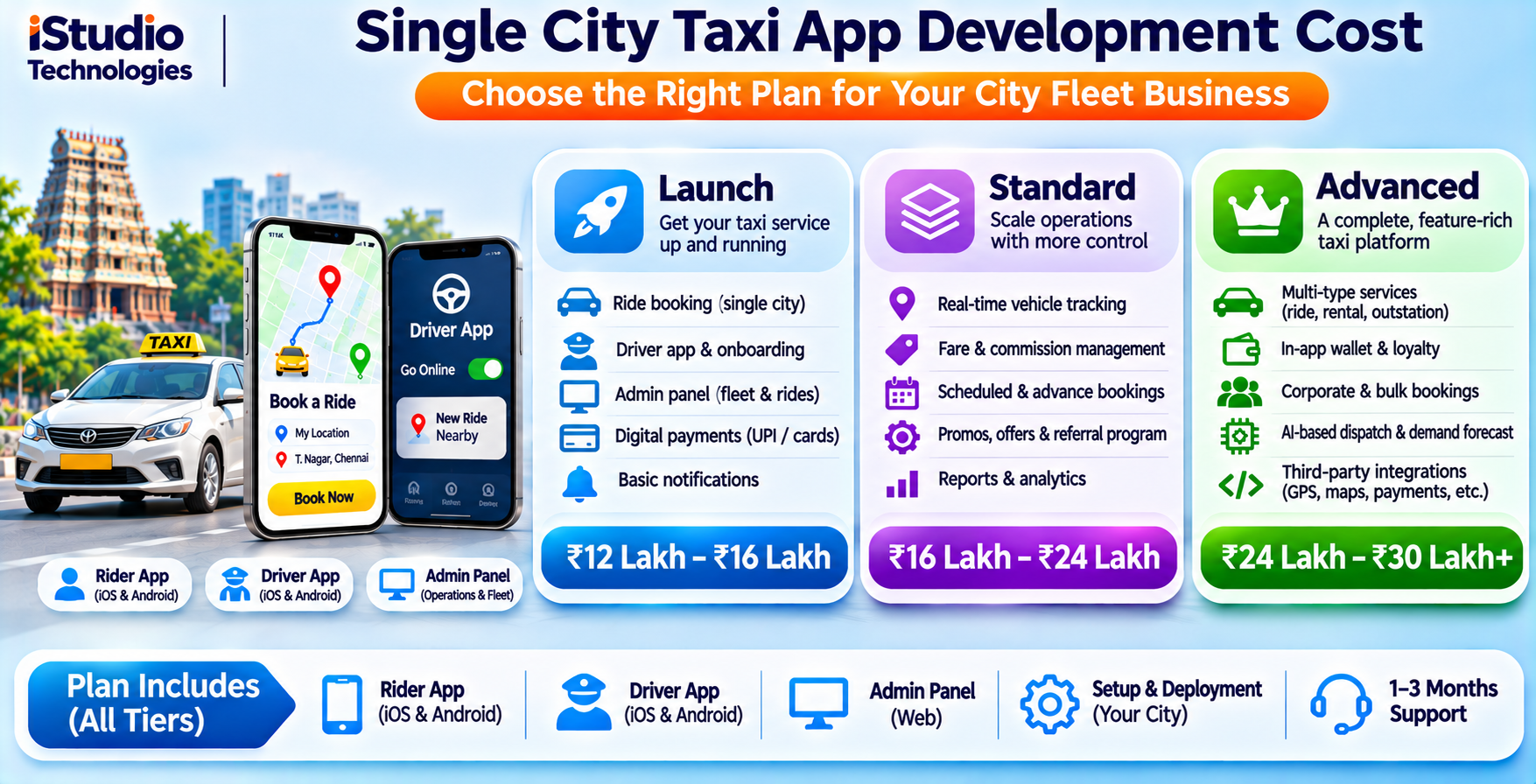
The single city taxi app development cost bands below track what Indian development teams commonly quote in 2026 for similar scope. Treat each as a planning range and not a fixed price.
| Tier | What it includes | One-time cost (2026) | Typical timeline |
|---|---|---|---|
| Launch version | Rider and driver apps, usually Android first, admin panel, booking and tracking, fare calculation, cash and one online payment method, ratings | ₹6 lakh to ₹14 lakh | 12 to 20 weeks |
| Standard | Launch plus Android and iPhone, driver wallet and payouts, promo codes, scheduled and rental rides, dispatch console, richer reports, multiple vehicle types | ₹14 lakh to ₹30 lakh | 20 to 32 weeks |
| Advanced | Standard plus smart dispatch, airport or station queues, corporate accounts, multi-language, deep analytics, integrations with your fleet and billing systems | ₹30 lakh to ₹70 lakh or more | 32 to 52 weeks |
Not included: maps and messaging usage, payment gateway charges, app store fees, tracking devices, driver phones and yearly hosting and support. The next sections cover each.
How to Read the Ranges
The low end of each tier assumes a clear scope, one city, standard screens and fast decisions from your side. The high end assumes custom design, several vehicle types, tricky payment flows or integrations. If a quote sits far below the range, ask what is missing. If it sits far above, ask which feature is driving the gap.
Start with a Pilot
Most successful operators start with the launch tier for a small group of drivers, learn how riders and drivers actually behave, and then add features in stages. Paying for a full advanced build before a single ride is booked is the most common way to waste money in this category.
What Moves the Price Up or Down
Several factors push single city taxi app development cost up or down, and you control most of them. Discuss each openly with any vendor.
- Platforms. One Android app is cheapest. Adding iPhone, or building both rider and driver apps for both systems, raises the price.
- Matching and dispatch logic. Sending a request to the nearest driver is simple. Balancing distance, ratings, queue order and acceptance time is more work.
- Fare rules. A base fare plus distance and time is easy. Night charges, waiting time, tolls, zones and peak pricing add rules and testing.
- Payments and wallets. Cash only is cheapest. Online payments, driver wallets, commission and settlement take careful design.
- Vehicle types and trip types. Each additional type, such as sedan, SUV, outstation or rental, needs its own fares and rules.
- Safety features. SOS, trip sharing, driver verification workflows and masked calling are important and add effort.
- Languages. English plus Tamil, or another local language, means translated text and testing.
- Design and branding. A custom interface in your brand costs more than a clean standard layout.
- Integrations. Linking to billing, corporate accounts or fleet tracking depends on the other system.
A practical way to save money is to decide which features you need on day one and which can wait. Scheduled rides, rentals and promo codes are all useful, but none is needed to book and complete a first trip.
Maps, Payments and Messaging: The Technical Costs
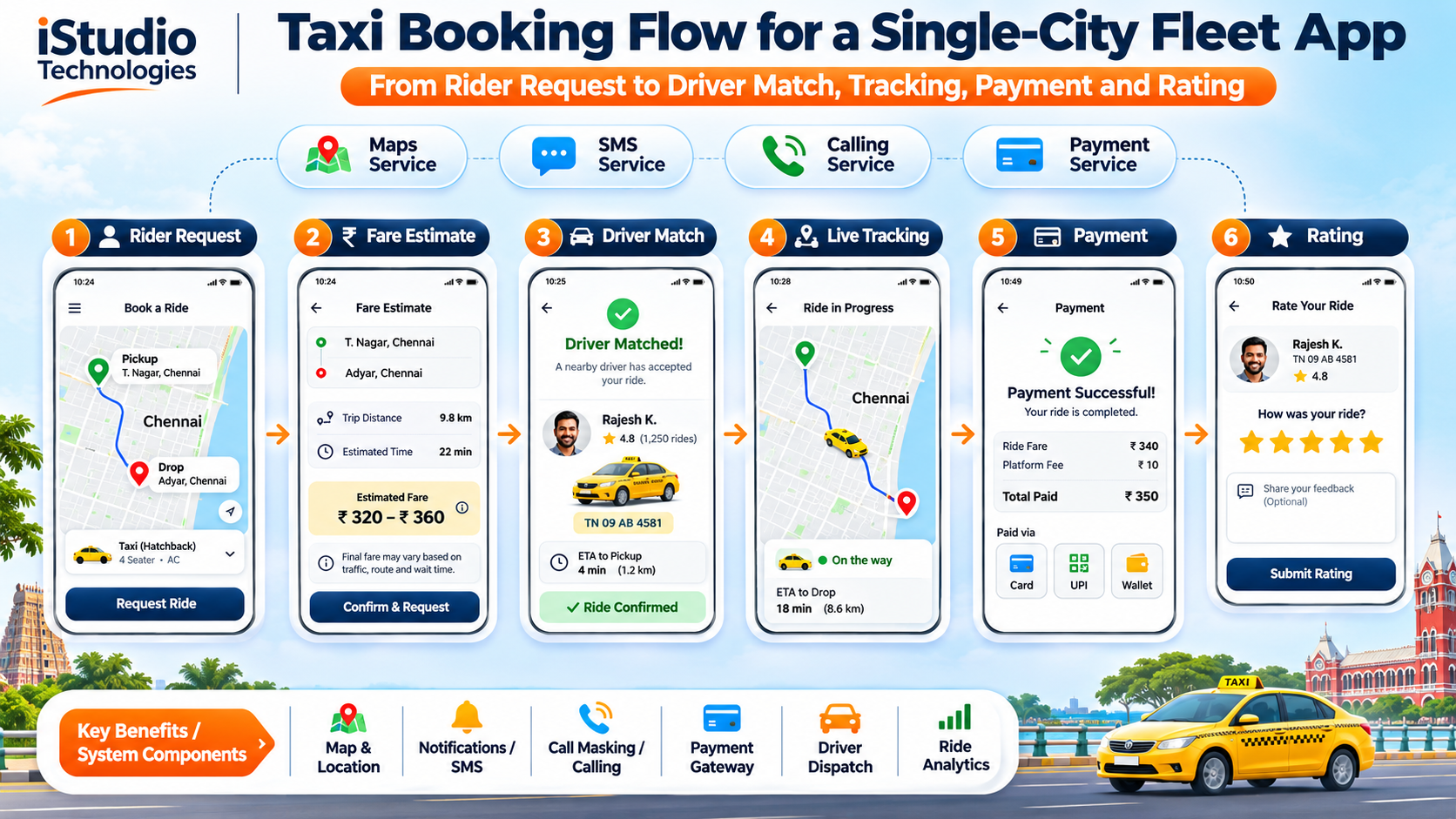
Technical services quietly shape single city taxi app development cost, because a taxi app depends on outside services that bill by use. These costs are not part of the development quote, so ask about them separately.
Maps and Routing
Every ride uses maps for place search, route, distance and live tracking. Providers bill by usage. Google Maps Platform, for example, prices each core service per billable event, with monthly free usage that varies by service, as its India pricing page explains. Rates and free thresholds change, so check the current page and estimate your monthly trips before you budget. Good design reduces calls, for example by not refreshing the map more often than needed.
Payments
Cash will remain common in many cities, but online payment is expected by many riders. Use a licensed payment gateway that supports UPI and cards, and talk to the provider about how money collected on behalf of drivers is handled and settled, because the rules for collecting and passing on payments are specific. Gateway charges apply to each online payment, and their terms change, so confirm current rates.
OTP, Calls and Notifications
- OTP and SMS. Sign-in codes and booking messages are charged per message.
- Masked calling. Letting rider and driver speak without sharing real numbers protects both and is billed per minute or per call.
- Push notifications. Ride alerts need reliable delivery, which depends on the phone makers' systems and on careful app settings.
- App store accounts. You will need your own developer accounts, which carry small fixed fees, and you should own them in your company's name.
Ask any vendor to list these services, who pays each one and how the bill is expected to grow with trips. It is the clearest sign of an honest quote.
Running Costs After Launch
Plan for running costs, because single city taxi app development cost is only the start of what a live taxi system spends each year. A busy app keeps using servers, maps and messages every day.
- Hosting and storage. Servers, databases, backups and monitoring grow with trips and with the location data you keep.
- Maps, messages and calls. Usage-based bills that rise with trips.
- Payment gateway fees. A share of each online payment.
- Support and updates. Bug fixes, security patches and changes to phone operating systems need a maintenance plan.
- Your own team. Someone must handle driver onboarding, customer support, disputes and payouts every day.
- Marketing. A good app does not bring riders by itself. Budget for offers, local advertising and partnerships.
As a planning estimate, set aside roughly 15 to 20 per cent of the build cost each year for hosting, support and updates, plus the usage-based bills above. Ask any vendor for a written estimate of yearly running costs next to the build quote, and treat a vendor who will not give one as a warning sign.
Treat the first year as a learning period. Real trips show which features riders use, how many calls and messages each trip creates and where the app is slow. Review the bills every quarter, remove features nobody uses and tune how often the map refreshes, because small changes can lower monthly costs without hurting the ride.
Build, White-Label or Hybrid?
Compare single city taxi app development cost with white-label products over at least three years, not one. A white-label taxi app is a ready-made product that a vendor customises with your name and logo, and it can launch much faster. The trade-off is less control and ongoing fees.
| Option | Good when | Watch out for |
|---|---|---|
| White-label product | You want to launch quickly with standard features and a small budget | Limited customisation, recurring fees, shared code with other operators, questions about who owns your data |
| Custom build | You have unusual workflows, plan to grow, or want to own the code and data | Higher up-front cost, longer timeline, need for a trustworthy team |
| Hybrid | You want a ready-made base now and custom parts later | Dependence on the base product's terms and its ability to change |
A Simple Three-Year Comparison
For arithmetic only, suppose a hypothetical white-label product charges ₹50,000 a month plus a ₹2 lakh set-up fee. Over 36 months that is ₹18 lakh plus ₹2 lakh, or ₹20 lakh. That is not a market price, so replace it with real quotes. Then add the build cost and three years of running costs for the custom option, and compare the totals along with the value of owning your code, your data and your roadmap.
Questions to Ask Before You Decide
- Who owns the source code, the rider and driver data and the app store listings?
- Can I export all my data in a usable format at any time?
- What happens to my service if the vendor closes or raises prices?
- Can the product handle my fare rules and my payout model?
- How will the cost change if I add a second city?
We will tell you honestly when a white-label product is the better choice. Custom software makes sense when control, data ownership or a product you can grow earns its extra cost.
Rules for Fleet Operators: Licence, Fares and Data
Rules affect single city taxi app development cost too, because some must be designed into the app. This is general guidance and not legal advice, so confirm every point with your state transport department and an adviser.
Aggregator Guidelines
The Ministry of Road Transport and Highways issued the Motor Vehicle Aggregator Guidelines, 2025, which appear in a Parliament reply on the subject. Press reports of the guidelines describe provisions on licensing, a limit on dynamic pricing of up to twice the base fare, a floor of half the base fare, a minimum share of the fare for drivers who own their vehicles, and rules on cancellations. We have not reproduced the provisions here, because the exact wording matters, so read the text itself.
The guidelines are issued to states, and each state decides how to adopt them. Reports in 2025 and 2026 show Tamil Nadu's own framework still being developed, with court directions on aggregator rules. If you operate in Tamil Nadu or another state, ask the transport department which licence or permit applies to a fleet operator who takes bookings through an app, because the answer depends on how your business is structured.
Vehicles, Drivers and Tracking
- Permits and registration. Passenger vehicles must carry the right permit, and your app should store and check permit and insurance expiry dates.
- Driver checks. Build a workflow for licence, identity and background verification before a driver can go online.
- Tracking devices and emergency buttons. Public service vehicles are generally covered by vehicle location tracking and emergency button rules, so check what applies to your cars and add device integration if needed.
- Fares and receipts. Show a clear fare breakdown and issue receipts that match your tax obligations.
Rider and Driver Data
India's Digital Personal Data Protection Rules were notified in November 2025, according to a Press Information Bureau release, and are being phased in. A taxi app collects names, phone numbers, trip histories and live locations. Collect only what you need, explain why, limit who can see it, secure it and delete it on schedule. Confirm what applies to you with an adviser.
Why Build with iStudio Technologies
We are iStudio Technologies, a software, web and mobile company in Valasaravakkam, Chennai, with 17+ years behind us, 500+ projects delivered and an in-house team that handles design, development, QA and support under one roof. For a single city taxi app development cost you can plan around, being local helps: we can sit in your control room, watch how bookings really flow and design the app around it.
We tell you honestly whether to build, white-label or mix the two. We do not promise a number of daily rides or a share of your city's market, because those depend on your service, pricing and marketing. We do commit to a written scope with a tier you can compare, an app you own and a clear estimate of running costs next to the build quote.
What We Need from You
Projects move fastest when you share your fleet size and vehicle types, your city and service area, your fare structure, how bookings arrive today, how you pay drivers, and the people who will run operations. One dispatcher and a few friendly drivers who can test early builds are worth more than a long specification.
Want a fixed-scope quote for your taxi app? Tell us your fleet, city and must-have features.
WhatsApp +91 88070 03902Frequently Asked Questions
How much does it cost to build a taxi app for one city in India?
How long does it take to build?
Can a fleet owner run their own taxi app?
Is a white-label taxi app cheaper than a custom one?
What running costs should I expect?
Do I need vehicle tracking devices as well?
Does iStudio Technologies build taxi booking apps?
Related iStudio Technologies Services
More of our work that connects to taxi and fleet apps, grouped by what you need next.
Apps
- Mobile app development company in Chennai, the home for rider and driver apps.
- Software development company in Chennai for admin panels and backends.
Fleet and Tracking
- Telematics solution provider in Chennai for vehicle tracking.
- Logistics software and mobile app development for fleets and dispatch.
Web
- Web development company in Chennai for booking sites and partner portals.
Get a Scoped Quote for Your Taxi App
Tell us your fleet, your city and the features you need first. We will recommend a tier and put the number in writing.
WhatsApp or call +91 88070 03902