
10 Jewellery Ecommerce Website Features Every Store Needs (Try-On, BIS Hallmark)
These jewellery ecommerce website features make a buyer comfortable spending a large amount online. They are in priority order, with the India-specific ones explained: price breakup, hallmark proof, gold rate handling and insured delivery.
Which Features Does a Jewellery Ecommerce Website Really Need?
A jewellery ecommerce website needs ten features before it can earn a high-value order: a price breakup, visible hallmark proof, detailed product information, honest try-on and size help, jewellery-specific search, live gold rate handling with a price lock, payments built for large amounts, insured delivery with clear policies, links to a store or video consultation, and fast mobile pages. Most Indian jewellery sites get the first two wrong, and those two decide whether a buyer trusts you.
This guide is for jewellers launching or rebuilding an online store and for the people building it. A buyer is spending a large sum on something they cannot touch, so every feature below reduces a specific fear.
One caveat: features do not sell by themselves. Photography, service and reputation matter just as much, and some popular features, such as 3D views, are optional. The price breakup, hallmark proof and delivery policy are not.
How We Prioritised These Ten Features
We ranked each feature on three questions. Does it build trust with a stranger? Does it reduce the risk of a high-value purchase? Is it needed because of a rule, a payment reality or delivery risk? Features that score well on all three come first. Features that only add visual polish come last.
The order below follows that logic, not the order that agencies usually list them. Try-on is often listed first because it demos well. We place it fourth because it does not answer the buyer's first question, which is whether the piece is what you say it is and what it will really cost.
The Ten Jewellery Ecommerce Website Features
Feature 1: A Price Breakup Customers Can Check
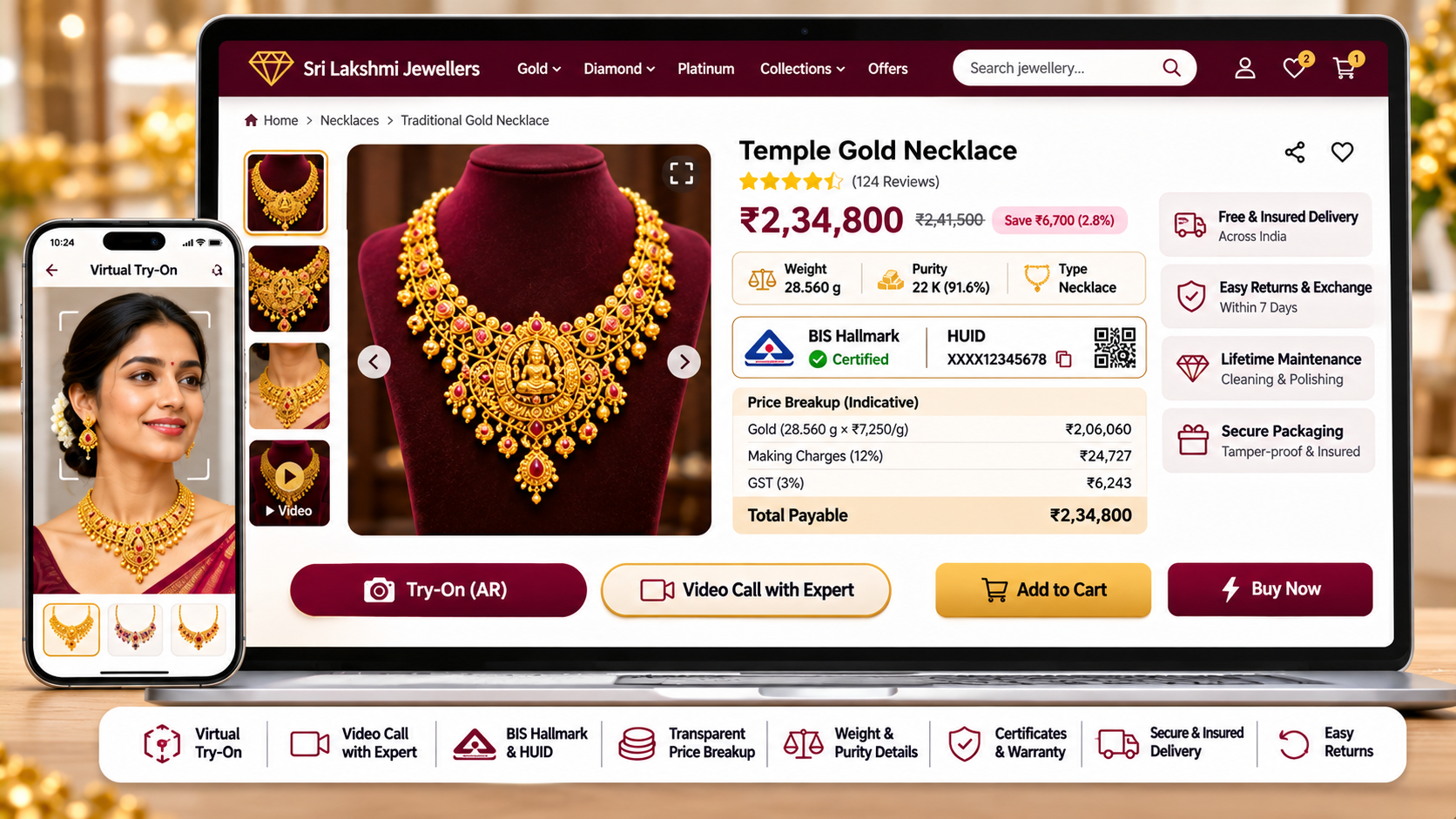
TrustJewellery is priced in parts, and buyers know it. Show the gold value, making charges or wastage, stone value, taxes and the total on every product page, and keep the same breakup in the cart, checkout and invoice.
Build: a breakup card that updates when the rate or size changes, discounts applied to a component (for example a percentage off making charges) and a downloadable invoice that matches the page. Avoid: showing a headline price and revealing extra charges at checkout.
Feature 2: Visible Hallmark and Purity Proof
Trust and rulesFor gold jewellery, show the purity (such as 22 karat), the net weight and the hallmark details. A BIS hallmarked gold article carries a hallmark that includes a unique six-character HUID, so give each piece a field for its HUID and a photo of the marks where you can.
Build: a hallmark panel on the product page, a short "how to verify" explainer that points buyers to BIS's own verification tools, and a purity filter. Avoid: claiming hallmarked purity for items that are not covered, or using one stock hallmark image for every piece.
Feature 3: Product Details That Match the Piece
ContentBuyers compare weights, sizes and stones, so give them the real numbers: gross and net weight, dimensions, metal, stone type, count and carat, clasp or closure type and the care instructions.
Build: a structured product template with fixed fields, a zoomable gallery with several angles, a short video and a photo of the piece on a hand or neck for scale. For diamonds and gemstones, attach the certificate details and make clear that a gem report is separate from the BIS hallmark on the metal.
Feature 4: Virtual Try-On That Stays Honest
ExperienceTry-on helps buyers picture earrings, necklaces and rings, and it can reduce hesitation. It does not show exact size, weight or finish, and its quality depends on the camera and lighting. Present it as a preview, and pair it with a size guide and a ring sizer.
Build: try-on for the top-selling categories only, a printable ring size chart and a clear note about its limits. Ask for camera permission only when the buyer taps the feature, and explain what happens to the image. Avoid: spending a large share of the budget on try-on before the first three features work.
Feature 5: Search and Filters Built for Jewellery
FindabilityGeneric filters frustrate jewellery shoppers. Buyers think in metal, purity, weight range, occasion, gender, style, collection, price band and whether the piece is ready to ship or made to order.
Build: filters on those attributes, search that understands words like "temple", "bridal" and "daily wear", and a clear "made to order" label with a lead time. If you serve Tamil-speaking buyers, support Tamil search terms.
Feature 6: Live Gold Rate with a Price Lock
PricingGold rates change through the day, so a fixed price printed on a page goes stale. The site must calculate prices from a current rate, then protect the buyer and the store when the rate moves during checkout.
Build: a rate feed you control, a visible "rate updated at" time, and a short price lock once the item is in the cart, such as a fixed number of minutes. After the lock expires, refresh the price and tell the buyer why. Our engineering note below explains the design.
Feature 7: Payments Designed for High-Value Orders
CheckoutA large order is not like a phone-case order. Buyers want several payment options and sometimes want to pay in parts. Stores need protection from fraud and from payments that fail at the last step.
Build: UPI, cards and net banking through a licensed gateway, a bank transfer option with a clear reference, part payment or booking amount where your policy allows, and manual review for unusual large orders. Confirm payment limits with your gateway, because they differ. If you plan a gold savings scheme, take legal advice first, since such schemes are regulated.
Feature 8: Insured Delivery and Clear Returns
PolicyBuyers worry that a parcel of gold will be lost, damaged or switched. State how you ship, whether the parcel is insured, who signs for it and how the buyer should record the opening.
Build: tracking, delivery with identity checks or an OTP, packaging described with photos and one plain page for returns, exchange and buyback terms, covering what is accepted, in what condition and how the value is calculated. Avoid: vague terms such as "easy returns" without conditions.
Feature 9: Store Visits and Video Consultations
OmnichannelMany jewellery buyers want to see the piece or talk to a person before paying. A site that connects to your store sells more than a site that pretends the shop does not exist.
Build: a "book a video call" option, a "reserve to see in store" option with an appointment slot, store addresses and hours, and a WhatsApp enquiry link. Our guide to WhatsApp booking integration shows how to take these bookings without a heavy build.
Feature 10: Fast Mobile Pages and Search-Ready Data
PerformanceMost visits will come from phones, and jewellery pages are heavy with images. Slow pages lose buyers before they see a price.
Build: compressed, correctly sized images served in modern formats, lazy loading below the fold, a fast checkout on mobile data and product structured data that describes name, price, availability and images for search engines. Structured data helps search engines read the page, and it does not guarantee a special display or a ranking.
iStudio Engineering Note: How the Price Engine Should Work
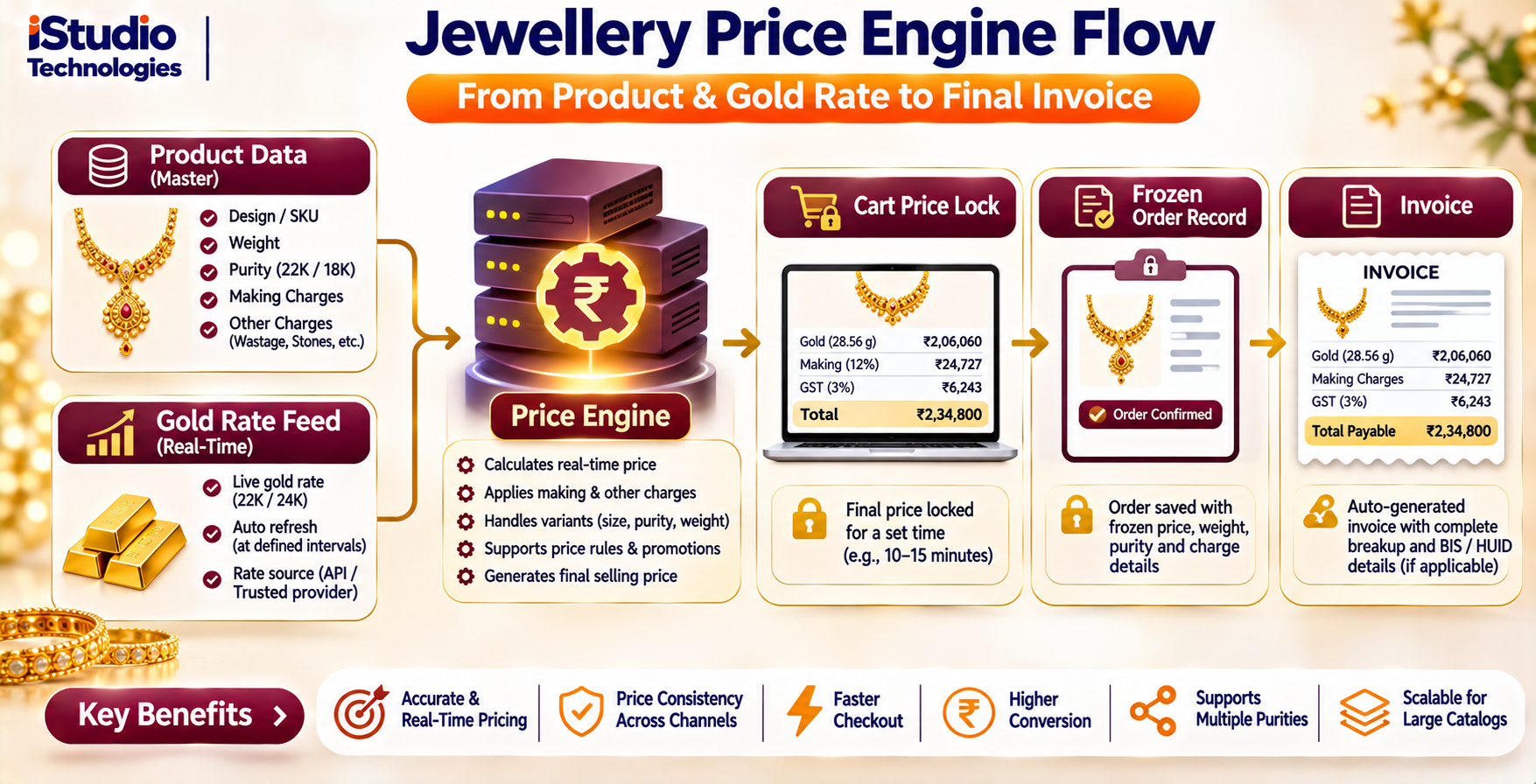
The most common technical mistake on jewellery sites is calculating prices in the browser or storing a fixed price on each product. Both break the moment the gold rate changes. A safer design has one price engine on the server that every page, cart and invoice uses.
- Store the ingredients, not the price. For each piece keep metal, purity, net weight, making charge rule, stone value and any fixed fees.
- Calculate on the server. Price equals the current rate times the net weight, plus making charges, stone value and taxes, rounded by one consistent rule.
- Snapshot the rate in the cart. Save the rate used, its time and the resulting total with the cart, so the buyer sees a stable number during the lock window.
- Freeze it in the order. When the order is placed, store the full breakup, the rate and the tax figures. The invoice, refund and return all read from this record.
- Handle expiry gracefully. If the lock expires, recalculate, show the change and ask the buyer to confirm. Do not charge a different amount silently.
This design also makes discounts safer, because a discount applies to a named component, and it makes audits and disputes simple, because every figure on the invoice can be traced. It adds some work up front, and it is far cheaper than fixing wrong invoices later.
Which Rules and Policies Affect a Jewellery Website?
This is general guidance and not legal advice. Rules change, so confirm each point with an adviser.
- Hallmarking. The Bureau of Indian Standards explains hallmarking in its hallmarking overview. A Parliament reply records that hallmarking of gold jewellery became mandatory from 23 June 2021 in notified districts, and BIS has extended and amended the requirements since, so check the current position and which of your items it covers before you write the product copy.
- Tax on the bill. Online explanations of how GST applies to gold and to making charges disagree with each other, so we do not give a rate here. Ask your accountant how to show tax on the product page and the invoice, and make the site print exactly that.
- Online selling rules. India's Consumer Protection (E-Commerce) Rules, 2020 set duties for online sellers, such as showing seller details and handling complaints. Review them with your adviser and publish clear seller, returns and grievance details.
- Customer data. India's Digital Personal Data Protection Rules were notified in November 2025, according to a Press Information Bureau release, and are being phased in. A jewellery store holds names, addresses, phone numbers and sometimes identity documents. Collect only what you need and keep it secure.
- Claims. Describe purity, origin and certification only as far as you can prove them, and show offer terms plainly.
What Should Launch First and What Can Wait?
A small jeweller does not need all ten on day one. This table shows our suggested order, based on how each feature affects trust and risk.
| Feature | When | Reason |
|---|---|---|
| 1. Price breakup | Launch | Buyers will not pay without it |
| 2. Hallmark and purity proof | Launch | Core trust signal for gold |
| 3. Product details and media | Launch | Replaces handling the piece |
| 6. Live rate and price lock | Launch | Without it, prices go stale or invoices are wrong |
| 7. High-value payments | Launch | Orders fail or cause fraud risk if skipped |
| 8. Insured delivery and clear returns | Launch | Removes the fear of loss and disputes |
| 10. Fast mobile pages and structured data | Launch | Most visitors arrive on phones |
| 5. Jewellery filters and search | Soon | Matters once the catalogue grows |
| 9. Store visits and video consultation | Soon | High value, simple to start with WhatsApp |
| 4. Virtual try-on | Later | Nice to have, costly, limited accuracy |
If you want help turning this into a scoped build, our web development team in Chennai can map the product template, price engine, payments and delivery workflow to your catalogue. For budgeting, see our guide to the cost of a jewellery store website in Chennai.
Planning an online jewellery store? Tell us your catalogue size, how you price and how you ship, and we will help you scope the first release.
Discuss Your Jewellery StoreCommon Questions
Is virtual try-on necessary for a jewellery website?
How should a jewellery site show the BIS hallmark?
How do I handle gold rate changes at checkout?
Should I show making charges separately?
Can I start with a basic platform and add features later?
Scope Your Jewellery Store's First Release
Share your catalogue size, how you price and how you deliver. We will map the product template, price engine and checkout for a first version.
Discuss Your Jewellery Store