
8 Home Service App Ideas for Chennai (Beyond a Plain Plumber and Electrician App)
Eight on-demand ideas scored for repeat demand, trust and build effort, with what to build first for each and the rules to check before you launch.
Which Home Service App Ideas Are Worth Building in Chennai?
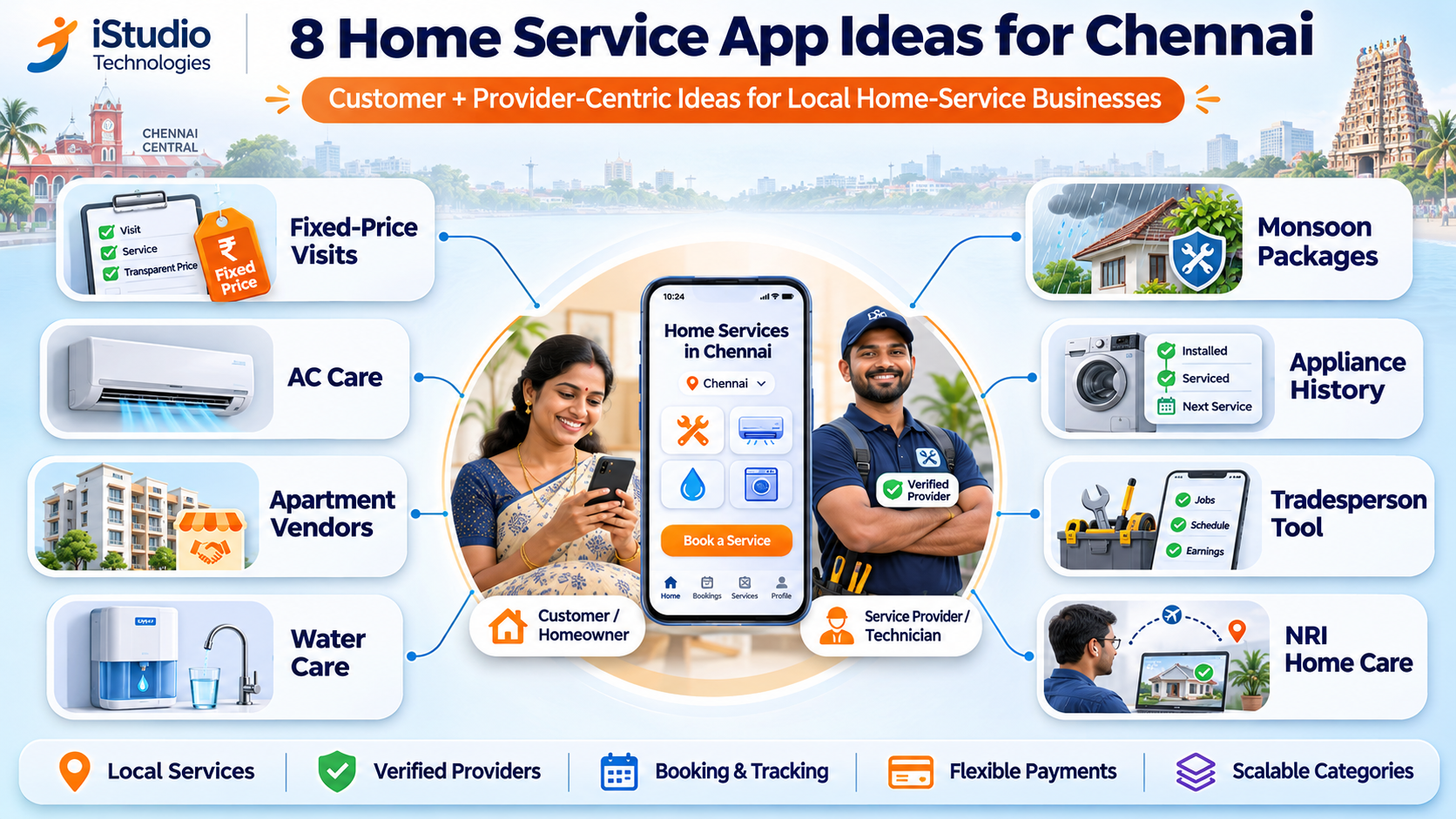
The strongest home service app ideas for Chennai are narrower than the plumber-and-electrician marketplace most founders start with. That broad idea needs customers, providers, trust and dispatch to work at once. Ideas built on repeat demand, such as AC care plans, apartment vendor management, tank cleaning schedules and monsoon-ready packages, are easier to launch and harder for a rival to copy.
This guide is for founders, existing service businesses and facility operators deciding what to build.
One caveat before you read on. The ratings below are our own assessment from how these apps are built and run, not market data, and we have not measured demand for any of them in Chennai. Talk to about ten real customers and ten real providers before you commit a rupee to development.
How We Judged These Eight Ideas
A good home service app idea passes five tests. We used the same five on every idea so the comparison is fair.
- Repeat demand. Will the same household need this again within a year? Repeat use lowers the cost of winning each booking.
- Trust needed. How uneasy is a customer about letting a stranger in or paying in advance? High trust needs mean more verification work.
- Provider supply. Can you realistically find and keep skilled people in your first few localities?
- Job size and frequency. Small one-off jobs are hard to make profitable after travel time. Plans and bundles help.
- Dispatch complexity. Matching a person to a job at the right time is the hardest technical part of most home service apps.
| Idea | Repeat demand | Trust needed | Build effort | Smallest first step |
|---|---|---|---|---|
| 1. Fixed-price plumber and electrician visits | Medium | High | High | One cluster of localities, manual dispatch |
| 2. AC servicing with yearly care plans | High | Medium | Medium | Plans and reminders before summer |
| 3. Vendor and complaint app for apartments | High | Medium | Medium | Pilot with one community |
| 4. Water-care for tanks, sumps and purifiers | High | Medium | Low to medium | Scheduled reminders and job reports |
| 5. Monsoon-ready home packages | Medium, seasonal | Medium | Low | Pre-sold packages on WhatsApp |
| 6. Appliance repair with service history | Medium | High | Medium | Appliance register and estimate approval |
| 7. Job and invoice app for tradespeople | High | Low | Low to medium | Quotes and invoices in Tamil |
| 8. Home care for NRI and rented properties | Medium | Very high | Medium | Inspection reports with photos |
Ratings are an iStudio assessment, not market data.
The Eight Home Service App Ideas
Each idea below follows the same short format: who it suits, why it fits Chennai, what to build first and what to watch out for.
Idea 1: Fixed-Price Plumber and Electrician Visits
MarketplaceWho it suits: an operator with capital and an operations team, ready to run supply as well as software. Why Chennai: demand is spread across many localities, so a small cluster of adjoining areas is a realistic start, and customers value a clear price before a stranger arrives.
Build first: a customer booking flow with a rate card for common jobs, a provider app, an admin panel and manual dispatch by your team. Add start and finish codes so attendance is provable. Watch out: extra work that appears once the job starts. Let the customer approve any added charge in the app.
Idea 2: AC Servicing with Yearly Care Plans
SubscriptionWho it suits: an AC technician team or a service company that wants recurring revenue. Why Chennai: a long hot season means air conditioners run for much of the year, and households would rather book a plan than chase a technician each summer.
Build first: a register of each home's AC units (brand, age, last service), plan purchase, reminders before the hot months and a technician checklist with photos. Watch out: demand spikes at the start of summer, and disputes over parts pricing.
Idea 3: A Vendor and Complaint App for Apartment Communities
B2B2CWho it suits: a facility management firm, a resident-association volunteer with technical skills or a founder with community contacts. Why Chennai: many people live in apartment complexes where a committee juggles electricians, plumbers, lift and pest-control vendors, often through chat groups, and complaints get lost.
Build first: complaint tickets by flat, an approved vendor list, quotes and approvals by the committee, and a status board residents can see. One sale to an association covers many homes. Watch out: committee changes, slow decisions and resident data. Treat names, flat numbers and phone numbers as personal data.
Idea 4: Water-Care Services for Tanks, Sumps and Purifiers
RecurringWho it suits: an existing tank cleaning, borewell or purifier service business. Why Chennai: many buildings depend on sumps, overhead tanks and purifiers that need regular cleaning and servicing, and local providers already advertise tank and sump cleaning as a service.
Build first: a record per building (tank type, size, last cleaned), automatic reminders and a job report with before-and-after photos that customers can keep. Watch out: worker safety, especially in confined spaces, and proof of work.
Idea 5: Monsoon-Ready Home Packages
SeasonalWho it suits: a small team that wants to test demand cheaply. Why Chennai: the northeast monsoon, usually from October to December, brings leaks, blocked drains and power problems, so a pre-season check has a clear reason to exist.
Build first: not an app. Sell two or three fixed packages, such as roof and terrace leak checks, drain clearing and electrical safety checks, through WhatsApp and a simple booking page, then build the app once repeat use is proven. Watch out: a short season, crew capacity and over-promising. Never guarantee protection from flooding, and keep electrical checks with qualified electricians.
Idea 6: Appliance Repair with Service History
Marketplace and recordsWho it suits: an appliance repair business that wants customers to come back. Why Chennai: households own several appliances, rarely remember warranty dates and do not keep bills.
Build first: an appliance profile with a bill photo, purchase and warranty dates and past repairs, plus an estimate the customer approves before work starts. Watch out: spare-part availability and price disputes. Do not claim to be an authorised service centre for any brand unless you are.
Idea 7: A Job and Invoice App for Independent Tradespeople
Provider toolWho it suits: a developer or small team who prefers software to running a field workforce. Why Chennai: many plumbers and electricians work independently, rely on phone calls and notebooks and would value a tool in Tamil more than a platform that takes a commission.
Build first: a customer list, quotes, invoices that can be shared on WhatsApp, job reminders and voice notes. Charge a small subscription. Because phone signal at job sites is uneven, design it to work offline and sync later, as we explain in our guide to building an offline-first field service app. Watch out: low willingness to pay and the effort of reaching tradespeople, who are rarely found through app stores.
Idea 8: Home Care for NRI and Rented Properties
Trust-heavyWho it suits: a property manager or a trusted caretaker team. Why Chennai: many families have members abroad who own or inherit a home in the city and need someone dependable to check on it.
Build first: scheduled inspection visits with timestamped photos, an owner dashboard, repair approvals before work starts and a simple record of keys and access. Watch out: trust above all else. Verify staff carefully, control key access, agree liability in writing and treat owners' data and property details as sensitive.
What Every Home Service App Needs on Day One
Whichever idea you choose, a customer lets someone into their home because of trust, and trust comes from a small set of features. Skimp on these and no amount of marketing will save the app.
- Provider verification. Identity, address and skill checks before a provider can take jobs. Store licence details and expiry dates where a trade needs a licence.
- Clear prices. A visit fee and a rate card for common jobs, with any extra charge approved by the customer before work continues.
- Proof of attendance and work. Start and finish codes, plus before-and-after photos.
- Masked calls and chat. Customer and provider talk without seeing each other's real numbers.
- Payment after the job. Pay through the app once the customer confirms completion, with a clear refund route.
- Two-way reviews and a support desk. Both sides rate each other, and a person can resolve disputes using the job record.
iStudio Engineering Note: Model Every Job as a State Machine
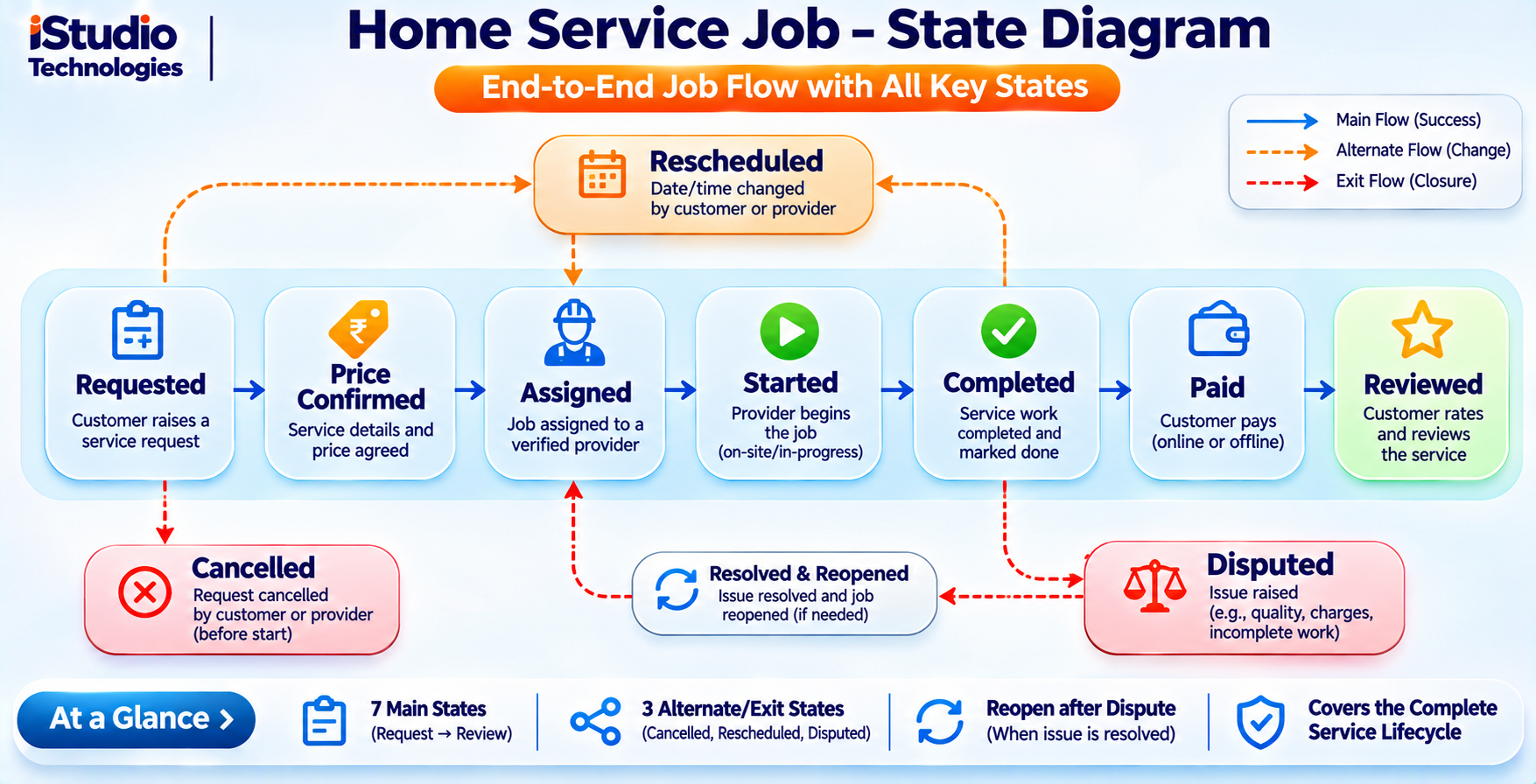
The most useful design decision in a home service app is to treat each job as a sequence of defined states, not as a free-form booking. A typical lifecycle is: requested, price confirmed, provider assigned, provider on the way, started, extra work proposed, completed, paid and reviewed, with cancelled, rescheduled and disputed as exits. Each change of state needs an actor (customer, provider or admin), a time and, where relevant, evidence such as a code or a photo.
This pays off in three ways. Payments and refunds follow the state, so money never moves on a guess. Support staff resolve disputes from the record instead of from memory. And the same model lets you add automatic dispatch later without rewriting the booking flow.
The Leakage Problem
Once a customer and a provider have met through your app, either may prefer to deal directly next time and skip your fee. This is called platform leakage or disintermediation, and every home service marketplace faces it. Policing it rarely works. Our recommendation is to make staying on the platform worth more than the fee: payment protection, a warranty that only applies to in-app jobs, plan or subscription pricing, masked contact details and tools that save providers time, such as invoices and a job calendar.
Which Rules Should You Check Before Launch?
This is general guidance and not legal advice. Rules change and depend on your model, so confirm each point with an adviser.
- Consumer protection for online platforms. The Consumer Protection (E-Commerce) Rules, 2020 were notified under the Consumer Protection Act, 2019 and came into force on 23 July 2020, according to a Parliament reply. They set duties for e-commerce entities, including marketplaces, such as grievance handling. Whether and how they apply to a platform that sells services depends on your model, so check the text.
- Gig and platform workers. A Parliament reply from March 2026 says the Code on Social Security, 2020 came into force on 21 November 2025 and for the first time defines gig workers and platform workers, with social security provisions. If independent providers work through your app, ask a labour-law adviser whether you count as an aggregator and what follows.
- Personal data. India's Digital Personal Data Protection Rules were notified in November 2025, according to a Press Information Bureau release, and are being phased in. A home service app holds names, addresses, phone numbers and sometimes photos of the inside of homes, so collect only what you need, explain why and keep it secure.
- Trade licences. Electrical work is regulated. Check what licence electricians must hold in your state and build licence details and expiry checks into the provider profile.
- Tax and payments. Service charges, commissions and payouts to providers have GST and invoicing implications. Ask your accountant how to structure invoices before you design the payment flow.
How to Pick an Idea and What to Build First
Choose by your starting point, not by which idea sounds biggest.
| If you already have | Look first at | Why |
|---|---|---|
| A team of technicians and a customer list | Ideas 2, 4 or 6 | You own the supply and need recurring bookings and records |
| Contacts in apartment communities or facility management | Idea 3 | One agreement reaches many homes |
| Capital and an operations manager, but no technicians | Idea 1 | You can build supply, but expect the hardest launch |
| Software skills and little capital | Idea 7 | No field workforce to run, and a low-cost first version |
| A small team and a short window | Idea 5 | You can test demand before building anything |
| A trusted caretaker or property business | Idea 8 | Trust is your main asset |
A Sensible Build Order
- Validate before building. Speak to about ten customers and ten providers. Ask what they use today, what annoys them and what they would pay for.
- Run it by hand. Take bookings by phone or WhatsApp and dispatch manually for a few weeks. Our guide to WhatsApp booking shows the lightest way to start.
- Build the foundations. Provider onboarding and verification, booking with fixed prices, a job record with the states above, and payment after completion.
- Keep dispatch manual at first. An admin panel where your team assigns each job teaches you the real rules. Automate matching once you know them.
- Add reviews, support and reminders, then plans or subscriptions where repeat demand is strong.
The same reasoning appears in our guide to the cost of a single-city taxi app, where dispatch is the other hard part. If you want one of these ideas turned into a scoped first release, our mobile app development team in Chennai can map the customer app, provider app and admin panel around your actual workflow.
Have one of these ideas in mind? Tell us your service, your first localities and who your first providers will be, and we will help you scope a first release.
Discuss Your App IdeaCommon Questions
Which home service app idea is easiest to start?
How do home service apps make money?
How do I stop providers taking customers off the app?
Do I need separate customer and provider apps?
Can I start with WhatsApp instead of an app?
Turn Your Home Service Idea into a Scoped First Release
Share your service, your first localities and your provider plan. We will map the apps and admin tools you need for a first version.
Discuss Your App Idea