
Field Sales Tracking App Cost: What an FMCG Distributor Pays to Build One in India
A field sales app does two jobs: it lets your salespeople book orders and collect payments at the outlet, and it shows you where they went and what they sold. These are our estimates in three tiers, what changes the price, what it costs to run and what to settle about tracking staff.
Field Sales Tracking App Cost: What Does an FMCG Distributor Pay?
We estimate a basic field sales app with attendance, outlet check-in and order booking at about ₹5 lakh to ₹12 lakh, a standard one with schemes, collections, photos and a manager dashboard at about ₹12 lakh to ₹28 lakh, and an advanced one integrated with your ERP or distributor system at about ₹28 lakh to ₹60 lakh or more. These are one-time build costs in 2026 prices, and running costs come on top.
This guide is for distributors and sales heads who must approve a budget and choose between building an app and renting one. It explains what each tier buys, so you can tell a fair quote from one that leaves out the hard parts.
An honest limit: these are iStudio's own estimates for typical projects, not market data and not a quote. Your price depends on how many salespeople you have, the complexity of your price lists and schemes, and whether the app must connect to your accounting or distributor software.
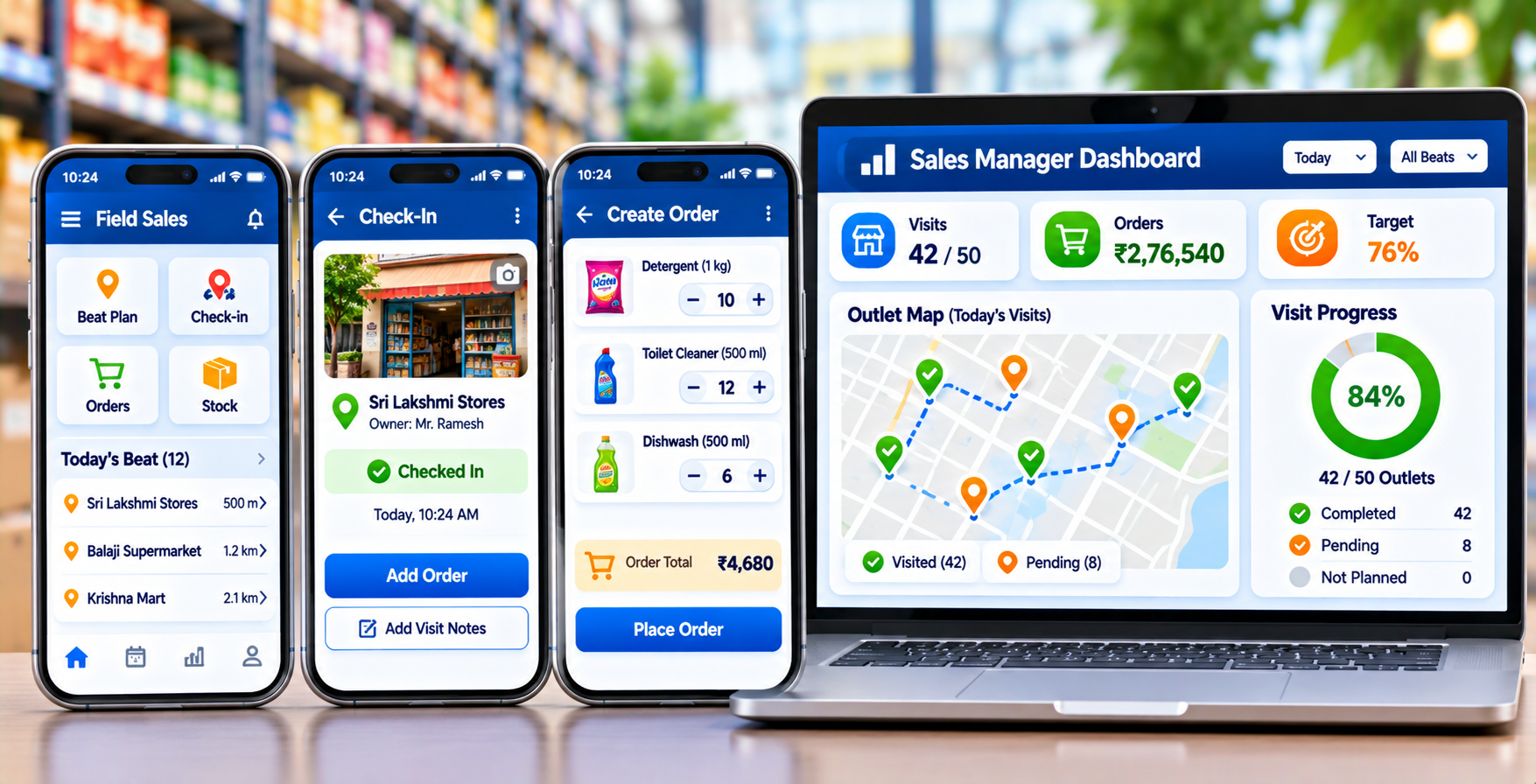
What Does a Field Sales App Include?
Check every row before comparing quotes. The field sales tracking app cost you are quoted often differs only because one vendor leaves out rows that another includes.
| Part | What it does | Effort |
|---|---|---|
| Attendance and day start | Salesperson starts and ends the day in the app, with a location check | Low to moderate |
| Beat plan and outlet list | Routes by day, outlet details, visit order and new outlet creation | Moderate |
| Outlet check-in | Visit recorded with time and location, and a reason when no order is taken | Moderate |
| Order booking | Product catalogue, price list, quantity, discounts and submit, with an order copy to the outlet | High |
| Schemes and pricing rules | Free items, slab discounts and outlet-wise prices applied automatically | High |
| Collections and outstanding | Show an outlet's dues, record payments and issue receipts | Moderate to high |
| Photos and surveys | Shelf photos, stock counts and competitor notes with a timestamp | Moderate |
| Expenses and targets | Claims with proof, monthly targets and progress by salesperson | Moderate |
| Offline mode | Everything above keeps working without network and syncs later | High; the hardest part |
| Manager dashboard | Visits, orders, route compliance and reports by team, area and product | Moderate to high |
| Integration | Orders flow into your ERP, accounting or distributor software, and stock and prices flow back | High; depends on the other system |
Cost Tiers: What Each Level Buys
| Tier | What it includes | One-time cost (2026) | Typical timeline |
|---|---|---|---|
| Basic | Android app with attendance, beat plan, outlet check-in, order booking without complex schemes, offline mode, a simple web admin and basic reports | ₹5 lakh to ₹12 lakh | 12 to 20 weeks |
| Standard | Basic plus schemes and pricing rules, collections and outstanding, shelf photos and surveys, expenses and targets, a manager dashboard and export to accounting software | ₹12 lakh to ₹28 lakh | 20 to 32 weeks |
| Advanced | Standard plus two-way integration with your ERP or distributor system, van sales with invoice printing, route suggestions, iPhone app, multi-distributor and multi-state support, analytics and tighter audit controls | ₹28 lakh to ₹60 lakh or more | 30 to 52 weeks |
iStudio estimates for 2026, one-time, excluding GST and third-party usage charges. Not market data and not a quote. This is how we see the field sales tracking app cost for a typical distributor.
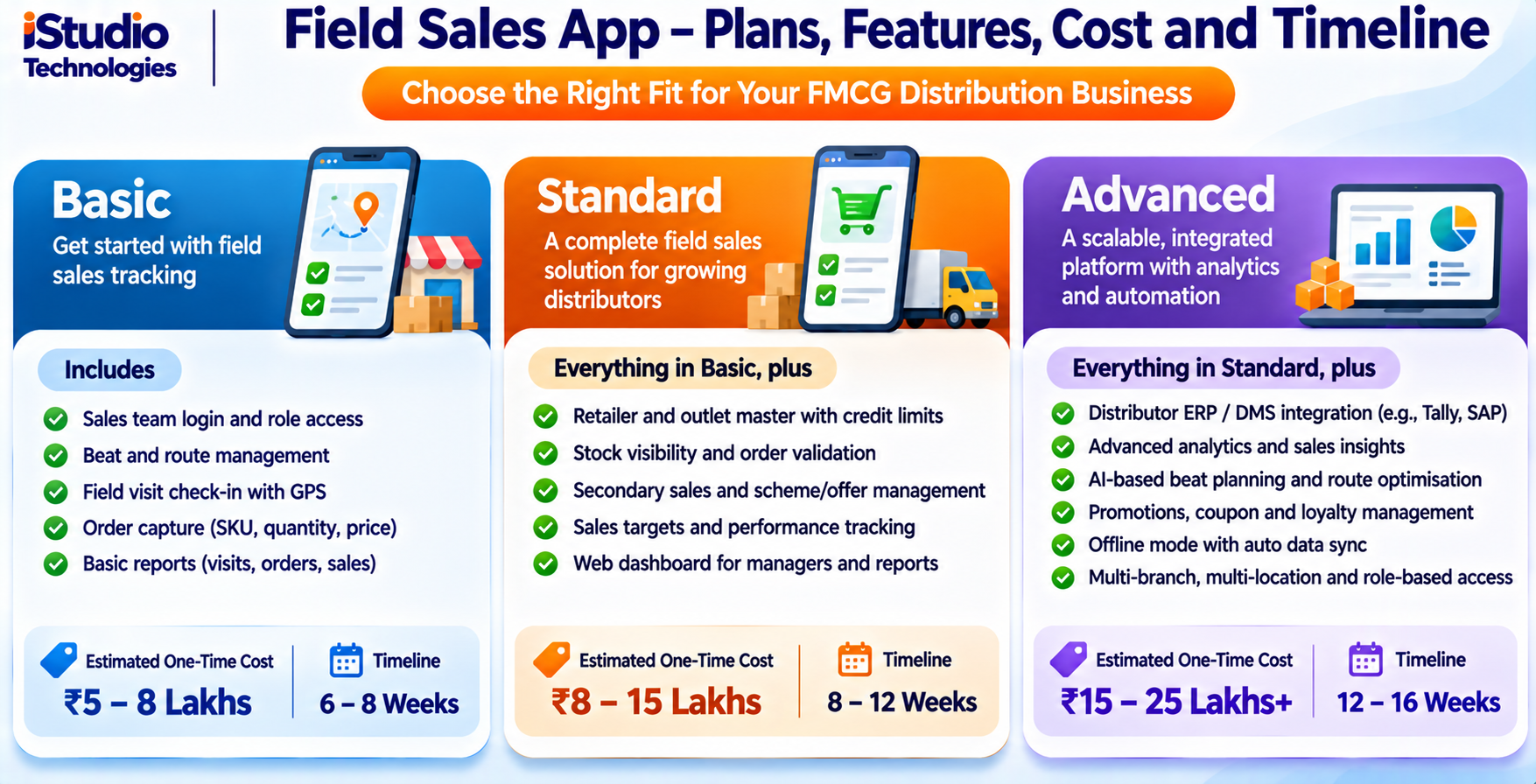
How to Choose a Tier
Choose Basic if you have a small team, simple price lists and the main aim is to prove that visits happen and to capture orders without paper. Choose Standard if schemes, collections and photo proof matter to your margins and your managers need daily visibility. Choose Advanced when orders must flow straight into your ERP, or when you run several distributors or states from one system.
What Moves the Price Up or Down
- Schemes and price rules. Simple price lists are easy. Slabs, combos, free goods and outlet-wise prices take design and testing.
- Integration. Connecting to an ERP or accounting tool depends on what interface it offers, and its vendor's cooperation sets the schedule.
- Offline depth. Taking orders offline is basic. Handling price changes, stock and conflicts offline is harder.
- Platforms and devices. Android only is cheaper than adding iPhone. Low-cost phones need extra testing.
- Languages. Tamil, Hindi or other language screens, and receipts in those languages, add design and checking.
- Data migration and training. Loading outlets, prices and opening balances, and training salespeople, is real work.
iStudio Engineering Note: Design for Weak Networks and Honest Location
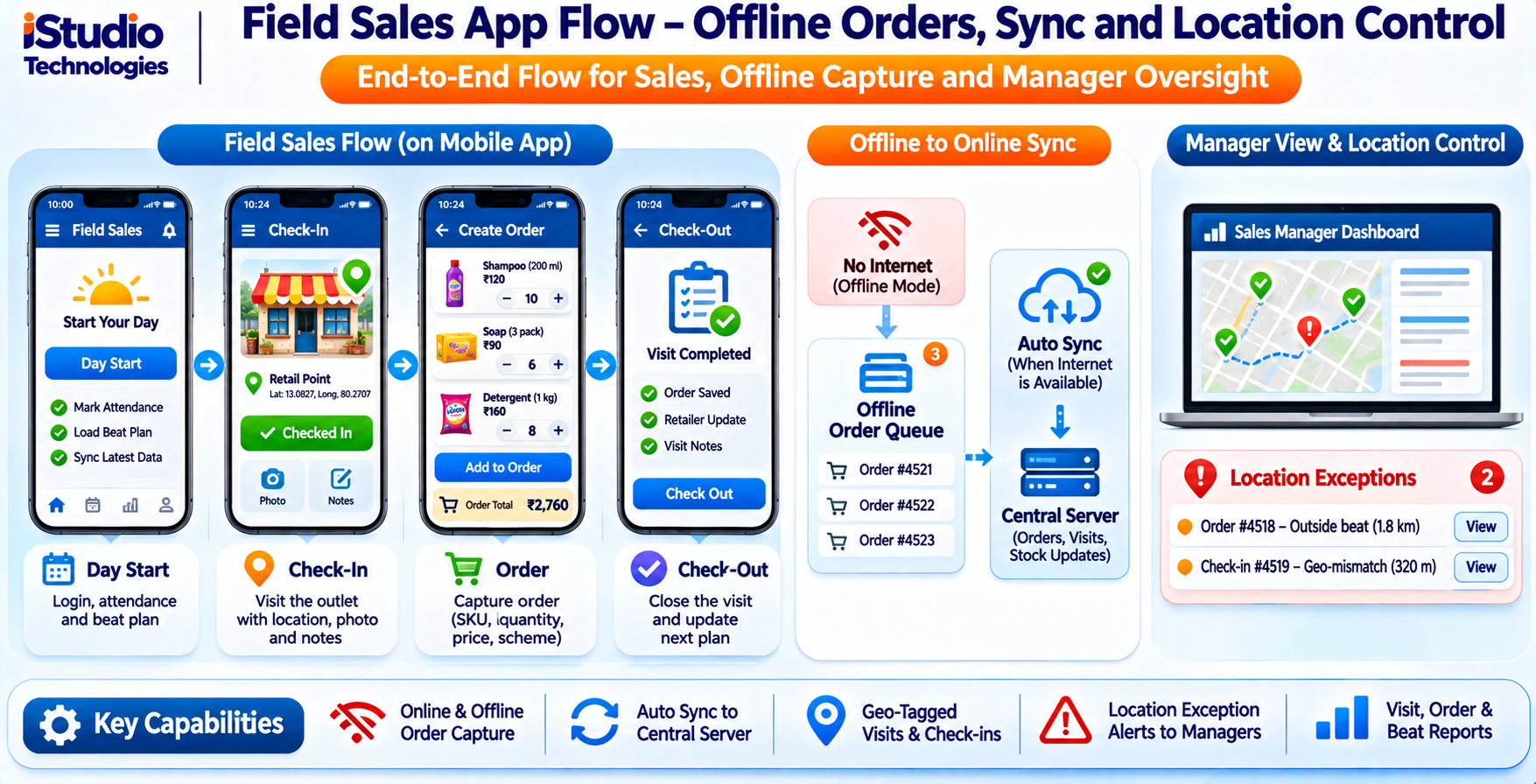
Two design choices decide whether a field sales app is trusted or abandoned, and they shape the field sales tracking app cost more than screens do. The first is that an order must never be lost when the network drops. The second is that location should be recorded in a way that is accurate and fair to the salesperson.
- Save every order on the phone first. The app writes the order to local storage, then sends it. Each order gets a unique ID when it is created, so a repeated send is stored once.
- Freeze the price at the time of the order. Save the price list version and the scheme applied with the order, so later price changes do not alter it.
- Record location at events, not all day. Capture location at day start, check-in, order and check-out. Continuous tracking drains the battery and raises privacy questions, so use it only if the business truly needs the route.
- Allow for GPS error. Set a tolerance around each outlet, because phone location can drift in dense areas. Flag a check-in far from the outlet for review and do not reject it automatically.
- Detect obvious tampering. Record whether the phone reports a mock location or a wrong clock, and show it to managers as a flag, not as proof.
- Show the salesperson their own data. A visible shift status, a clear start and stop for tracking and a view of what the company sees build trust and reduce disputes.
- Require approval for exceptions. Discounts above a limit, returns and edits to submitted orders go to a manager and are logged.
These choices add some build effort and prevent the arguments that follow a lost order or an unfair location flag. They are what separates a Standard build from a Basic one.
Which Rules and Policies Apply to Staff Tracking?
This is general guidance and not legal advice. Rules change, so confirm each point with a qualified adviser. The field sales tracking app cost should include the time to meet them.
- Telling staff what you collect. Write a short policy that says what the app records, when, why and who can see it, and share it with every salesperson before they start. Legal commentary on India's data protection law treats processing for employment purposes as a recognised use, and says it does not give an employer a free hand to monitor everything, so keep tracking to what the job needs.
- Data protection law. India's Digital Personal Data Protection Rules were notified in November 2025, according to a Press Information Bureau release, and are being phased in. Outlet owners' names and phone numbers are also personal data, so keep access limited and secure.
- Google Play background location rules. If your Android app reads location in the background, Google Play requires a separate in-app disclosure, as its guidance on prominent disclosure and consent explains. Its permissions policy says sensitive permissions must be necessary for the app's core functions. This is another reason to record location at events and to explain each request in plain words.
- Work hours and personal time. Track only during working hours, give salespeople a clear way to end the shift, and do not follow them off duty.
- Invoices and tax. If the app issues invoices or receipts, ask your accountant what must appear on them and how GST applies. We do not state a rate here.
What Does It Cost to Run, and Should You Build or Buy?
The one-time build is only part of the field sales tracking app cost over the years. Ask each vendor to list the yearly items and price them separately.
- Servers and storage. Orders, photos and location history need hosting, backups and monitoring.
- Map and location services. Map displays and route features are usually charged by usage. Check the current price list of any provider.
- Messages. SMS or WhatsApp copies of orders to outlets carry a per-message charge.
- Updates and support. Phones and operating systems change every year, so budget for fixes, store updates and a support line for salespeople.
- Training new staff. Sales teams change often, and every new person needs to be trained.
| Option | Good when | Watch out for |
|---|---|---|
| Ready-made field force software (per user, per month) | Your process is standard and you want to start quickly | Fees that grow with each user, limited scheme rules and data held by the vendor |
| Custom app built for you | Your schemes, beats or integrations are unusual and the app is core to your business | Up-front cost and the need for a trustworthy team after launch |
| Ready-made core with custom additions | You want speed now and your own features later | Depends on how much the vendor lets you extend |
Questions to Ask Any Vendor
- What happens to an order if the phone has no network for a whole day?
- How and when is location recorded, and can salespeople see it?
- Which of our price rules and schemes are included, and which cost extra?
- Who owns the source code and the data if we change vendors?
If you want a team to scope this for your distributorship, our mobile app development team in Chennai can map your beats, schemes and systems to a tier. For a related build, see our guide to fleet tracking dashboard development cost.
Planning a field sales app for your distributorship? Share your team size, price rules and systems, and we will estimate the tier and running costs.
Get a Scoped EstimateCommon Questions
How much does a basic field sales app cost in India?
Does the app need to work offline?
Is live location tracking necessary?
Can the app connect to our accounting or ERP software?
Should we build our own or rent a ready-made app?
Get a Scoped Estimate for Your Field Sales App
Share your team size, beats, price rules and systems. We will suggest a tier, a timeline and the running costs to plan for.
Get a Scoped Estimate