
Google Ads ROI Real Estate: How to Measure Real Returns for a Project
A property sale takes weeks or months and passes through calls, site visits and negotiations, so the number in your ad dashboard is rarely the return. This guide shows the stages to measure, how to connect Google Ads to your CRM, and how to work out what a booking really costs you.
Google Ads ROI Real Estate: What Does Real Return Mean?
Real return means the revenue or margin from sales that came from your ads, minus the ad spend, compared with that spend. To get it, you must follow each lead from the click to a booking and a registered sale, record every stage in a CRM, and feed the later stages back to Google Ads. Cost per lead is a starting point, and it is not a return.
This guide is for developers, sales heads and marketers of apartment, villa and plot projects. It explains the stages to track, the tracking design, how to calculate what a booking costs, and the rules and pitfalls that distort the numbers.
An honest limit: we quote no benchmarks for cost per lead or conversion rates, because they vary by city, project and price band. The worked example uses invented numbers to show the method, and your own figures will differ.
Why Do Leads and Cost per Lead Mislead?
Leads are easy to count, which is why google ads roi real estate reports so often stop at cost per lead. A campaign that brings many cheap leads can look best on a dashboard and still bring no buyers, while a campaign with fewer, dearer leads may produce the bookings.
- Lead quality varies. A form fill from someone browsing is not a buyer with a budget and a timeline.
- The sales cycle is long. A buyer may click in one month and book several months later, so a monthly report that compares spend with that month's sales is wrong.
- Many sources overlap. The same buyer may see your ad, a portal listing and a broker's message before visiting.
- Calls are lost. Many property enquiries are phone calls or chat messages, and a dashboard that counts only form fills misses them.
- Sales data sits elsewhere. The booking happens in the sales team's CRM or spreadsheet, so Google Ads never learns which clicks paid off, and the campaign cannot improve.
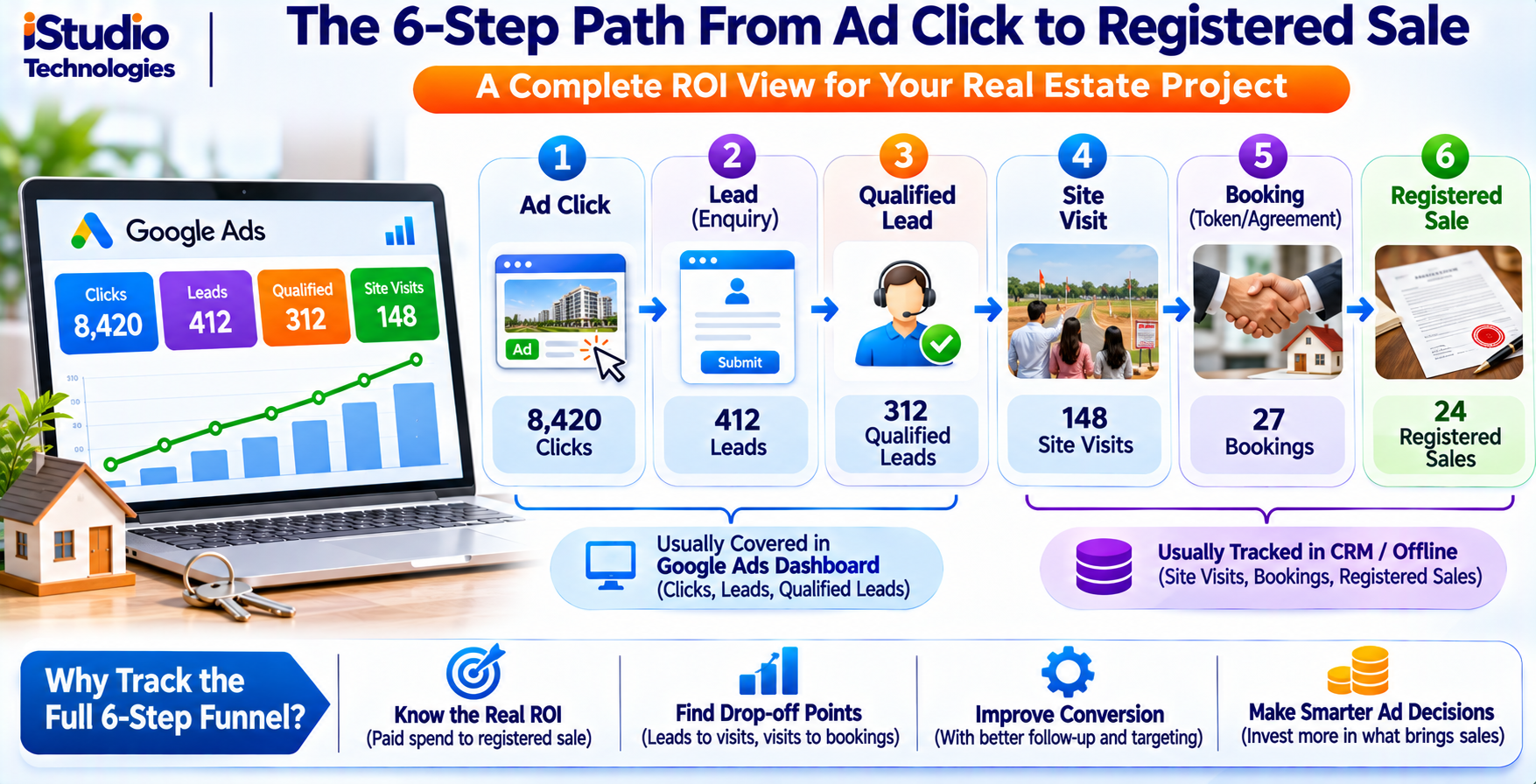
What Is the Funnel to Measure, Stage by Stage?
Each stage below is one row of a google ads roi real estate report. Agree the definitions with your sales head before the campaign starts, so that marketing and sales count the same things.
| Stage | Definition to agree | What to record |
|---|---|---|
| 1. Lead | A form fill, call or chat from a person who gave contact details | Source, campaign, keyword and click ID where available |
| 2. Qualified lead | Budget, timeline and unit type match the project, confirmed by a call | Date qualified, reason if rejected |
| 3. Site visit | The buyer physically visits, or takes a verified virtual tour | Date, visit type, sales person |
| 4. Negotiation | A unit is chosen and price talks are active | Unit, quoted price, objections |
| 5. Booking | A token or booking amount is paid for a unit | Unit, booking value, payment date |
| 6. Registered sale | Agreement and registration are completed | Final value, date, any cancellation |
Which Numbers to Calculate
- Cost per qualified lead, per site visit and per booking. Divide the ad spend by the count at each stage.
- Stage conversion rates. The share of leads that become qualified, of qualified that become visits and of visits that become bookings. These tell you where the funnel leaks, which is often in follow-up speed and not in the ads.
- Ad cost as a share of booking value. Ad spend divided by the total value of the bookings that came from ads.
- Return on margin. Use your own margin per unit: (margin from attributed sales minus ad spend) divided by ad spend. Do this only with numbers your finance team confirms.
- Cohorts by lead month. Group sales by the month the lead arrived, not the month of the sale, and update the report as late bookings come in.
Why Follow-Up Speed Belongs in the Report
A property enquiry cools quickly. Record the time between a lead arriving and the first call, and the number of attempts before the lead is marked unreachable. If many leads are never reached, the fault lies in the handling, and spending more on ads will only make it worse. Review these figures weekly with the sales team, share the reasons leads are rejected, and use them to refine the ad text and the landing page so that fewer unsuitable enquiries come in.
A Worked Example of Google Ads ROI Real Estate Arithmetic
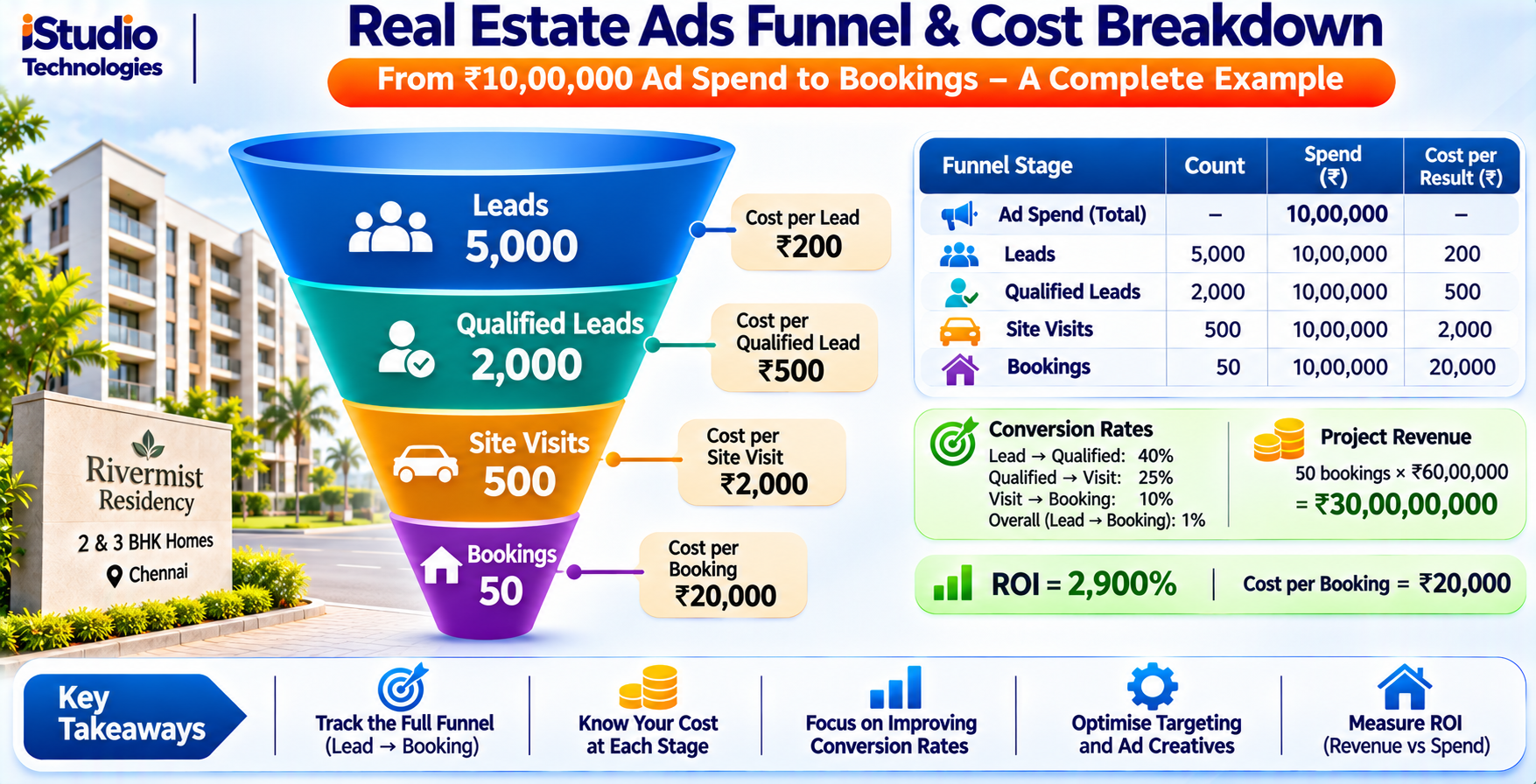
The numbers below are invented to show the method. They are not benchmarks and they are not a forecast. Suppose a project spends ₹10,00,000 on Google Ads in a quarter.
| Stage | Count (invented) | Share of previous stage | Cost per stage |
|---|---|---|---|
| Leads | 400 | ₹2,500 | |
| Qualified leads | 120 | 30% | ₹8,333 |
| Site visits | 30 | 25% | ₹33,333 |
| Bookings | 4 | 13.3% | ₹2,50,000 |
Illustrative arithmetic only. Costs are ₹10,00,000 divided by each count, rounded.
If each booked unit is worth ₹80 lakh, four bookings are worth ₹3.2 crore, and the ad spend is about 3.1% of that value. Whether that is a good result depends on your margin, your other sales costs and how many of those bookings reach registration. Under your own numbers, the return on margin is the margin from those units, minus the ad spend, divided by the ad spend.
Notice what the example shows. The cost per lead of ₹2,500 sounds modest, and the cost per booking is a hundred times higher. A change that raises the visit-to-booking rate, such as faster follow-up, can improve the return as much as cheaper clicks would.
iStudio Engineering Note: Connect the Click to the CRM
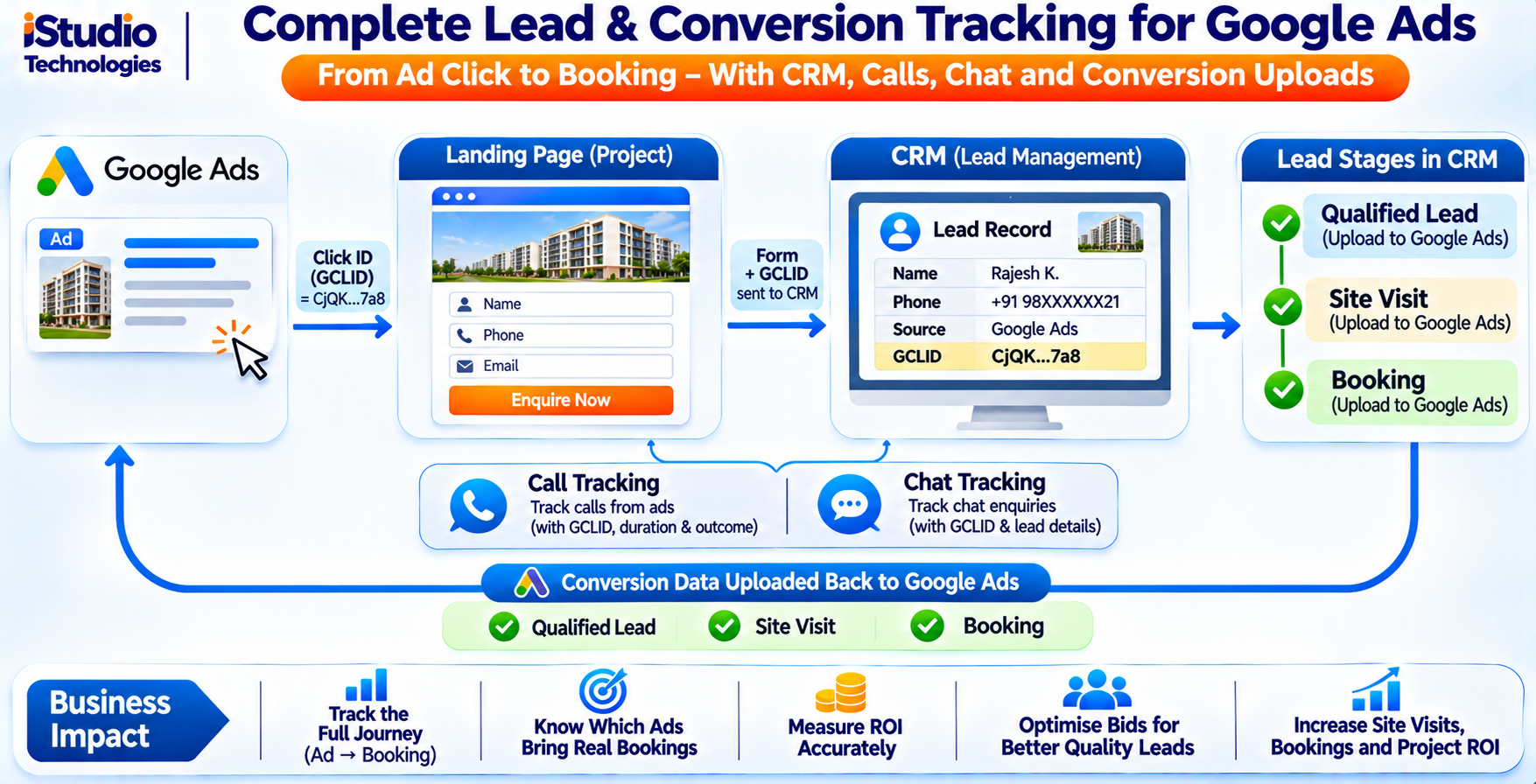
The weak point in most google ads roi real estate reporting is the gap between the click and the CRM. If the click is not tied to the lead record, you cannot tell Google Ads which clicks led to bookings. A tidy design closes the gap.
- Capture the click ID on the landing page. Google Ads can add a click identifier to the address when someone clicks an ad. Store it in a hidden form field together with the campaign and keyword details, and keep it with the lead.
- Track calls and chats too. Use call tracking numbers or tagged chat links for each campaign, and create a lead record automatically for every call or chat, with the source.
- Send every lead to the CRM at once. Save the source, click ID and consent, assign it to a sales person with a due time for the first call, and log every contact.
- Use agreed stage names. The CRM stages should match the funnel table. Staff move a lead only when the definition is met, and a rejected lead carries a reason.
- Import the later stages into Google Ads. Google's help on offline conversions with the click ID explains how sales outside the website can be matched to the ads that led to them. Upload qualified leads, site visits and bookings as separate conversion events, with a value where you can.
- Watch the time limit. Google's guidelines for importing offline conversions say that conversions uploaded more than 90 days after the last click are not imported. Property sales are often slower than that, so upload each stage when it happens, and do not wait for the registration. Upload methods have been changing, so ask your developer to check the current one.
- Reconcile every month. Compare the CRM's counts with Google Ads' counts, and ask each buyer at the site visit how they first heard about the project, because brokers and portals also take credit.
Stage events let Google's bidding learn from qualified leads and visits and not from every form fill. It needs enough events to learn from, so a small project may start by optimising for qualified leads and move down the funnel later.
Which Rules and Pitfalls Can Distort Google Ads ROI Real Estate Numbers?
This is general guidance and not legal advice. Rules change, so confirm each point with your adviser.
- RERA in your ads. State real estate regulators have issued orders against promoters whose advertisements did not show the project's registration number, citing Section 11(2) of the Real Estate (Regulation and Development) Act, 2016. Check your state authority's current rules, and put the registration number in your ads and landing pages. Our guide to a RERA-compliant real estate website in Chennai covers the website side.
- Honest claims. Show price, possession dates and amenities only as you can prove them. A misleading advertisement can lead to regulator action and complaints.
- Buyer data. India's Digital Personal Data Protection Rules were notified in November 2025, according to a Press Information Bureau release, and are being phased in. Leads share names, phone numbers and sometimes financial details. Ask for consent in plain words, record it, limit who can see the data and delete it on schedule. Sending customer data to Google for conversion matching also needs a clear consent basis, so ask your adviser.
- Reporting pitfalls. Do not compare one month's spend with the same month's sales. Do not count a booking twice when a buyer enquires through several channels. Do not treat a cancelled booking as a sale. And do not judge a campaign after a few weeks, when most of its buyers have not yet visited.
If you want a team to set this up, our digital marketing team in Chennai can design the tracking, connect it to your CRM and build the stage reports. For the CRM itself, see real estate CRM development cost in Chennai.
Spending on Google Ads for a property project? Share your funnel stages and CRM, and we will show you where the tracking breaks.
Request a Tracking ReviewCommon Questions
What is a good cost per lead for real estate?
How long should I wait before judging a campaign?
Can Google Ads know about sales that happen offline?
How do I handle buyers who also came through brokers or portals?
Is call tracking necessary?
Know What a Booking Really Costs
Share your funnel stages and CRM. We will map where the tracking breaks and how to connect your clicks to bookings.
Request a Tracking Review