
PPC Real Estate Builders Chennai: Lead-Focused Management for Builders and Developers
A flat or plot is a large, slow decision, so clicks are cheap compared with a site visit and a visit is cheap compared with a booking. Good Google Ads management is built around that gap. This guide covers what an agency should manage, how campaigns should be organised, what we estimate management costs in three tiers and which advertising rules apply.
PPC Real Estate Builders Chennai: What Should Lead-Focused Management Include?
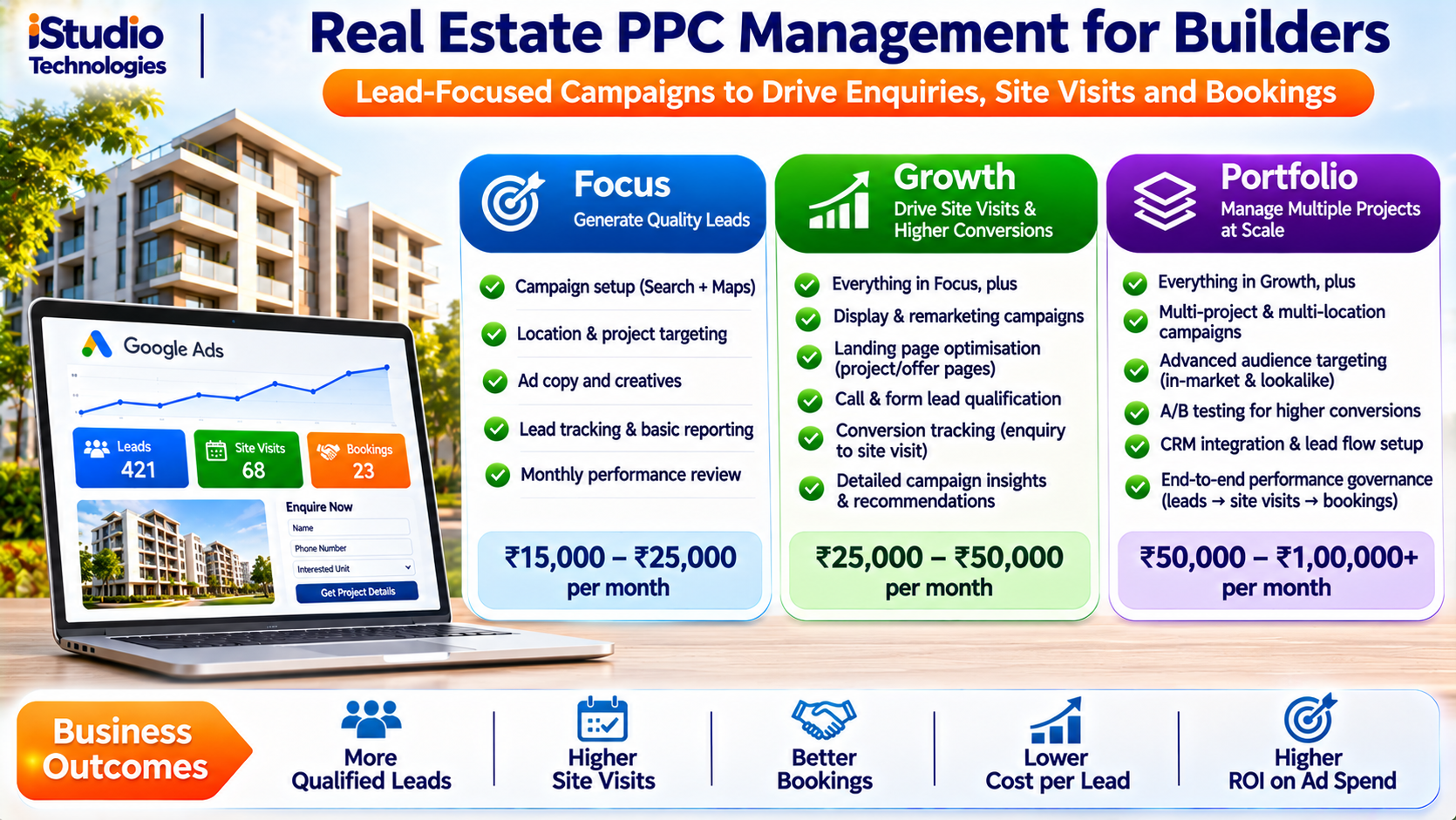
Lead-focused management means campaigns organised by project and buyer intent, ads and landing pages that carry the registration details the rules require, call and form tracking, weekly feedback from your sales team on lead quality, and reports that go beyond cost per lead to site visits and bookings. We estimate management at about ₹30,000 to ₹60,000 a month for one project, about ₹60,000 to ₹1.2 lakh for a few projects, and about ₹1.2 lakh to ₹2.5 lakh and up for a portfolio. Ad spend is separate.
This guide is for builders, developers and sales heads who are hiring an agency or reviewing one. It explains what makes this kind of advertising different, what the work involves, how we organise campaigns, what the tiers include and what the rules require.
An honest limit: the fees are iStudio's own estimates for typical engagements, not market data and not a quote. We quote no cost-per-lead benchmarks, because they vary by micro-market, price band and project, and we cannot promise leads, visits or sales. Your own tracking is the only reliable measure.
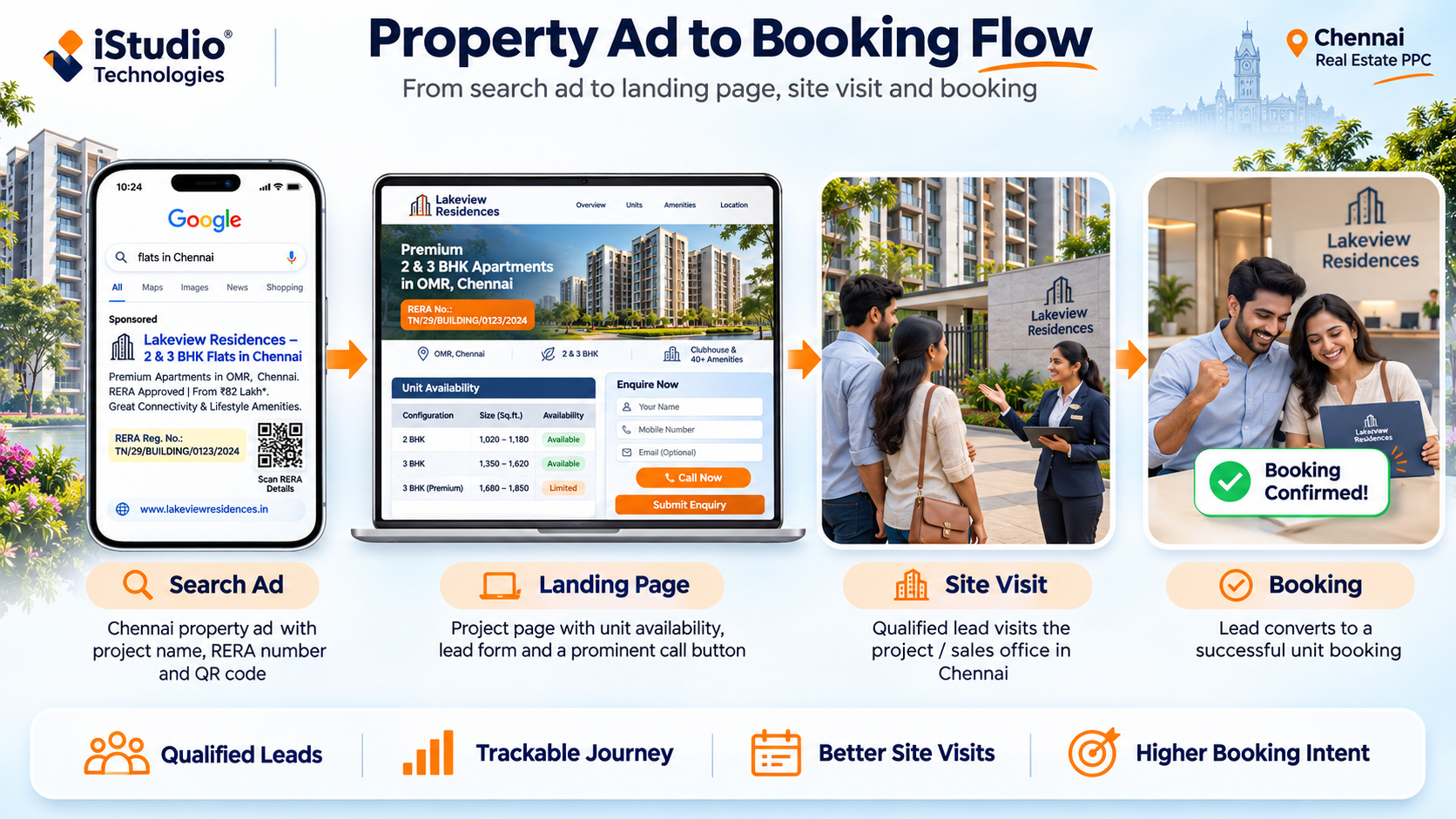
Why Is Real Estate PPC Different from Other Google Ads Work?
Ppc real estate builders chennai work has features that general advertising guides miss. Knowing them helps you judge a proposal.
- The sale is long and large. A buyer may click, enquire, visit twice and decide months later, so click-level numbers say little about results.
- Location is the product. Buyers search by locality and corridor, so campaigns must be built around micro-markets and not one broad Chennai campaign.
- Many searches are not buyers. People look for rentals, resale listings, jobs with builders, brokers and plain information. Without careful keyword control, a campaign pays for these clicks.
- Buyers come from several places. Some search from Chennai, some from other cities or abroad, so location settings need a decision for each project.
- Rules govern the advertisement itself. The details an ad must show are set by the regulator, and a good agency builds them in from the start.
- Follow-up decides results. A good lead that is called late is a lost lead, so the agency and the sales team must work as one.
What Does Lead-Focused Management Cover, Step by Step?
| Step | What the agency does | What you should receive |
|---|---|---|
| 1. Audit and goals | Review any past campaigns, the sales funnel and what a qualified lead means for each project | A short written plan with agreed definitions |
| 2. Market and keyword map | Map projects to micro-markets, unit types and buyer intent, and list negative terms to avoid | A keyword and structure sheet you can read |
| 3. Campaign build | Search campaigns by project and intent, with ads written around the project's real facts and its registration details | Campaigns and ads for your approval before launch |
| 4. Landing pages and forms | A page for each project with unit details, location, the registration number and QR code, a short form and a call button | Pages that load fast on phones and carry the required details |
| 5. Tracking | Track forms, calls and chat clicks, and tie each lead to its campaign in your CRM | A lead sheet or CRM feed with source and keyword |
| 6. Weekly optimisation | Remove wasteful search terms, adjust bids and budgets, test ad text, and use sales feedback on lead quality | A weekly note of what changed and why |
| 7. Reporting | Leads, qualified leads, site visits and bookings by project and campaign, with costs at each stage | A monthly report that matches your own CRM |
A sound ppc real estate builders chennai scope ends in reports that your sales team can check against its own records. To measure results beyond the lead, see our guide to Google Ads ROI for real estate, which explains the stages to track and how to feed them back into Google Ads.
Management Tiers: What Each Level Buys
| Tier | What it includes | Management fee (2026) |
|---|---|---|
| Focus | One project. Search campaigns by unit type and micro-market, one landing page review, form and call tracking, weekly optimisation, monthly report | ₹30,000 to ₹60,000 a month |
| Growth | Two or three projects. Focus scope plus remarketing, a broader campaign type where it suits, lead form assets, CRM stage reporting, sales feedback calls every week | ₹60,000 to ₹1.2 lakh a month |
| Portfolio | Many projects or several cities. Growth scope plus call tracking by campaign, offline conversion import from the CRM, a shared negative keyword library, custom dashboards, a named account lead | ₹1.2 lakh to ₹2.5 lakh and up a month |
iStudio estimates for 2026, monthly, excluding GST and ad spend. A one-time setup of about ₹25,000 to ₹75,000 for tracking and landing pages is common. Not market data and not a quote. This is how we see ppc real estate builders chennai management fees for a typical engagement.
What Moves the Fee
- Number of projects and micro-markets. Each adds campaigns, pages and reporting.
- Ad spend and how fast it changes. Large budgets need closer daily control.
- Tracking depth. Connecting to a CRM and importing later stages takes setup and care.
- Landing pages. New pages for each project and unit mix add design and build time.
- Languages and creative. Tamil and English ads and pages, and images or video, add work.
iStudio Engineering Note: Build Campaigns Around Projects and Intent
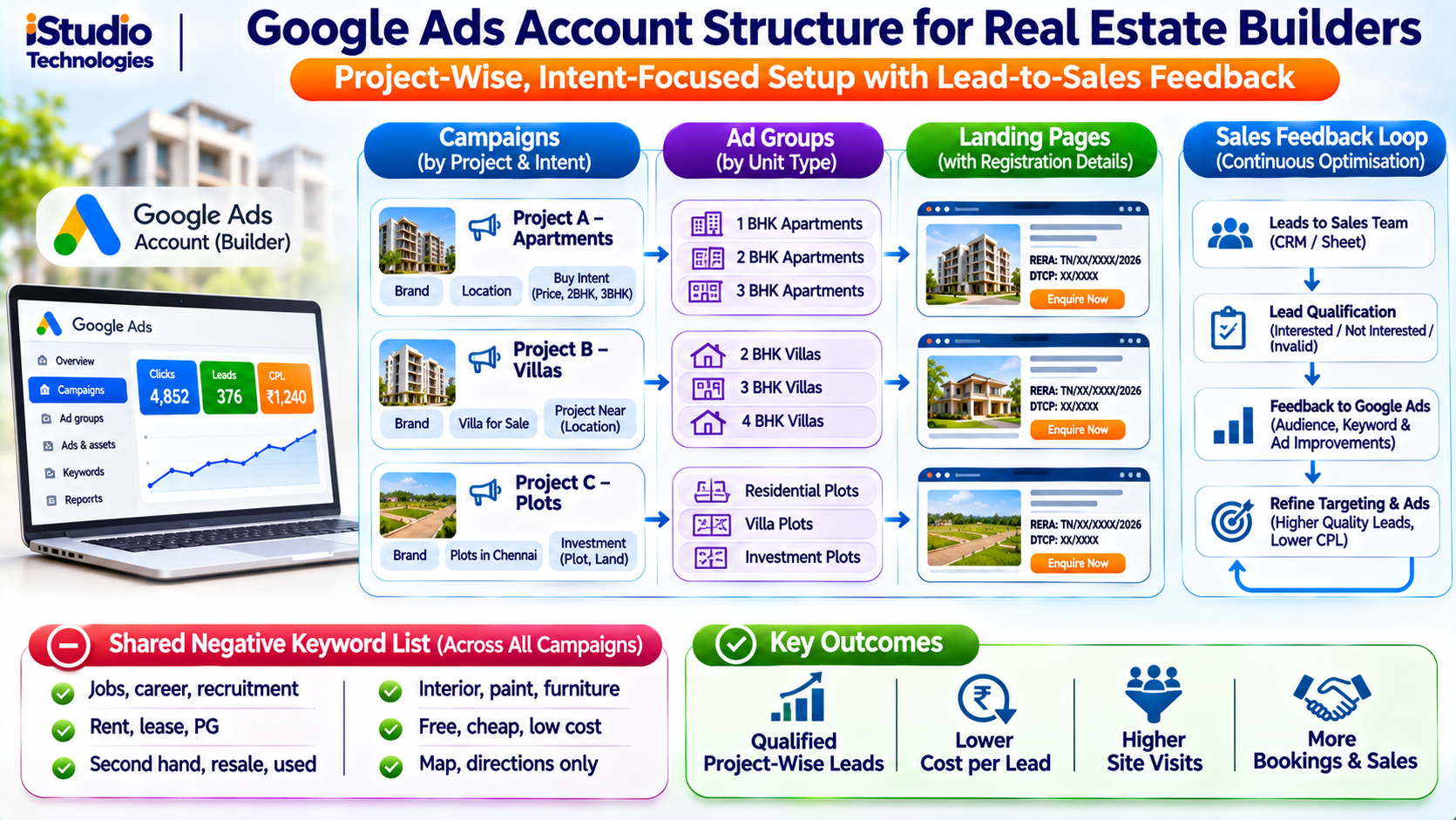
The most common structural mistake in ppc real estate builders chennai accounts is one large campaign for everything, with a mix of project names, localities and generic terms. The budget flows to whatever clicks cheaply, and reports cannot say which project is working. A tidy structure fixes this.
- One campaign for each project and intent group. Separate people searching for your project by name, people searching for a unit type in a locality and people searching for the area in general. Each group has its own budget and ads.
- Ad groups by unit type and micro-market. For example, two-bedroom and three-bedroom flats in a named locality, or plots near a named corridor. Keep each ad group's keywords and ad text closely matched.
- Shared negative keyword lists. Google's help on negative keywords explains how to avoid showing ads for searches containing chosen terms. Start with rentals, resale, jobs, free, brokers and students, and review the search terms report every week for new ones.
- A deliberate location setting. Google's help on advanced location options says that location targeting by default includes people in and people showing interest in a location, with options to limit it. Decide for each project: include interest if you want overseas or out-of-city buyers, or limit to presence if you want buyers who are in the area.
- Ads that state facts. Use the project's real location, unit sizes and registration details, and avoid superlatives you cannot prove. Test two or three ad variants at a time and keep notes.
- A landing page for each project. One page, one goal. Show unit types, location, the registration number and QR code, a short form with consent and a call button, and keep it fast on phones.
- Close the loop with sales. Each week, the sales team marks leads as qualified, not reachable or not interested with a reason. The agency uses those reasons to add negative terms, change ad text and move budget.
This structure takes more setup than a single campaign and makes results readable, which is what lets you shift money to the projects and phrases that produce visits.
Which Advertising Rules Apply to Builders in Tamil Nadu?
Rules on advertising property are strict, and every ppc real estate builders chennai campaign must be built around them. This is general guidance and not legal advice. Rules and directives change, so read the current text and confirm with your adviser.
- Register before you advertise. The Tamil Nadu Real Estate Regulatory Authority says on its official website that a promoter must upload the details of the proposed project, including registration details. Under the Real Estate (Regulation and Development) Act, 2016, advertising or offering a project for sale without registering it is not allowed. Check this with your adviser for each project.
- The advertising directive. Press reports say the authority issued a directive, in force from 1 July 2025, requiring advertisements in every medium, including digital and social media, to show the registration number, a scannable QR code in the prescribed form, the authority's website, the approved project location and the promoter's contact details, and barring vague disclaimers and unverifiable claims such as an inflated count of amenities. Read the order itself on the authority's site, and apply it to ad text, images, landing pages and lead forms.
- Penalties. Later press reports describe graded penalties for major violations, such as advertising an unregistered project or leaving out the registration number or QR code. Treat them as a reason to build compliance into approval, and confirm the current position.
- Make the check part of the workflow. Give each ad and landing page a compliance checklist signed off before launch, and again whenever the text changes. Our guide to a RERA-compliant real estate website in Chennai covers the website side.
- Buyer data. India's Digital Personal Data Protection Rules were notified in November 2025 and are being phased in. Ask for consent in plain words on every form, limit who sees lead data, and delete it on a schedule.
Questions to Ask Any Agency
- Who approves ad text for registration and QR details before it goes live?
- Will you report site visits and bookings, or only leads and clicks?
- Is the Google Ads account in our name, and can we see every setting and report?
- How do you handle search terms that bring rentals, resale and brokers?
- What is the notice period, and what do we keep if we leave?
If you want a team to run this, our digital marketing team in Chennai can audit your accounts and propose a structure for your projects. For the CRM that holds your stages, see real estate CRM development cost in Chennai.
Advertising a property project in Chennai? Share your projects, localities and current campaigns, and we will review the structure and the compliance details.
Request a Campaign ReviewCommon Questions
How much does PPC management cost for a builder in Chennai?
How much should we spend on ads?
Should we run Google Ads and Facebook ads together?
What must a property ad show in Tamil Nadu?
How long before we see results?
Get a Review of Your Property Campaigns
Share your projects, localities and current campaigns. We will review the structure, tracking and compliance details and suggest what to change.
Request a Campaign Review