
Plan, Schedule & Execute — All on One Floor
Demand planning, MPS, MRP, scheduling, shop-floor control & live OEE — your complete production OS.
Powering production at 120+ Indian factories.
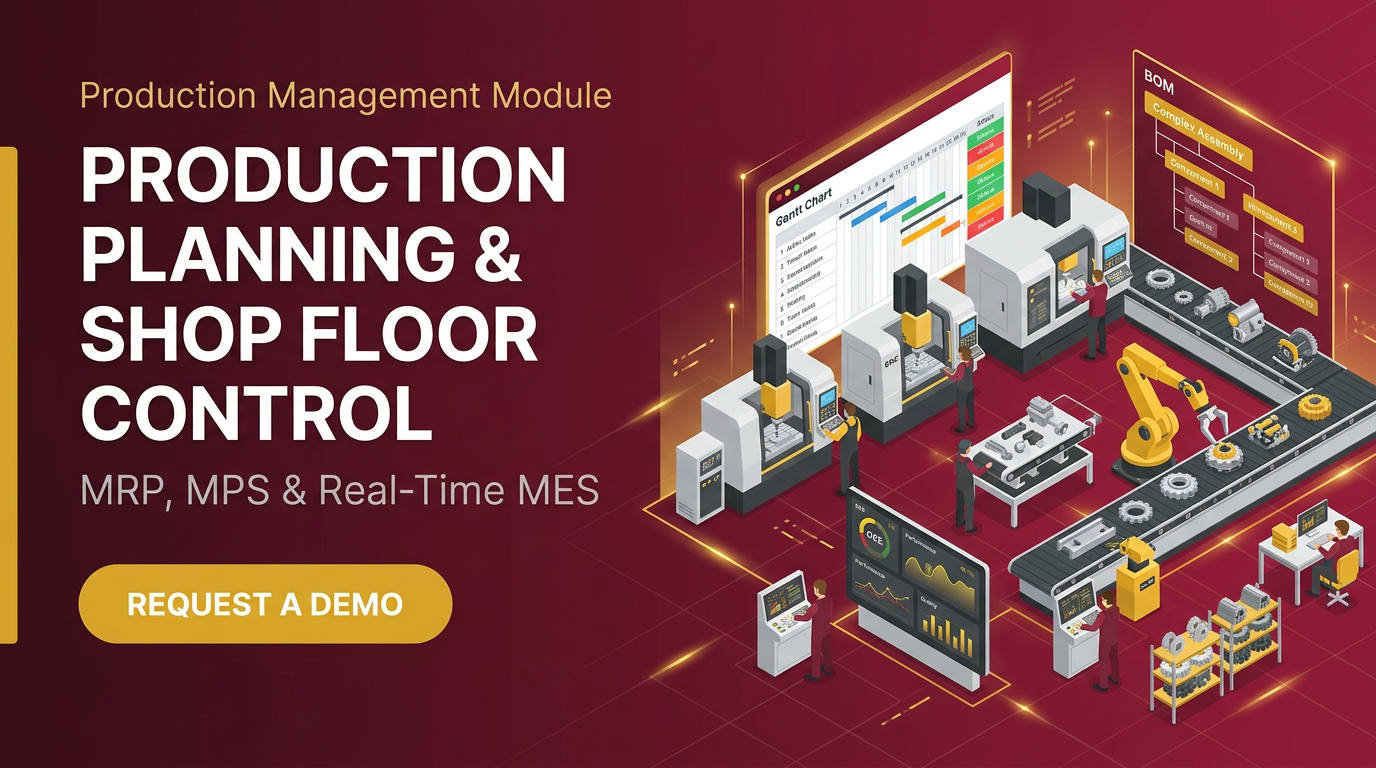
Why manufacturers choose ARC ERP Production Management
Outcomes you can measure in the first quarter
On-Time Delivery 95%+
Finite-capacity scheduling with what-if planning.
Cut WIP by 25%
Real-time shop-floor visibility & bottleneck alerts.
Higher OEE
Live downtime, quality & performance tracking.
From demand forecast to delivered unit — one connected system
Production is the heartbeat — and the hardest thing to get right
Related: Financial Accounting module — ARC ERP
Sales sells, finance counts, but production produces. Every other module in an ERP exists to support what happens between the moment a raw material enters your factory gate and the moment a finished product leaves it. Get production right, and the rest of the business gets easier. Get it wrong, and no amount of clever sales or finance will save you. This is why production planning and control deserves a deep, manufacturing-native module — not a thin scheduling layer bolted onto an accounting system.
ARC ERP’s Production Management module is a complete suite of ten interconnected sub-modules, designed to take a Chennai-based manufacturer from spreadsheet-driven planning to a real-time, MRP-driven, shop floor-connected operation. It is built for discrete and process manufacturers, for make-to-order and make-to-stock environments, and for the hybrid reality that most Indian factories actually live in.
The ten pillars of production
1. Production Planning
This is where strategy meets execution. The planning screen pulls demand from confirmed sales orders, AI-assisted forecasts, and manual additions for new business in the pipeline. It nets demand against on-hand inventory and open POs, generates a master production schedule (MPS) by daily, weekly or monthly buckets, and runs capacity checks against machine availability and labour shifts. What-if scenarios let the planner test ‘what if we add a Sunday shift on Line 3’ or ‘what if we expedite raw material on PO-1247’ before committing to a plan.
2. Production Scheduling
The MPS becomes a Gantt-style schedule showing which job runs on which machine in which shift. Drag-and-drop sequencing lets the planner respect priorities, changeover times, and resource constraints. Machine-wise job allocation, shift planning, and operator assignment are all visible on a single screen. Bottleneck machines (typically the constraint as defined by Theory of Constraints) get special attention with finite scheduling, while non-bottleneck resources are scheduled with simpler heuristics.
3. Material Requirement Planning (MRP)
Multi-level Bills of Materials (BOM) drive the MRP run. The system explodes finished goods demand into component and raw material requirements, nets against current stock and open POs, and generates planned orders — purchase requisitions for bought-out items and production orders for sub-assemblies. Shortage reports highlight items at risk; auto-generation of PRs takes the clerical load off the planner. For factories with seasonal patterns or campaign-based production, lot-sizing rules (fixed lot, lot-for-lot, period-of-supply) ensure realistic procurement.
4. Shop Floor Control
The work order is the unit of life on the shop floor. Operators start, pause and complete jobs from a tablet at the line, recording quantity produced, scrap generated, and any downtime. Real-time WIP visibility shows the planner exactly where every order stands. Machine-status integration (running, idle, breakdown, changeover) feeds the OEE calculation. Barcode and QR-code scanning eliminates manual data entry and the errors that come with it.
5. Resource Management
People, machines and tools are the three resources that constrain production. ARC ERP manages all three. Machine masters with capacity, OEE history and maintenance status. Workforce masters with skills, certifications, shift calendars and availability. Tool masters with life cycles, calibration schedules and current location. Skill-based assignment ensures the right operator is on the right job, especially important for SPM and CNC operations common in Tamil Nadu’s engineering clusters.
6. Production Dashboard
The plant head’s daily cockpit. OEE by machine, throughput vs target, downtime breakdown by reason, cycle time comparison against standard, scrap and rework trends. Updated in real time, drillable to the individual transaction. The pattern recognition this enables — ‘why does Line 2 always have low OEE on second shift on Wednesdays?’ — is the foundation of continuous improvement.
7. Downtime Management
Every minute of downtime is logged with reason code (planned changeover, breakdown, no material, no operator, no power, quality stop, no orders) and duration. Pareto analysis ranks downtime causes; trend charts show whether improvement initiatives are working. Root cause analysis tools, integrated with the maintenance module, help convert recurring downtime into permanent fixes.
8. Quality Control
Quality is built in, not inspected in. In-process inspections happen at predefined stages with electronic checklists; first-article inspections gate the start of new production runs; final inspections verify before the product can be moved to dispatch. Defects are logged with photos and severity, contributing to a defect Pareto and root cause analysis. Compliance with ISO 9001, IATF 16949 and customer-specific standards is documented automatically.
9. Order Management
The customer-facing view of production. Every customer order’s progress is visible from Draft → Released → In-Progress → Completed → Shipped. Promised vs actual delivery, partial completions, and proactive customer alerts (‘your order is on the line and will ship Thursday’) turn production into a customer experience differentiator, not just an internal process.
10. Production Analytics
Beyond dashboards, the analytics layer applies statistical and ML techniques to find patterns invisible to the human eye. Bottleneck detection uses queue analysis to find the constraint that is actually limiting throughput, often different from the one operations ‘knows’ is the problem. Cost analysis breaks down product cost by material, labour, machine, energy and overhead. Performance benchmarking compares plants and lines within a multi-branch group, surfacing best practices. AI-powered optimisation suggestions recommend specific actions — ‘reorder the Tuesday schedule to reduce changeover time by 18 minutes.’
Built for Indian manufacturing realities
Related: Sales & CRM module — ARC ERP
Indian factories rarely run textbook just-in-time. Power cuts, labour absenteeism, vendor delays, and last-minute customer changes are the norm, not the exception. ARC ERP’s production module is built to absorb these realities. Re-planning is fast — when a critical raw material is delayed by two days, the planner reschedules in minutes, with downstream impacts (delivery dates, cash flow, capacity) computed automatically. Manual interventions are first-class events, captured with reason codes that feed continuous improvement.
For multi-branch manufacturers — increasingly common in Chennai’s auto-component and electronics ecosystems — the module supports inter-plant transfers, contract manufacturing, and consolidated planning across plants. A group can plan as one, while each plant executes with its own discipline.
Job-work and subcontracting
Subcontracting is a fact of life in Tamil Nadu manufacturing — heat treatment, plating, machining, painting, assembly. ARC ERP handles job-work with full GST Section 143 compliance: returnable challans, ageing tracking, three-year limits for capital goods, automatic reversals if material does not return on time. The job worker becomes an extension of your shop floor, with visibility into the work-in-progress sitting at his premises and the ability to receive intermediate goods directly back into your production flow.
Integration with maintenance, quality and digital twin
Production does not happen in isolation. A breakdown in maintenance halts a job; a defect in quality scraps a unit; a sensor reading from the digital twin predicts a slowdown before it happens. ARC ERP’s production module is integrated with all three at the data level, so a single event ripples through the whole system in real time. This is the difference between an integrated ERP and a collection of point solutions stitched together with middleware.
Outcomes our customers measure
- Schedule adherence improved from 70% to 90%+ within a year of go-live.
- OEE improvements of 8 to 15 percentage points on bottleneck lines.
- WIP inventory reduced by 20 to 35% through better synchronisation.
- Order-to-dispatch lead time compressed by 25 to 45%.
- Scrap and rework reduced by 15 to 30% through real-time visibility and root cause discipline.
- On-time-in-full (OTIF) to customers improved by 10 to 25 percentage points, often unlocking preferred-supplier status with OEMs.
Why ARC ERP for production
Related: Purchase & Procurement module — ARC ERP
Most ERPs treat production as a transactional record-keeping function. ARC ERP treats it as the operating heart of the business. Every screen has been designed by listening to plant heads, planners, supervisors and operators at customer sites across Chennai. As one of the focused manufacturing ERP software development companies in Chennai, we built this module specifically because the global ERPs we evaluated either over-engineered for Fortune 500 plants or under-served Indian MSMEs.
If your production team still works off Excel schedules pinned to a notice board, and if your plant head learns about yesterday’s downtime in this morning’s meeting, ARC ERP’s Production Management module will change the way your factory runs. From plan to execution to analysis, in one connected system, in real time
Frequently Asked Questions
Answers from our Chennai-based ARC ERP implementation team.
Yes. ARC ERP includes Master Production Schedule (MPS), Material Requirement Planning (MRP), finite-capacity scheduling and shop-floor execution.
Yes. The production planning module supports scenario / what-if analysis so you can simulate demand spikes, capacity constraints or material shortages before committing to a plan.
Yes. ARC ERP captures live machine downtime, performance and quality data, and computes OEE in real time on the production dashboard.
Book a CMMS walkthrough
See how ARC ERP fits your manufacturing operation. Free 30-minute consultation with our Chennai-based ERP specialists.