
AI Logistics Software Development Company Architecting Autonomous Supply Chains
We architect, build, and deploy agentic AI infrastructures that transition enterprise 3PLs, freight forwarders, and global manufacturers from reactive monitoring to autonomous, self-healing execution.
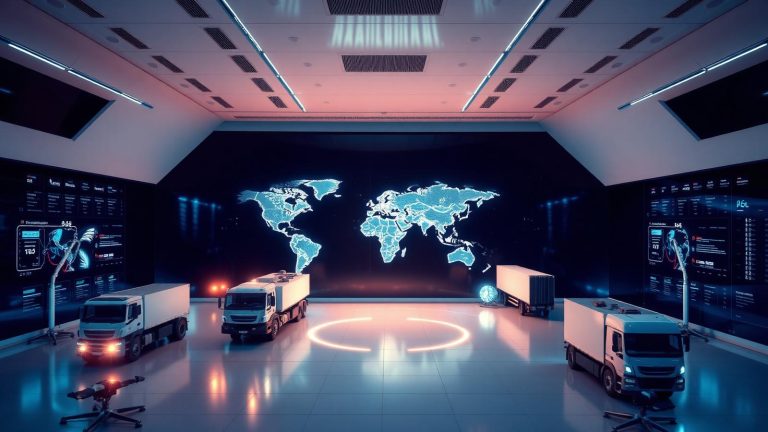
It’s 4:47 AM on a Tuesday. A critical link in your supply chain goes down—a sudden labor strike at a port handling 40% of your inbound freight, or a severe weather anomaly grounding regional air cargo. In a traditional supply chain, the next four days spiral into manual data pulls, spreadsheet reconciliation, delayed vendor communications, and reactive, highly expensive rerouting. Every decision happens under pressure with stale data.
In an AI-native autonomous supply chain, the response happens in seconds. The disruption signal triggers a background agent. It evaluates alternative carriers, recalculates network capacities, checks the financial health of backup suppliers, initiates a new purchase order, updates the warehouse management system (WMS), and alerts the end customer with a revised ETA. The team arrives at the office to a stabilized situation with a complete audit trail of the machine’s decisions.
The disruption is identical. The outcome difference relies entirely on the software architecture.
At iStudio Technologies, we operate as a specialized AI logistics software development company. We do not bolt generative chatbots onto legacy systems. We architect, build, and deploy agentic AI infrastructures that transition enterprise 3PLs, freight forwarders, and global manufacturers from reactive monitoring to autonomous, self-healing execution.
The 2026 Logistics Paradigm: The Death of the Dashboard
For the last decade, supply chain software vendors promised “visibility.” Dashboards proliferated. Control towers aggregated data from Electronic Data Interchange (EDI), Telematics, and Enterprise Resource Planning (ERP) systems.
But visibility without execution just means watching your supply chain fail in high definition.
When a ship is delayed, a dashboard flashes red. A human operator still has to log into the Transportation Management System (TMS), call the carrier, email the warehouse floor manager to adjust labor schedules, and update the CRM. By 2026, human-speed execution is the primary bottleneck in global logistics.
Enter Agentic AI
We have moved past predictive analytics. Predictive AI tells you a container will be three days late. Agentic AI is an autonomous software construct that possesses perception, reasoning, and the authority to act. It detects the delay, evaluates the cost of an air-freight expedite against the penalty of missing a Service Level Agreement (SLA), selects the mathematically optimal path, and executes the API calls to make it happen—all within predefined financial guardrails.
This is the baseline for modern supply chain software development. If your systems require a human to manually approve standard operational adjustments, your architecture is obsolete.

Competitor Analysis: Custom Architecture vs. Off-The-Shelf AI
When executives look to integrate AI into their logistics operations, they often evaluate massive enterprise suites or generic AI vendor plugins. While these platforms offer robust out-of-the-box forecasting, they suffer from structural rigidities when applied to highly specialized or legacy-heavy environments.
Where Generic AI Fails the Enterprise
The Custom Data Model Gap
Generic AI products assume your data fits their schema. If your company relies on a heavily modified AS400 mainframe, bespoke IoT sensor arrays, or non-standard partner EDI feeds, off-the-shelf agents fail to contextualize the data accurately.
Generalized Reinforcement Learning
Pre-packaged AI models are trained on generalized supply chain data. They do not understand the specific micro-economics of your warehouse labor costs, your unique carrier contracts, or your specific risk-tolerance thresholds.
The "Black Box" Problem
Many SaaS AI tools provide recommendations without exposing the underlying logic. In logistics, if a system automatically spends $50,000 to reroute freight, the operations director needs complete mathematical traceability as to exactly why that decision was made.
The Custom Software Advantage
As a custom AI logistics software development company, iStudio Technologies builds agentic architectures directly around your proprietary data and operational physics. We deploy open-source and fine-tuned models directly within your private cloud infrastructure, ensuring data sovereignty, absolute traceability, and zero vendor lock-in.
Core Architectural Frameworks for AI-Native Logistics
Building an autonomous supply chain requires fundamentally restructuring how applications communicate. It is not a single monolith; it is an ecosystem of specialized agents, connected through an event-driven architecture.
1. Multi-Agent Orchestration Layers
Instead of one massive AI trying to run the whole company, we build Multi-Agent Systems (MAS). These are networks of specialized, narrow AI agents that negotiate with each other to solve complex routing and inventory problems.
The Procurement Agent
Continuously monitors raw material pricing, geopolitical news feeds, and supplier risk scores.
The Inventory Agent
Monitors warehouse capacity, holding costs, and SKU velocity.
The Transport Agent
Tracks fleet availability, spot market freight rates, and weather patterns.
If the Procurement Agent detects a supplier delay, it signals the Inventory Agent. The Inventory Agent calculates if safety stock will cover the gap. If not, it signals the Transport Agent to find an expedited carrier for a secondary supplier. They negotiate the optimal balance between freight cost and stockout penalties, executing the transaction via REST webhooks.

2. Operational Digital Twins
You cannot let autonomous agents practice on your live supply chain. We build Operational Digital Twins—high-fidelity, real-time mathematical simulations of your physical network.
Using Graph Neural Networks (GNNs), we map every supplier, port, warehouse, and customer as a node. The edges between them represent transit times, costs, and capacities.
Before an agent executes a massive inventory reallocation, it simulates the decision within the Digital Twin thousands of times using Monte Carlo simulations. This allows the system to stress-test routing algorithms against potential disruptions (e.g., simulating a 30% fuel price spike or a canal blockage) and deploy the policy with the highest probability of success.
3. Edge AI for Hyper-Local Execution
Not all AI can live in the cloud. For warehouse robotics, sorting facilities, and driver telematics, latency is the enemy.
We develop and deploy quantized Machine Learning models directly onto edge devices—industrial scanners, forklift IoT terminals, and truck telematics units. This allows a warehouse camera system to use computer vision to identify a damaged package, classify the severity, and route it to a QA station in milliseconds, without waiting for an API call to a centralized server.
Strategic Use Cases: How Agentic AI Executes in Production
When we architect custom supply chain software, we focus on deploying AI against high-volume, high-friction operational workflows. Here is how these systems operate in the wild.
Dynamic Rerouting and Self-Healing Networks
Traditional routing optimization relies on static parameters: distance, speed limits, and average unloading times.
We build dynamic routing engines utilizing Reinforcement Learning (RL). The system treats the supply chain like a complex game board. It ingests real-time telemetry—port congestion indices, bridge closures, weigh station delays, and spot-market carrier capacity.
If a truck breaks down en route to a micro-fulfillment center, the agent doesn’t just alert a dispatcher. It immediately calculates the exact SKUs on the truck, assesses the inventory levels at the destination, cross-references nearby third-party carriers, dispatches a replacement vehicle via an automated API call, and adjusts the delivery promises for the end consumers. The network heals itself before the customer knows there was a problem.
AI Copilots for Warehouse Floor Orchestration
Warehouse Management Systems typically use static rules for wave planning and picking. This breaks down during demand spikes or labor shortages.
iStudio Technologies develops AI Copilots for warehouse managers. These systems ingest live data from IoT hardware, employee RF scanners, and incoming truck ETAs.
Predictive Slotting: The AI continuously analyzes order velocity. If a specific SKU suddenly trends in regional sales, the system proactively directs forklifts to move pallets from reserve storage to forward-picking locations before the shift starts.
Dynamic Task Interleaving: Instead of a picker walking back empty-handed after dropping off a load, the agentic AI assigns the closest, highest-priority task (like a put-away or a cycle count) based on the worker’s exact X/Y coordinates in the facility. This eliminates dead travel and increases labor efficiency rapidly.
Autonomous Procurement and Supplier Risk Management
Master data hygiene is the foundation of global trade, yet most companies rely on outdated supplier health scores.
We engineer Risk Management Agents that continuously scrape global data structures. They monitor weather satellites for crop yields, financial filings for vendor bankruptcy risks, and maritime databases for port strikes.
If the agent detects a high probability of disruption for a Tier 2 supplier in Vietnam, it automatically flags the vulnerability, pulls up pre-vetted secondary suppliers in Mexico, compares the landed costs, and drafts a purchase order for human approval. For low-value commodities, the system is granted full autonomy to execute the PO and secure the inventory.
The iStudio Technologies Engineering Stack
Enterprise logistics requires zero downtime. The architecture must be fault-tolerant, highly concurrent, and secure. We do not rely on low-code wrappers. We build from the ground up using a modern, scalable tech stack.
Data Ingestion & Normalization Layer
Supply chain data is inherently messy. You have flat files from old vendors, XML from customs agencies, and JSON from modern APIs.
Event Streaming: We use Apache Kafka to handle millions of real-time events (GPS pings, temperature sensor drops, scan guns) without dropping a single packet.
Data Lakehouse: We deploy architectures on platforms like Databricks, combining the structured ACID transactions of a data warehouse with the unstructured capabilities of a data lake. This provides a unified, clean layer for the AI to train on.
Model Deployment & Orchestration
LLMs for Unstructured Data: We deploy fine-tuned open-weight models securely within your Virtual Private Cloud (VPC). These models excel at reading unstructured customs documents, emails from carriers, and messy commercial invoices, translating them into structured JSON data for the ERP.
Agentic Frameworks: We utilize advanced frameworks to build the reasoning loops and tool-calling capabilities that allow the AI agents to execute specific tasks.
Integration & API Gateways
An AI is only as powerful as the systems it can control. We build robust middleware to connect the intelligence layer to legacy infrastructure. Whether you are running SAP S/4HANA, Manhattan Associates WMS, or a custom AS400 system, we build secure, bidirectional API gateways to ensure the AI can both read state and execute commands.
Security, Governance, and Human-in-the-Loop Controls
A system capable of spending thousands of dollars in freight costs automatically requires military-grade governance. Trusting an autonomous system does not mean abandoning oversight.
We implement strict Human-in-the-Loop (HITL) architecture:
Financial Thresholds
An agent can automatically rebook freight up to a $5,000 premium. Anything higher triggers an immediate notification to a logistics manager with a one-click approval requirement.
Explainable AI (XAI)
Every action taken by the system generates a human-readable log. If the system chooses Carrier B over Carrier A, it logs the exact mathematical weighting (e.g., "Carrier A has a 42% probability of delay based on current weather patterns").
Role-Based Access Control (RBAC)
We utilize Zero Trust security models. Agents are only given the exact API permissions necessary to complete their specific function. An inventory agent cannot access HR or payroll data.
Building the Business Case: The ROI of Autonomous Logistics
The transition to agentic AI requires capital, but the cost of inaction is exponentially higher. When pitching a custom AI development project to the board, the ROI calculations fall into three hard metrics:
Reduction in Working Capital
By moving from static safety stock to dynamic, AI-managed inventory thresholds, enterprises routinely reduce on-hand inventory by 15-20% without impacting fill rates. This frees up millions in frozen capital.
Decreased Expedite Costs
Because agents detect disruptions days earlier than humans, they can route around the problem using standard freight rates rather than relying on last-minute, premium air freight.
Labor Arbitrage and Scalability
As order volumes grow, you do not need to scale your back-office headcount linearly. AI agents handle the routine track-and-trace, carrier follow-ups, and data entry, allowing your logistics professionals to focus on strategic carrier negotiations and network design.
According to 2026 industry forecasts, organizations that fail to adopt agentic workflows will operate with a severe cost disadvantage compared to AI-native competitors.
Moving Forward: The Architecture Audit
You cannot buy an autonomous supply chain off a shelf. It must be engineered into the DNA of your operations.
The journey starts with understanding your data readiness. At iStudio Technologies, our first engagement is a deep-dive Architecture Audit. We map your current WMS, TMS, and ERP connections. We identify the specific operational bottlenecks costing you money—whether it is yard congestion, poor forecasting, or manual data entry—and we design a phased technical blueprint to deploy agentic AI where it will deliver immediate cash-flow improvements.
According to 2026 industry forecasts, organizations that fail to adopt agentic workflows will operate with a severe cost disadvantage compared to AI-native competitors.
Phase 1: Data Integration & Cleansing
We build the pipelines to unify your fragmented WMS, TMS, and IoT data into a single, high-fidelity data lakehouse.
Phase 2: Predictive Foundation & Digital Twins
We model your physical supply chain in a graph database and deploy machine learning models to forecast demand and predict bottlenecks.
Phase 3: Agentic Deployment (Copilots)
We introduce AI Copilots that sit alongside your planners, offering highly accurate recommendations and drafting workflows.
Phase 4: Full Autonomous Execution
With guardrails firmly established, we grant the Multi-Agent System API access to execute low-risk, high-volume decisions automatically.
Ready to architect your autonomous supply chain?
Book a deep-dive Architecture Audit with iStudio Technologies.