
How to Build a RERA-Compliant Real Estate Website for Chennai Builders
The TNRERA disclosures your site must show, the features that bring enquiries, and honest INR cost ranges for 2026.
The short answer for Chennai builders
A rera compliant real estate website chennai builders can trust does four things before it does anything clever. It shows the project's TNRERA registration number, links to the project page on the TNRERA portal, states accurate project details and approvals, and captures buyer enquiries straight into your own system. Get those four right and the rest is design and marketing.
This guide is for Chennai builders, developers, and marketing leads. It maps every TNRERA disclosure to a real website element, walks through the build, gives honest INR cost ranges, and covers the 2025 advertising rules. A rera compliant real estate website chennai developers put live starts with treating the site as advertising under the Act.
In short: Your website is an advertisement under the RERA Act, so treat it like one. Put the registration number and a TNRERA page link on every project, keep the details honest, and give buyers an easy way to enquire. Final legal compliance is the promoter's responsibility, verified against TNRERA.
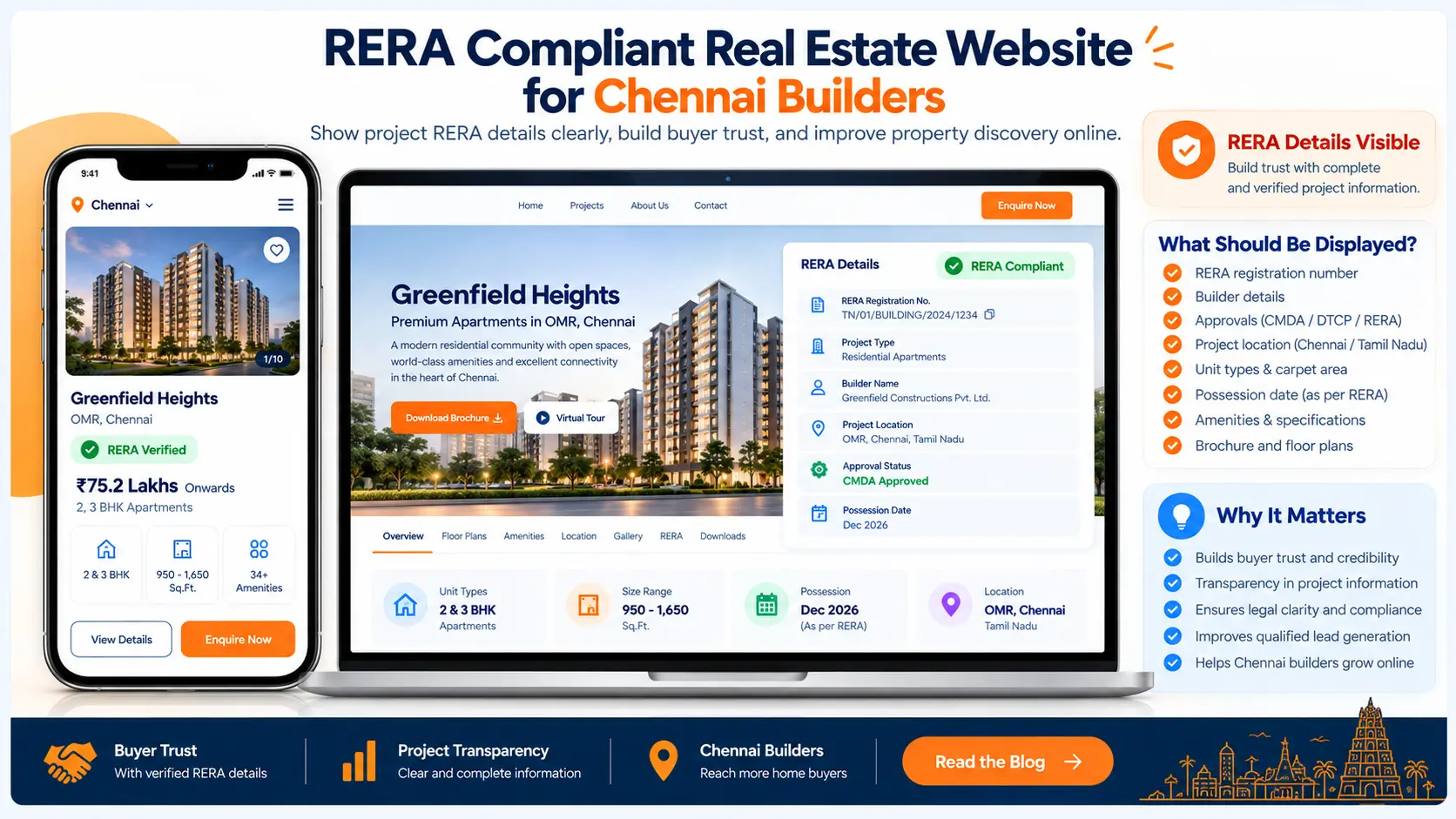
What a rera compliant real estate website chennai builders need actually means
A rera compliant real estate website is a builder's site that follows the disclosure duties the Real Estate (Regulation and Development) Act places on a promoter, applied to the place most buyers now look first. It is not a certificate you buy, but a set of honest, verifiable details shown where a buyer can see them.
The legal basis in plain language
The RERA Act, 2016 created state regulators to bring order to property sales. In Tamil Nadu that regulator is TNRERA. Section 11 sets out the promoter's duties, including keeping project details current on the Authority's portal and carrying the registration number and the Authority's website address in advertisements, as the regulator's own rights and duties of a promoter text spells out. List a project online with prices, plans, and a "book a site visit" button, and you are advertising a registered real estate project, so the same disclosure logic applies.
Your website is advertising under the Act
A Chennai buyer searches, lands on your project page, and judges you in seconds. TNRERA's 2025 advertising order treats ads broadly, naming hoardings, print, brochures, flyers, bus-shelter boards, and digital posts. A rera compliant website for builders builds those disclosure habits into the template so every project page is clean by default.
Compliance and marketing on the same page
Builders sometimes treat compliance as the boring tax on a pretty website. That framing costs you. The registration number, the TNRERA link, and the honest carpet area are trust signals a cautious buyer looks for in 2026, so a real estate website design chennai team puts the RERA details block where it reassures and sells.
The TNRERA disclosure checklist your website must display
Here is the practical core of the page. Display the items below where a buyer and the regulator can both find them. Treat it as a checklist you can hand to whoever builds the site. These tnrera website requirements follow the RERA Act and TNRERA's guidance; confirm the exact current wording on rera.tn.gov.in before you publish, because the promoter carries the legal responsibility.
| Disclosure item | What it is | Where it lives on the site | Basis / verify |
|---|---|---|---|
| RERA registration number | TNRERA project registration number | Project header, footer, every ad | RERA Act Section 11(2) |
| TNRERA page link | Link to the project on rera.tn.gov.in | RERA details block and footer | Section 11(2), Authority website address |
| Project details | Unit or plot types, units, status | Project page and listing | TNRERA portal upload |
| Approvals | Approvals taken and pending | Project approvals sub-section | TNRERA project disclosure |
| Carpet area | Carpet area per unit type | Floor plan and unit spec block | RERA carpet-area definition |
| Approved plans | Sanctioned layout and plans | Project documents section | TNRERA project disclosure |
| Promoter details | Name, office address, contact | About and project page | TNRERA July 2025 ad order |
| QR code | QR linking to the TNRERA project page | Project page and all ads | July 2025 order [verify against TNRERA] |
Project and promoter disclosures
On each project page, lead with the registration number and the TNRERA link. State the unit or plot types, number of units, current status, and the approvals on record, and if an approval is pending, say so. Add the promoter name, office address, and a working contact on the About and project pages, as TNRERA's 2025 order requires. Keep the tnrera registration number on website pages current whenever status changes.
QR code and the TNRERA page link
TNRERA's July 2025 advertising order requires the registration number and a QR code linking to the project's TNRERA page, placed at the top-right of ads in a readable font. Because your website advertises the project, treat a working rera qr code on real estate website pages as the safe default, and confirm the precise page-type application with TNRERA [verify against TNRERA].
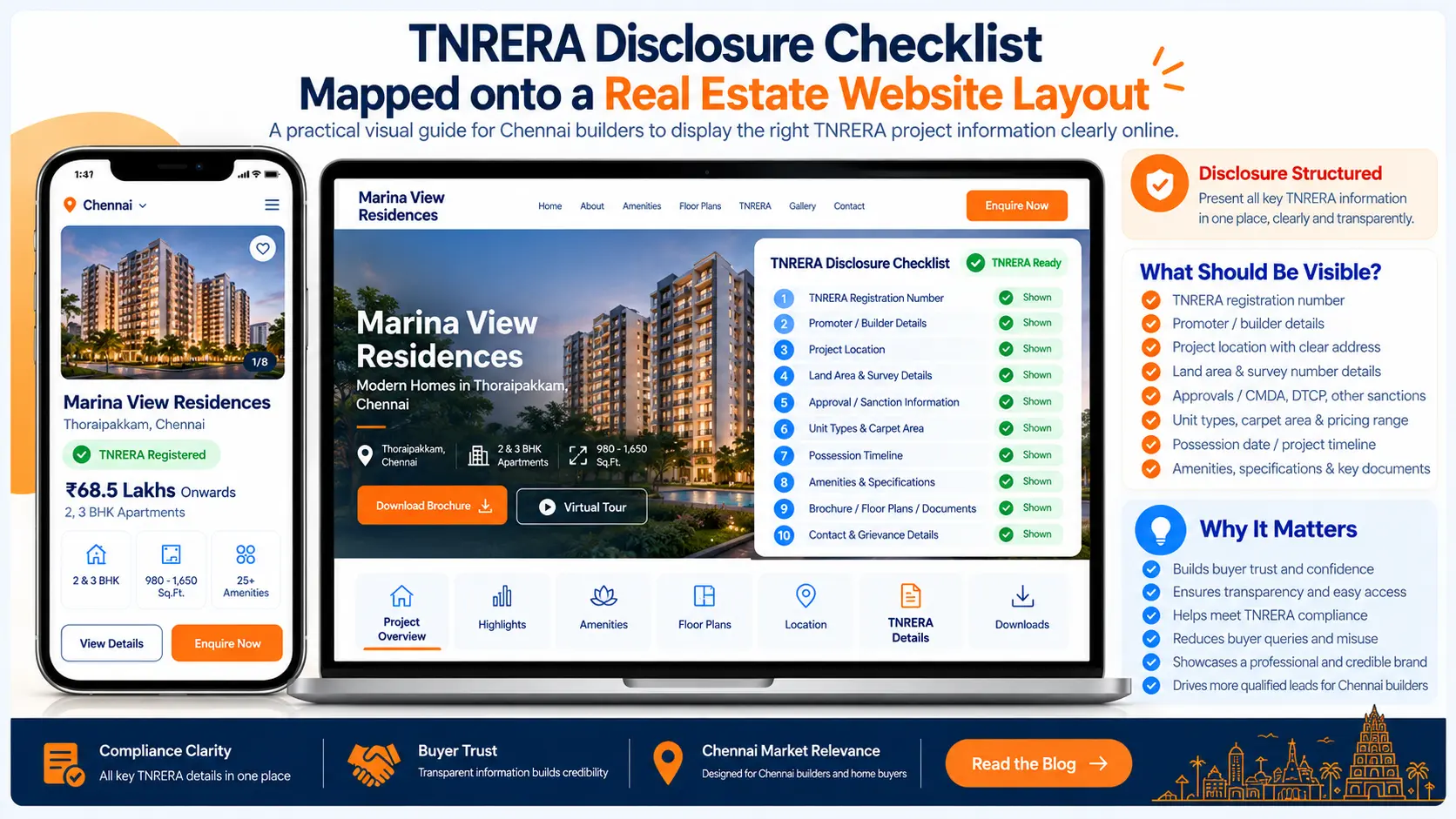
Core features of a real estate website for builders
Compliance keeps you safe. Features sell homes. A strong real estate website for builders chennai developers use pairs the RERA details block with the tools a buyer needs to shortlist and enquire, which is the real point of real estate website development chennai teams get hired for.
Project and property listing pages
The listing page is the content model of the whole site. Each project is a record with a name, locality, status, price band, unit types, the RERA details block, a gallery, and an enquiry action. Get the data model right and search, filters, and related projects slot in cleanly, which is the backbone of property listing website development in chennai.
Floor plans, galleries, and virtual tours
Buyers want to picture the home. Clear floor plans with the carpet area labelled, a fast image gallery, and an optional virtual tour do more for conversion than any slogan. Label the carpet area honestly, since it doubles as a RERA disclosure.
Search and filter
A Chennai buyer thinks in localities and budget. Let them filter by area (OMR, Velachery, Porur, Tambaram, Guindy), budget band, BHK, and status. Good property search filters turn a browser into a shortlist in under a minute.
EMI calculator and buyer tools
Small tools earn trust. An EMI calculator, a cost-of-ownership note, and a gated brochure each nudge a serious buyer closer. Keep them fast and honest rather than heavy.
Lead capture: turning visitors into site visits and off the portals
A pretty site that collects nothing is a brochure. The reason to own your website is lead capture, with the bonus of less dependence on portal commissions.
Enquiry forms, WhatsApp, and site-visit booking
Give a buyer three ways to act: a short enquiry form, a WhatsApp button, and a site-visit booking slot. A real estate website with lead capture chennai builders rely on keeps the form to a few fields, fires an instant acknowledgement, and drops the lead where the sales team will see it. The site visit booking feature real estate website pages carry is often the highest-intent action on a real estate website for builders chennai developers run, so make it one tap.
Why owning the site reduces portal dependence
Listing portals bring reach, but they take a cut and keep the relationship with the buyer. Every enquiry through your own pages is a lead you own, with data you keep. The portal is rented reach; your website is an asset.
Tracking and following up leads
Wire the forms into a simple CRM or a shared sheet with WhatsApp handoff, tag the source, and track which localities and projects pull enquiries. That feedback loop turns a real estate website design chennai project into a sales channel.
Want your project pages to capture enquiries directly instead of feeding a portal? Tell us your project count.
WhatsApp +91 88070 03902How to build a rera compliant real estate website, step by step
Here is the build sequence we follow for a rera compliant website for builders. It works whether you choose WordPress or a custom stack, and it keeps compliance in from day one rather than bolted on at the end.
- Confirm your TNRERA registration details and gather approvals. Pull each project's registration number, TNRERA page link, sanctioned plans, approvals taken and pending, and carpet areas. This is the source of truth the whole site quotes. If a detail is not confirmed on the portal, do not publish it.
- Plan the site structure and project content model. Decide the fields every project record holds, the listing and filter logic, and the fixed pages. Map the RERA details block as a reusable component so it appears identically on every project.
- Choose the platform, WordPress or custom. For one or a few projects, WordPress is fast and maintainable. For many projects with portal-style search, a custom build pays off. More on that tradeoff below.
- Design responsive project templates with the RERA details block. Build mobile-first, since most Chennai property searches happen on a phone. The RERA details block, with the registration number, TNRERA link, and QR code, sits in a fixed, visible spot on every template.
- Build lead capture, search, and the compliance footer. Wire the enquiry form, WhatsApp action, and site-visit booking. Add search and filters. Put the registration number and TNRERA link in the global footer so it rides on every page.
- QA the disclosures, test speed, then launch and index. Check every project page shows the correct registration number and a working TNRERA link and QR code. Test Core Web Vitals, submit the sitemap, and confirm indexing. A wordpress real estate website for builders passes the same disclosure and speed checks as a custom one.
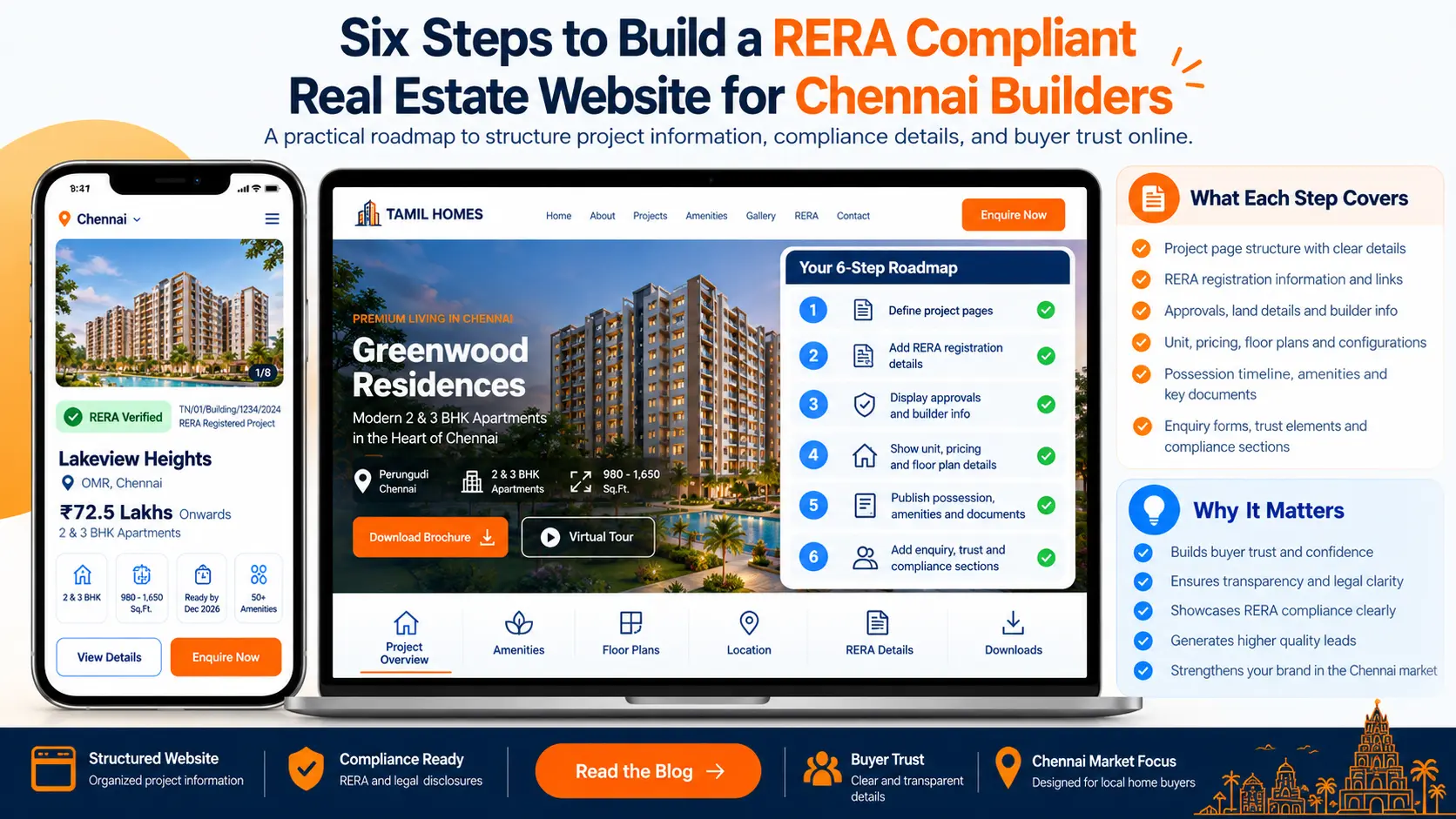
WordPress vs custom build for a builder website
There is no universal winner, only a fit for your situation. This is the property website development chennai decision most builders agonise over, so here is the honest version.
When WordPress is the right call
If you have one project or a handful, want to launch in weeks, and will update content yourself, WordPress is usually the pragmatic pick. Mature real estate themes and plugins give you listings, filters, and enquiry forms without building from scratch, and your team can edit pages without a developer. The tradeoff is working within the theme's limits and keeping plugins updated.
When a custom property portal is worth it
Once you run many projects, with heavy listing volume, agent or builder logins, map-based search, or verification workflows, a custom build earns its cost. This is real estate portal development chennai territory: a tailored data model, search that scales, and performance you control. It costs more and takes longer, but for a large operator it is the right call, and for a single project it is usually overkill.
The honest test: count your projects and update frequency. Few projects point to WordPress; many projects and portal-grade search point to custom.
Real estate website development cost in Chennai: honest INR ranges
Budget is the question everyone asks and few answer straight. These are market-based estimates for a Chennai build in 2026, not iStudio's quoted prices. Scope moves the number more than anything, so each range comes with what changes it.
Brochure vs multi-project vs full portal
| Build tier | Typical INR range (2026, est.) | What you get |
|---|---|---|
| Brochure / single-project site (WordPress) | ₹35,000 to ₹1,00,000 | A few project pages, enquiry form, RERA details block, responsive |
| Multi-project site with search and lead capture | ₹1,00,000 to ₹3,50,000 | Multiple templates, filters, EMI calculator, site-visit booking, basic CRM |
| Full custom property portal (Housing / 99acres style) | ₹5,00,000 to ₹20,00,000+ | Logins, large listing volume, advanced search, maps, verification |
These bands sit on the broader Indian market curve. General business websites in India run roughly ₹50,000 to ₹2,00,000, and custom web applications ₹2,00,000 to ₹15,00,000 or more in 2026, so a real estate website development cost in chennai quote tracks that national curve rather than sitting above it. Real estate adds listing data, filters, and compliance detail, which is why a builder site with real search lands above a plain brochure.
What changes the price
Number of projects and listings, WordPress versus custom, design complexity, integrations (CRM, payment, maps, WhatsApp), content and photography, SEO scope, and ongoing maintenance all move the figure. A website design for real estate developers in chennai with ten live projects and map search differs from a single-tower launch page, so builder website design chennai quotes should reflect that scope, not a flat template rate.
Want a fixed figure for your exact scope? Send your project count and the features you need.
WhatsApp or call +91 88070 03902Advertising and compliance rules to respect in 2025 and 2026
Compliance is not a one-time task at launch. The rules tightened in 2025, and a builder website has to keep pace.
The 2025 TNRERA advertising tightening
In July 2025 TNRERA issued an order cracking down on misleading real estate ads. It requires the RERA registration number and a QR code at the top-right of ads in a readable font, covering hoardings, print, brochures, flyers, bus-shelter boards, and digital posts, as the Times of India reported. It also requires the promoter name, office address, and contact, and bars misleading distance and price claims. Since your website advertises registered projects, build these into your templates.
QR code and registration-number display
TNRERA later backed the order with graded penalties, with larger fines for advertising unregistered projects or for missing, unreadable, or misleading registration numbers and QR codes. A compliant builder site therefore carries a working registration number and QR code on every project page. The nuance to confirm with your legal advisor is how the ad order maps to each page type on a site, which is why we mark it [verify against TNRERA].
Keeping the site compliant after launch
Project status changes as approvals come through and units sell. Set a quarterly check to reconcile every project page against the live TNRERA portal, update status and approvals, and confirm each QR code still resolves. You can verify any project on the TNRERA official portal. Compliance is a maintenance habit.
Why work with a Chennai web design company for your real estate website
You can hire a team anywhere, so here is the honest local case.
Local understanding of TNRERA and Chennai micro-markets
A real estate web design company in chennai sits inside the market it builds for. We know the TNRERA portal, the 2025 ad order, and the micro-markets a builder sells into: an OMR IT-corridor launch reads differently from an Anna Nagar redevelopment or an ECR villa plot. A web design company in chennai that knows Velachery, Guindy, Porur, Adyar, and T. Nagar as buyer search terms builds filters and copy that match how Chennai buyers search.
In-house team, no outsourcing
We are iStudio Technologies, based in Valasaravakkam, Chennai, with 17+ years behind us and 500+ projects delivered. Design, development, SEO, and support sit under one roof, so the people who build your rera compliant real estate website chennai project also tune its page speed and fix it when a status changes. We will tell you which platform fits and put the real estate website development company in chennai for builders figure for your scope in writing. We do not promise rankings or a fixed lead count, and final legal compliance stays the promoter's responsibility, verified against TNRERA.
Frequently asked questions
Does a builder legally need to show RERA details on their own website in Chennai?
What must a rera compliant real estate website chennai builders run actually display?
WordPress or custom development for a Chennai builder website, which is better?
How long does it take to build a real estate website for builders in Chennai?
How much does a real estate website development project cost in Chennai?
Do I need a QR code and TNRERA registration number on my property website?
Can one website list multiple RERA-registered projects?
Will my own website reduce dependence on portals like 99acres and Housing?
Explore more from iStudio
More of our work and writing that connects to a RERA-compliant real estate build, grouped by service, industry, and topic.
By service
- Web design company in Chennai, where every builder website build starts.
- Web development company in Chennai for custom portals and integrations.
By industry
- Real estate portal development in Chennai, for multi-project listing platforms.
- Website design for interior designers in Chennai, an adjacent property-sector build.
By topic
- SEO for real estate companies in Chennai, to help buyers find your new site.
Get a fixed quote for your RERA-compliant builder website
Tell us your project count, your localities, and whether you need a multi-project search. We will scope it honestly, build the TNRERA details block in from day one, and put the number in writing.
WhatsApp or call +91 88070 03902