
What Does It Cost to Build a Logistics Fleet Tracking Dashboard?
Honest 2026 rupee tiers for a custom fleet tracking dashboard in India, what pushes the price up, what it costs to run after launch and when buying beats building.
Fleet Tracking Dashboard Development Cost: The Short Answer
A custom logistics fleet tracking dashboard typically costs about ₹3 lakh to ₹7 lakh for a basic live-map version, ₹7 lakh to ₹18 lakh for a standard version with alerts, reports and a driver app, and ₹18 lakh to ₹45 lakh or more for an advanced version with route intelligence and integrations with your transport or ERP systems. Tracking devices, SIM data and yearly running costs are extra.
We are a Chennai software company that builds logistics and tracking software. This guide explains what a dashboard includes, where its location data comes from, what each tier buys, what changes the price, what you pay after launch and when it is cheaper to buy a subscription instead.
All figures are 2026 market estimates for planning, not a quote. A real quote needs your vehicle count, device types and workflow. Use these ranges to judge whether a proposal is sensible, then ask for a fixed scope in writing.
Planning a fleet tracking dashboard? Message our team on WhatsApp or call +91 88070 03902 with your vehicle count, current devices and what you want to see on the screen, and we will scope it with you.
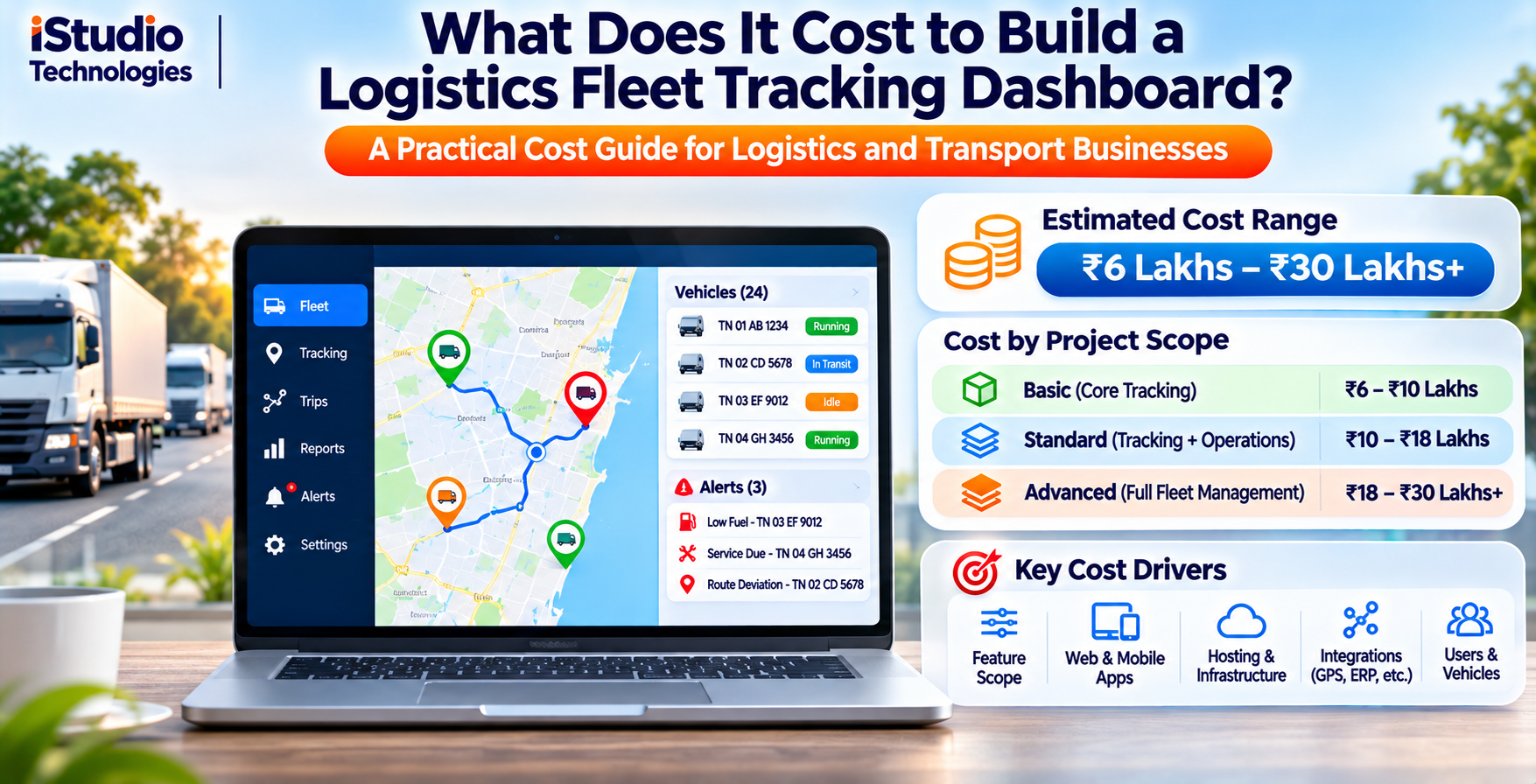
What a Fleet Tracking Dashboard Actually Includes
Before you can estimate fleet tracking dashboard development cost, you need to know what the dashboard does. Owners often say "live tracking" and mean ten different things, and each adds work.
| Module | What it does | Effort |
|---|---|---|
| Live map | Shows each vehicle's position, direction and status, refreshed regularly | Core; every tier |
| Trip history and playback | Replays past routes with stops, speeds and times | Core; storage grows with data |
| Alerts | Warns on idling, over-speeding, route deviation, long stops, device offline | Moderate; rules take design |
| Geofences | Triggers on entering or leaving depots, customer sites or no-go zones | Moderate |
| Vehicle and driver records | Documents, expiry reminders, assignments, trip logs | Moderate |
| Reports | Distance, running and idle time, stop reports, driver and vehicle summaries, exports | Moderate to high |
| Roles and access | Branch, manager and customer views with different permissions | Moderate; important for security |
| Driver app | Trip start and end, proof of delivery, phone-based tracking | High; separate mobile build |
| Integrations | Links to TMS, ERP, billing, customer tracking links and notifications | High; depends on the other system |
Write your own version of this list, mark each item as must-have, nice-to-have or later, and ask every vendor to price from that same list. It is the quickest way to compare quotes fairly.
Who Looks at the Dashboard
A dispatcher wants a busy, detailed screen. A transport owner wants a daily summary on a phone. A customer wants a simple link with an arrival time. Each audience adds screens and permissions, so decide early whether the dashboard is internal only or also customer-facing. Customer-facing tracking links usually raise the cost because they need stricter security and a polished design.
Think about the phone as well as the desktop. Owners and branch managers often check the fleet on a phone between meetings, so a clean mobile view of the key numbers, such as vehicles running, vehicles idle and alerts today, can matter more than a dense control-room screen that only the dispatcher opens.
Where Your Location Data Comes From
Data sources shape fleet tracking dashboard development cost more than owners expect, because the dashboard is only as good as the signals feeding it. There are three common sources, and many fleets use a mix.
- GPS tracking devices. A device fitted in each vehicle sends position over a mobile network. Different brands use different data formats, so your software must understand each one. Every extra device type adds integration work.
- Data from an existing provider. If a telematics or device provider already collects your data, you may be able to pull it into your own dashboard through their programming interface, subject to their terms and fees.
- The driver's phone. A driver app can report location without extra hardware. It is cheaper to start, but it depends on the driver keeping the app running, the phone charged and permissions granted, so it is less dependable than a fitted device.
- Extra sensors. Fuel, temperature and door sensors add useful data and extra parsing, alerts and reports.
Why Update Frequency Matters
The more often a device reports, the smoother the map and the larger the data. As a simple illustration, a vehicle that reports every 10 seconds sends 8,640 positions a day. For 100 vehicles that is 864,000 positions a day, or roughly 26 million a month. Slower reporting cuts storage, processing and network costs, but makes the map less precise. Choose the frequency that fits the decision: a long-haul truck rarely needs a ping every 10 seconds, while a last-mile delivery may.
Hardware Is a Separate Budget
Tracking devices, installation and SIM data plans are not part of the software build. As a rough planning figure, a basic tracker costs a few thousand rupees per vehicle, and certified or sensor-equipped devices cost more, plus a monthly data charge. Get current quotes from device suppliers, and make sure the devices you choose can send data to your platform.
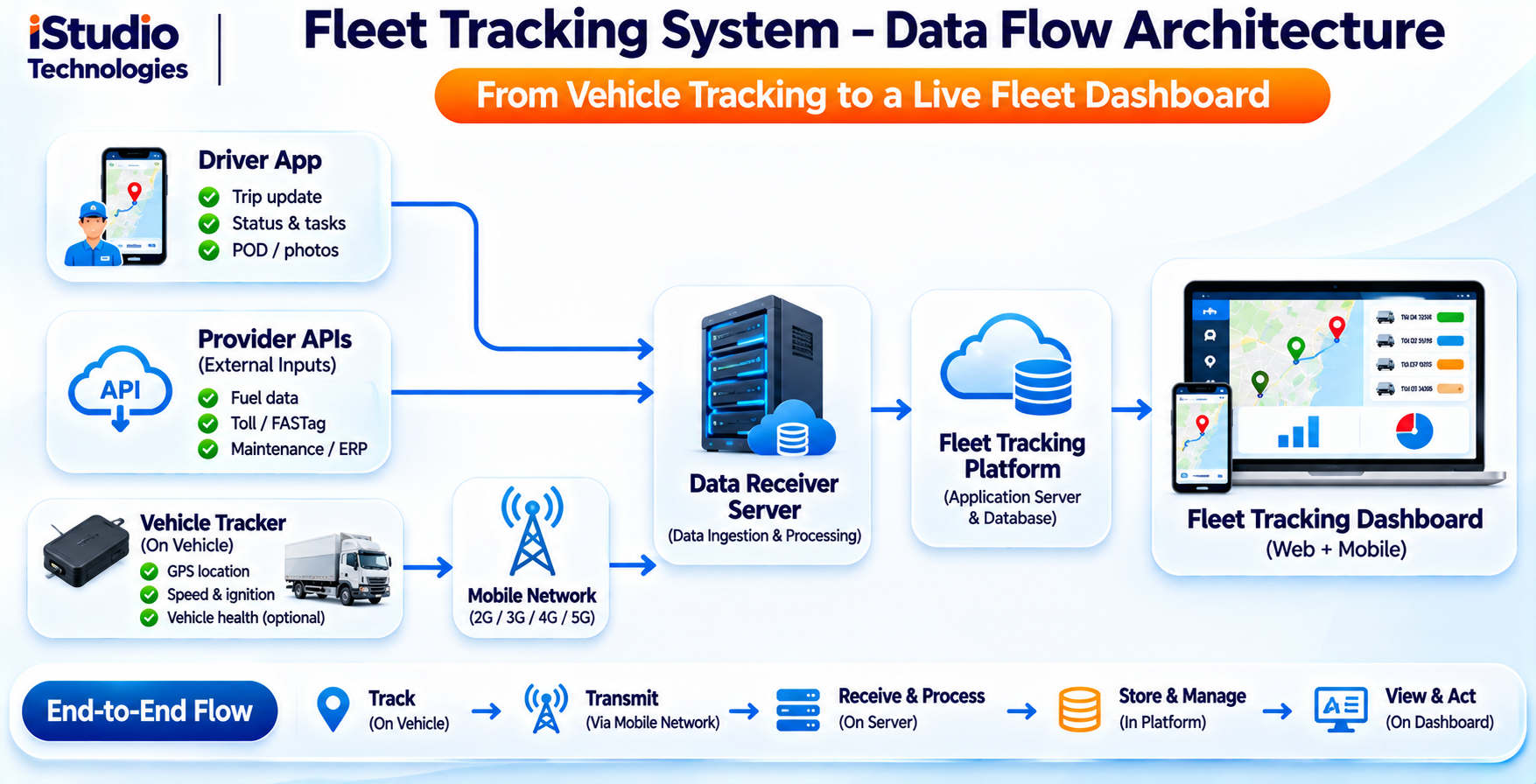
Cost Tiers: What Each Level Buys
The fleet tracking dashboard development cost bands below track what Indian software teams commonly quote in 2026 for similar scope. Treat each as a planning range and not a fixed price.
| Tier | What it includes | One-time cost (2026) | Typical timeline |
|---|---|---|---|
| Basic | Live map, vehicle list, trip history and playback, simple alerts, one device source, user logins, basic reports | ₹3 lakh to ₹7 lakh | 8 to 12 weeks |
| Standard | Basic plus geofences, a configurable alert engine, vehicle and driver records, more report types, roles, driver app and two or three device types | ₹7 lakh to ₹18 lakh | 12 to 24 weeks |
| Advanced | Standard plus route and ETA intelligence, sensor data, TMS or ERP integration, customer tracking links, multi-branch or multi-tenant design and open APIs | ₹18 lakh to ₹45 lakh or more | 24 to 40 weeks |
Not included: tracking devices and installation, SIM and data plans, map and messaging usage fees, and yearly hosting and support. Those are covered below.
How to Read the Ranges
The low end assumes a clear scope, one or two device types, standard screens and quick decisions from your side. The high end assumes several device formats, custom reports, tricky integrations or strict security needs. If a quote falls far below the range, ask what has been left out. If it sits far above, ask which feature is driving the difference.
Start Smaller Than You Think
Many fleets begin with the basic tier for a pilot of ten or twenty vehicles, learn what dispatchers actually use, and then add alerts, the driver app and integrations in stages. A staged build spreads the cost and avoids paying for screens nobody opens.
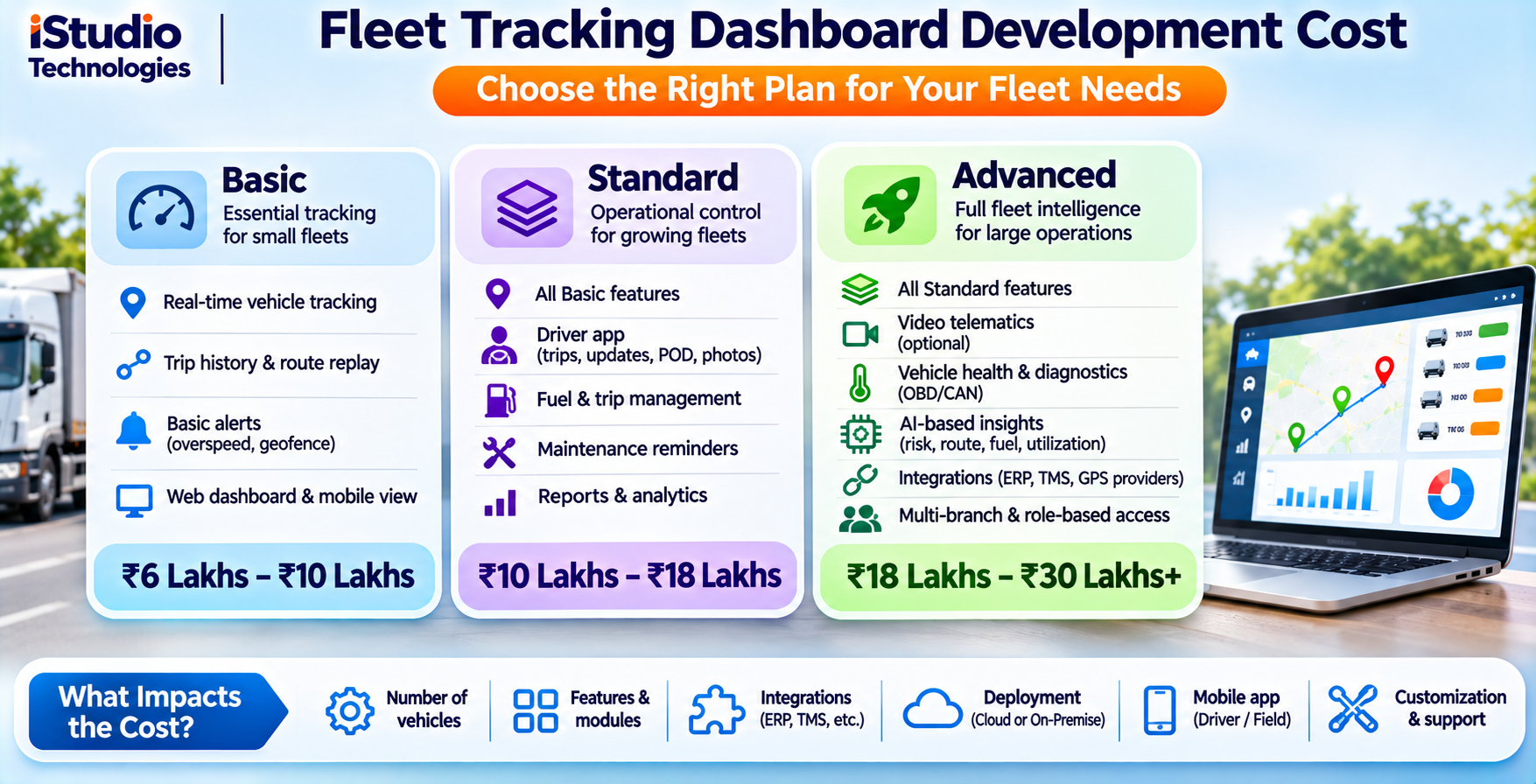
What Moves the Price Up or Down
Several factors push fleet tracking dashboard development cost up or down, and you control most of them. Discuss each openly with any vendor.
- Number of device types. Each data format needs its own receiver and testing. One format is far cheaper than five.
- Vehicle count and update frequency. They decide how much data the system must receive, store and display, which affects architecture and hosting.
- Alert complexity. A simple speed limit is easy. Rules that combine time, place, load and driver take real design and testing.
- Reports. Standard reports are quick. Custom, scheduled and exportable reports across branches take longer.
- Mobile apps. A driver app for Android alone costs less than Android and iPhone, and offline behaviour adds more.
- Integrations. Linking to a TMS, ERP or billing system depends on the other system's quality and documentation.
- Multi-branch or reseller design. If different branches or your customers see only their own vehicles, the data model and permissions become more complex.
- Design and branding. A custom interface in your brand costs more than a clean standard layout.
- Security and uptime. Audit logs, backups and high availability for a large fleet add engineering time.
A cost-saving route that works well: reuse trusted components, such as a standard map library, for the screens everyone has, and spend your budget on the rules and reports that are unique to your business.
Running Costs After Launch
Plan for running costs, because fleet tracking dashboard development cost is only part of the total. A dashboard that tracks vehicles all day keeps spending after launch.
- Hosting and storage. Servers, databases and backups grow with the volume of positions you keep. Decide how long to keep detailed history and archive older data cheaply.
- Map usage. Map services bill by usage. Google Maps Platform, for example, prices each core service per billable event, with monthly free usage that varies by service, as its India pricing page explains. Rates and free thresholds change, so check the current page before you budget.
- Alerts by SMS or WhatsApp. Messaging providers charge per message, so plan how many alerts you really need.
- SIM and data plans. Each tracker needs connectivity, charged monthly per device.
- Device replacement. Devices fail, get damaged or are stolen, and need replacing.
- Support and updates. Bug fixes, security patches, new reports and changes to phone operating systems need a maintenance plan.
As a planning estimate, budget roughly ₹40,000 to ₹4 lakh a year for hosting, support and updates, depending on fleet size and tier, plus the per-vehicle costs for SIMs and messages. Ask any vendor for a written estimate of yearly running costs next to the build quote, and treat a vendor who will not give one as a warning sign.
Treat the first year as a learning period. Real usage shows which alerts your team acts on, which reports get opened and how much data you really store. Review the bills every quarter, switch off alerts nobody reads, and adjust the update frequency per vehicle type, because small changes here can lower the monthly bill without hurting the service.
Build, Buy or Hybrid?
Compare fleet tracking dashboard development cost with subscription fees over at least three years, not one. A subscription looks cheap in month one and can cost more than a build by year three, but a build costs more up front and needs upkeep.
A Simple Way to Compare
Multiply the monthly fee per vehicle by the number of vehicles and by 36 months. For arithmetic only, suppose a hypothetical subscription of ₹300 per vehicle per month for 200 vehicles: ₹300 x 200 x 36 is ₹21.6 lakh over three years. That is not a market price, so replace it with real quotes. Then add the build cost and three years of running costs for the custom option, and compare the totals along with the value of owning your data and features.
| Option | Good when | Watch out for |
|---|---|---|
| Ready-made subscription | Your needs are standard and the fleet is small | Per-vehicle fees that grow with the fleet, limited customisation, data you cannot easily export |
| Custom build | You have unusual workflows, a large or growing fleet, or you want to resell tracking or integrate deeply | Up-front cost, ongoing upkeep and the need for a trustworthy team |
| Hybrid | You want standard tracking now and custom reports or integrations later | Dependence on the provider's data access terms |
Questions to Ask Before You Decide
- Can I export all my data, in a usable format, at any time?
- Will the system work with the devices I already own?
- Who owns the source code and the data?
- What happens to my service if the vendor closes?
- How will costs change if my fleet doubles?
We will tell you honestly when a ready-made product is the better choice. Custom software makes sense when it earns its extra cost through savings, control or a product you can sell.
Rules and Data Privacy
Rules affect fleet tracking dashboard development cost too, because compliance features must be designed in, not added later. This is general guidance and not legal advice, so confirm the details with an adviser.
Vehicle Location Tracking Devices
The Ministry of Road Transport and Highways has mandated vehicle location tracking devices and emergency buttons for new public service vehicles registered on and after 1 January 2019 under rule 125H of the Central Motor Vehicles Rules, according to a Parliament reply. Devices must meet the AIS 140 standard, and states set up their own command centres and procedures. Whether your vehicles fall under the rule depends on their category and your state, so check before you buy devices. If you run goods vehicles, do not assume the rule covers them or exempts them.
Driver Privacy and Data Protection
India's Digital Personal Data Protection Rules were notified in November 2025, according to a Press Information Bureau release, and are being phased in. Location data tied to a named driver is personal data. Tell drivers what you track and why, track them only during duty, secure the data and limit who can see it. Keep a clear policy, and confirm what applies to you with an adviser.
- Use role-based access, so a branch manager sees only that branch.
- Keep an audit log of who viewed or exported tracking data.
- Set a retention period, and delete or archive old history on schedule.
- Share customer tracking links that expire and show only the one shipment.
Why Build with iStudio Technologies
We are iStudio Technologies, a software, web and mobile company in Valasaravakkam, Chennai, with 17+ years behind us, 500+ projects delivered and an in-house team that handles design, development, QA and support under one roof. For a fleet tracking dashboard development cost you can plan around, being local helps: we can visit your depot, watch your dispatchers work and design around how they really decide.
We tell you honestly whether to buy, build or mix the two. We do not promise a fixed percentage of fuel saved or deliveries improved, because outcomes depend on how you run your fleet. We do commit to a written scope with a tier you can compare, a system you own and a clear estimate of running costs next to the build quote.
What We Need from You
Projects move fastest when you share your vehicle count and types, the tracking devices you use or plan to use, the reports you produce today, the systems the dashboard must connect to, and the people who will use it. One dispatcher who can test early builds is worth more than a long specification.
Want a fixed-scope quote for your fleet dashboard? Tell us your vehicles, devices and must-have features.
WhatsApp +91 88070 03902Frequently Asked Questions
How much does it cost to build a fleet tracking dashboard in India?
How long does it take to build?
Do I need to buy new GPS devices?
Can a driver's phone replace GPS devices?
Is AIS 140 mandatory for my vehicles?
What are the yearly running costs?
Does iStudio Technologies build fleet tracking dashboards?
Related iStudio Technologies Services
More of our work that connects to fleet tracking, grouped by what you need next.
Logistics and Tracking
- Logistics software and mobile app development, the home for our fleet and dispatch work.
- Telematics solution provider in Chennai for vehicle and asset tracking.
Build
- Software development company in Chennai for custom dashboards and backends.
- Mobile app development company in Chennai for driver and customer apps.
Shipping and Web
- Container space optimization software for shipping and logistics.
- Web development company in Chennai for portals and customer tracking pages.
Get a Scoped Quote for Your Fleet Tracking Dashboard
Tell us your vehicles, devices and must-have features. We will recommend a tier and put the number in writing.
WhatsApp or call +91 88070 03902