
How Much Does a Multi-Property Hotel Booking Website Cost in India?
Honest 2026 rupee tiers for a direct-booking website across several properties, what pushes the price up, what to connect to it and what it costs to run after launch.
Hotel Booking Website Cost India: The Short Answer
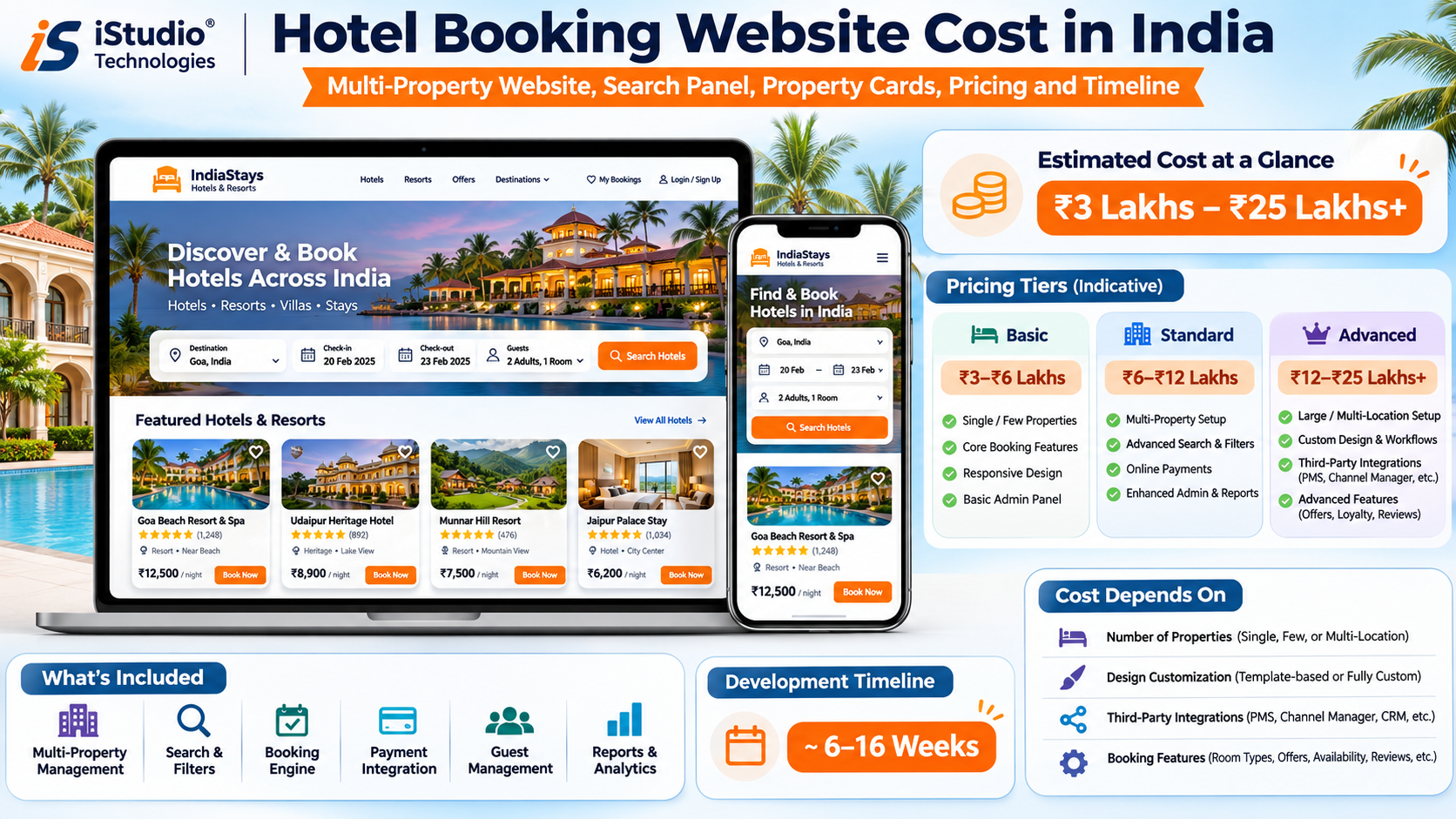
A multi-property hotel website in India typically costs about ₹1.5 lakh to ₹4 lakh if it only shows properties and takes enquiries, ₹4 lakh to ₹12 lakh with a direct booking engine and online payments, and ₹12 lakh to ₹35 lakh for a full platform that links to a channel manager and property management system. Large chains with custom rules and many integrations can pay ₹35 lakh to ₹80 lakh or more. Hosting, payment fees and subscriptions are extra.
We are a Chennai web and software company that builds booking websites. This guide is written for the owner or manager of two or more hotels, resorts or serviced apartments who wants more bookings direct and fewer through commission-charging platforms. It explains what the site includes, what each tier buys, what changes the price, what to connect and what it costs after launch.
All figures are 2026 market estimates for planning, not a quote. A real quote needs your property count, room types and the systems you already use. Use the ranges to judge whether a proposal is sensible, then ask for a fixed scope in writing.
Planning a booking website for your hotels? Message our team on WhatsApp or call +91 88070 03902 with your property count, room types and current booking systems, and we will scope it with you.
What a Multi-Property Booking Website Includes
A realistic hotel booking website cost India owners can plan around starts with listing what the site must do. "A booking website" can mean a brochure with a phone number or a full engine that sells rooms live, and the price difference is large.
| Part | What it does | Effort |
|---|---|---|
| Property pages | A page per property with rooms, photos, facilities, location, policies and reviews | Core; scales with property count |
| Search and availability | Lets guests pick dates and guests, and shows what is free at what price | Moderate to high |
| Rate plans and offers | Different prices for breakfast, refundable or not, long stays, seasons and promo codes | Moderate; rules take design |
| Booking engine and cart | Selects room, adds extras, collects guest details, takes payment and confirms | High; the core of direct sales |
| Payments | Online payment, part payment or deposit, refunds and receipts | Moderate |
| Admin and content | Staff manage content, offers, bookings and reports without a developer | Moderate |
| Channel manager and PMS links | Keep rooms and rates identical on your site, travel platforms and front desk | High; depends on the other systems |
| Marketing basics | Search-friendly pages, structured data, analytics, email and WhatsApp enquiries | Moderate |
Why Multi-Property Is Different
With one hotel, you manage one set of rooms and one front desk. With several, you must decide whether guests search across all properties, how a group offer applies to each one, whether each property keeps its own staff login and how reports roll up for the owner. These choices change the data design, so settle them before the build, not during it.
Start with What Guests Need
A guest wants real photos, honest prices, clear cancellation rules and a short path to pay. Anything on the list above that does not serve that goal can wait for a later version.
Cost Tiers: What Each Level Buys
The hotel booking website cost India bands below track what Indian web teams commonly quote in 2026 for similar scope. Treat each as a planning range and not a fixed price.
| Tier | What it includes | One-time cost (2026) | Typical timeline |
|---|---|---|---|
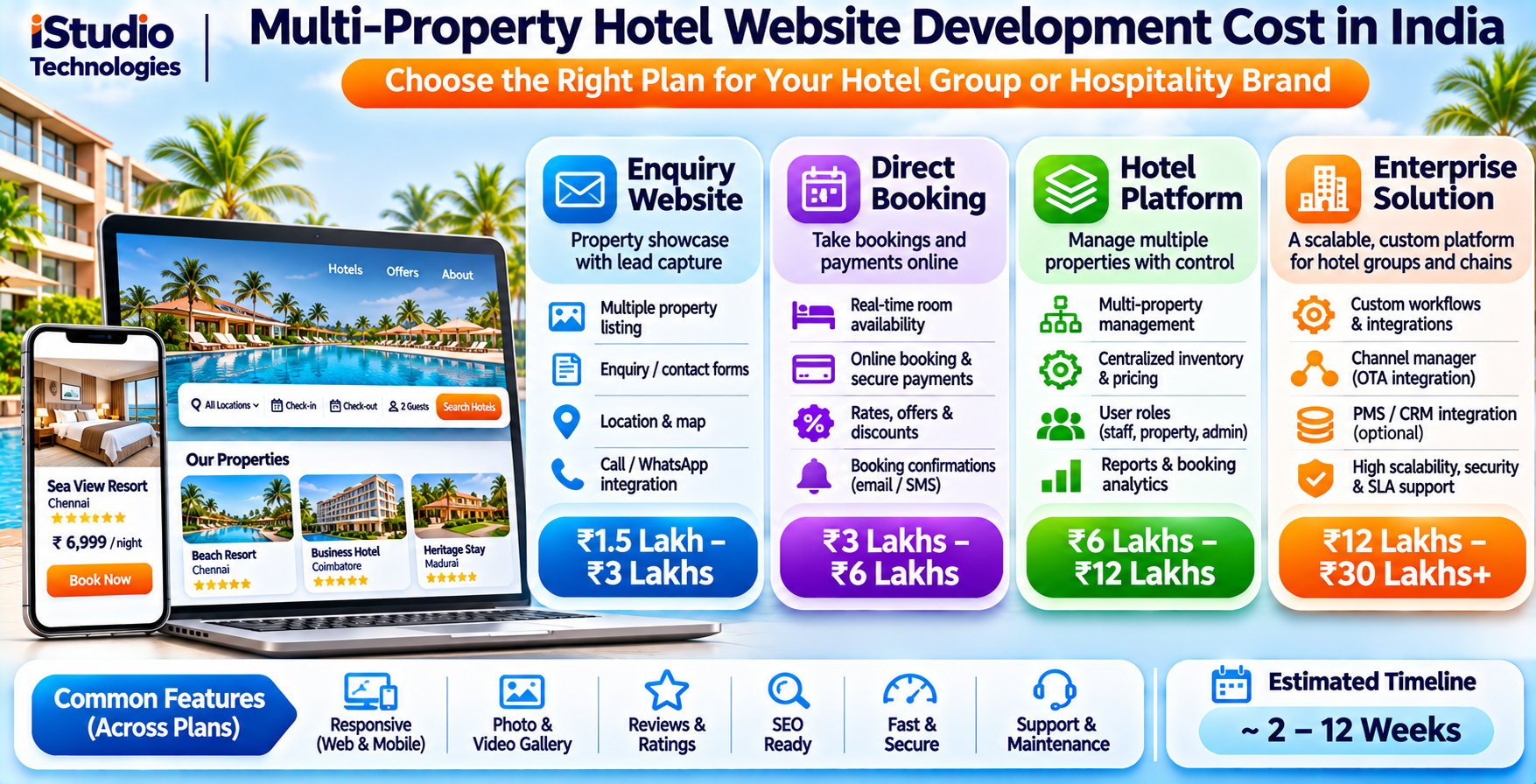
| Enquiry website | Group site with a page per property, room and facility pages, gallery, offers, enquiry and WhatsApp buttons, basic search-friendly set-up | ₹1.5 lakh to ₹4 lakh | 4 to 8 weeks |
| Direct booking website | Enquiry site plus availability search, room and rate plans, booking engine, online payments, confirmation emails and an admin panel | ₹4 lakh to ₹12 lakh | 10 to 20 weeks |
| Multi-property platform | Booking website plus channel manager and property management links, cross-property search, group offers, multi-currency, roles and reports | ₹12 lakh to ₹35 lakh | 20 to 36 weeks |
| Enterprise | Platform plus loyalty, corporate and group booking tools, deep analytics, several languages and custom integrations | ₹35 lakh to ₹80 lakh or more | 36 to 60 weeks |
Not included: hosting, payment gateway charges, subscriptions to channel manager or property management products, photography and the cost of reaching guests through search and advertising. The next sections cover them.
How to Read the Ranges
The low end of each tier assumes a clear scope, standard design and quick decisions from your side. The high end assumes custom design, complex rate rules or hard integrations. If a quote sits far below the range, ask what is missing. If it sits far above, ask which feature is driving the gap.
Many Owners Start in the Middle
Hotel groups often begin with the direct booking tier, prove that guests will book on their own site, and then add the channel manager and property management links when volume justifies them. Jumping straight to the platform tier is a common way to overspend.
What Moves the Price Up or Down
Several factors push hotel booking website cost India up or down, and you control most of them. Discuss each openly with any vendor.
- Number of properties. Each adds pages, room data, photos, staff logins and testing.
- Room types and rate plans. A handful of simple rooms is easy. Dozens of room types with meal plans, seasons and refund rules take design and testing.
- Booking engine approach. Embedding a ready-made engine costs less than building your own, though you accept its design limits and fees.
- Integrations. Each channel manager or property management link needs build, testing and often the provider's approval.
- Payments. Full payment is simple. Deposits, part payments, refunds and pay-at-hotel options add logic.
- Languages and currencies. Guests from abroad expect their language and currency, which means translation, formatting and extra testing.
- Design depth. A fully custom design that matches your brand costs more than a polished template.
- Content. Professional photography, copywriting and virtual tours are separate costs and often worth it.
- Speed and scale. Peak-season traffic needs a site that stays fast when many guests search at once.
A practical way to save money is to decide which features you need before the first booking and which can follow. Loyalty schemes and corporate portals can follow later.
Integrations: Channel Manager, PMS and Payments
Integrations decide hotel booking website cost India more than design does, because the website must agree with the other systems that sell and hold your rooms. If it does not, you risk selling the same room twice.
Three Systems, One Truth
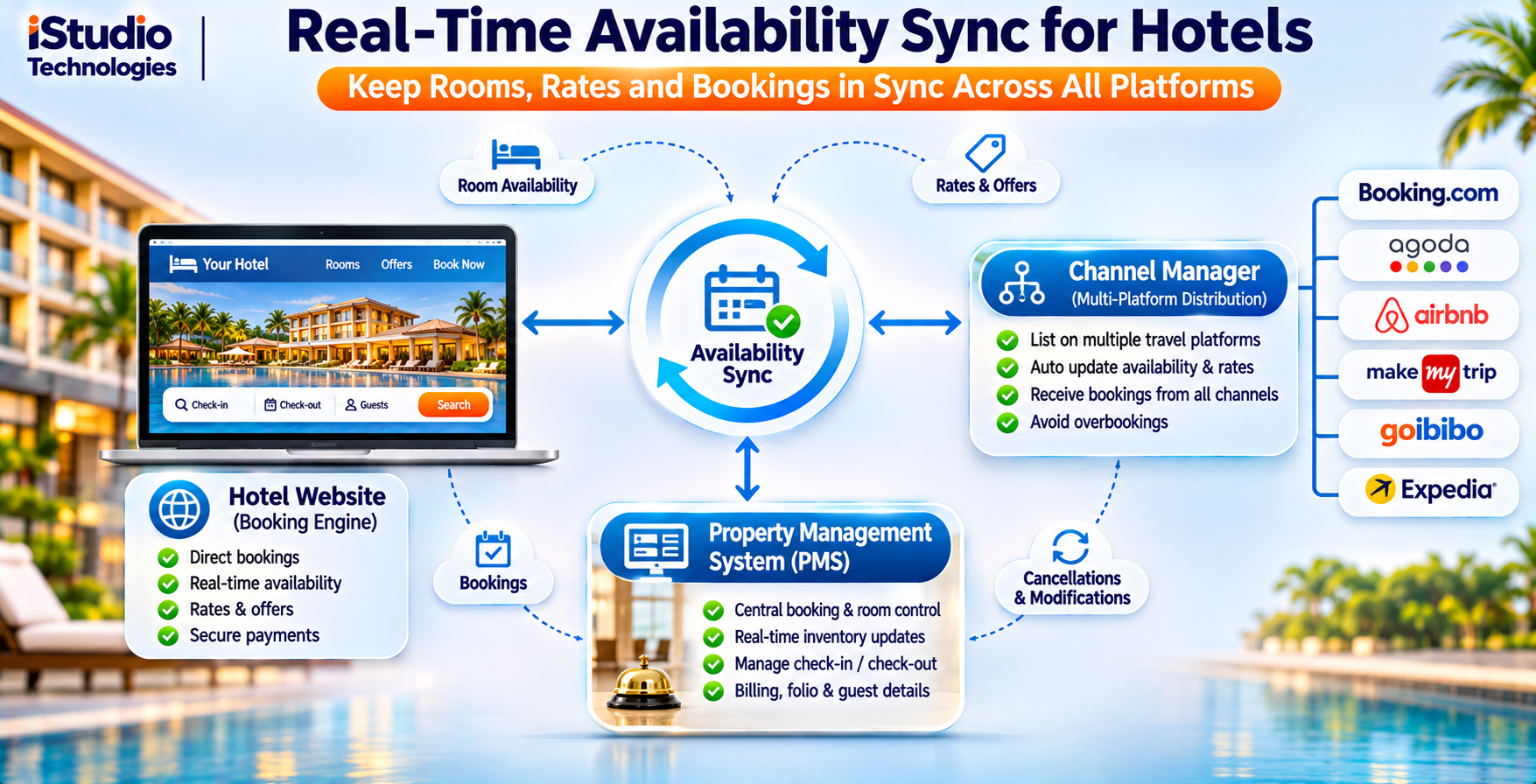
- Property management system (PMS). The front desk's record of rooms, guests and stays. It is usually the source of truth for what is occupied.
- Channel manager. A service that pushes your rooms and rates to travel platforms and pulls their bookings back, so every channel stays in step.
- Your website and booking engine. Another sales channel, and the one where you keep the guest relationship and avoid commission.
The aim is two-way synchronisation: when a room sells anywhere, availability drops everywhere within moments. The more of your inventory flows through one channel manager that your website connects to, the simpler and cheaper the website build. If your website must talk to each travel platform on its own, the cost and risk rise sharply.
Questions to Ask Before You Integrate
- Which PMS and channel manager do you use? Ask whether they offer a documented programming interface and whether they charge for access.
- Who is the source of truth? Decide where rates and availability are edited, so staff do not update three places.
- How fast must changes appear? Near-instant for availability, slower is acceptable for descriptions.
- What happens when a link fails? A good design shows a safe message and alerts your team, not a wrong price.
- Who supports it? Fixing a sync fault may involve your developer and the provider, so agree responsibilities up front.
Payments
Use a licensed payment gateway that supports UPI, cards and net banking, and ask how refunds and part payments are handled. International guests may need card support in other currencies. Gateway charges apply to each payment and their terms change, so confirm current rates with your provider.
Taxes, Rules and Guest Data
Tax and guest rules shape hotel booking website cost India too, because the site must show prices correctly and collect the right guest details. This is general guidance and not legal advice, so confirm every point with your accountant and an adviser.
GST on Rooms
GST on hotel accommodation depends on the room tariff. A Parliament reply states that for a transaction value of ₹7,500 or less per day, the rate was reduced from 12 per cent with input tax credit to 5 per cent without input tax credit, on the GST Council's recommendation at its 56th meeting on 3 September 2025. Higher tariffs attract a different rate, and rules for restaurants inside hotels also depend on the room tariff, so ask your accountant how this applies to each property.
Your website should therefore show whether a price includes taxes, apply the right rate for each room and date, and produce invoices that match your records. Rules change, so keep tax logic configurable and not hard-coded.
Show Honest Prices
Display the total a guest will pay as early as you can, with taxes and any fees clear. Adding charges only at the last step annoys guests and can attract regulatory attention under India's rules on misleading practices, so check the current position with an adviser. Show cancellation terms before payment, not after.
Foreign Guests and Form C
Accommodation providers in India are generally required to report foreign guests, using what is known as Form C, through the Bureau of Immigration's online Form C portal, generally within 24 hours of arrival. Your booking system can help by collecting passport, visa and arrival details at booking or check-in and passing them to the front desk. Confirm the current requirements with the authorities.
Guest Data Protection
India's Digital Personal Data Protection Rules were notified in November 2025, according to a Press Information Bureau release, and are being phased in. A booking site collects names, phone numbers, ID details and payment information. Ask only for what you need, explain why, keep it secure and delete it on schedule. Payment card details should stay with your payment gateway and never sit in your own database.
Running Costs After Launch
Plan for running costs, because hotel booking website cost India is only the first bill. A booking site takes payments, sends messages and carries your sales, so it needs steady care.
- Hosting and security. A fast, secure server, backups, monitoring and an SSL certificate, scaled for peak season.
- Payment gateway fees. A share of each online payment, which grows with direct bookings.
- Channel manager and PMS subscriptions. Usually monthly or yearly fees per property.
- Email, SMS and WhatsApp. Booking confirmations and reminders are charged per message by providers.
- Support and updates. Bug fixes, security patches, new offers and changes to the systems you connect to.
- Marketing. A booking site does not fill rooms by itself. Budget for search optimisation, ads, email and reviews.
As a planning estimate, set aside roughly 15 to 20 per cent of the build cost each year for hosting, support and updates, plus the subscriptions and fees above. Ask any vendor for a written estimate of yearly running costs next to the build quote, and treat a vendor who will not give one as a warning sign.
Direct Bookings and Commission
The business case for a direct site is that each booking taken there avoids the commission a travel platform charges. Commission rates vary by platform and agreement, so use your own figures. Work out your average booking value, your commission on platform bookings and how many bookings the site must win each month to cover its yearly costs. That break-even number is more useful than any general claim about savings.
Build, Buy or Hybrid?
Compare hotel booking website cost India with a subscription booking engine over at least three years, not one. A subscription looks cheap in month one, and can cost more than a build by year three, but a custom build costs more up front and needs upkeep.
| Option | Good when | Watch out for |
|---|---|---|
| Subscription booking engine on a template site | You have a few properties, standard rules and a small budget | Per-property fees, limited design control, data held by the provider |
| Custom website with your own booking logic | You have many properties, unusual rate rules or a group brand to protect | Higher up-front cost, longer timeline, need for a trustworthy team |
| Hybrid: custom website with an embedded engine | You want your own design and content, with a proven engine handling inventory | The engine's fees and limits still apply |
A Simple Three-Year Comparison
For arithmetic only, suppose a hypothetical subscription costs ₹4,000 a month per property for 8 properties. That is ₹32,000 a month, or ₹3.84 lakh a year, and ₹11.52 lakh over three years. That is not a market price, so replace it with real quotes. Add your own build and running costs for the custom option, and compare totals along with the value of owning your design, your data and your guest relationships.
Questions to Ask Before You Decide
- Who owns the guest data, the content and the domain?
- Can the system handle my rate rules and group offers?
- Does it connect to my PMS and channel manager?
- What happens to my site if the vendor closes or raises prices?
- How will costs change when I add a ninth property?
We will tell you honestly when a subscription is the better choice. Custom work makes sense when control, brand or scale earns its extra cost.
Why Build with iStudio Technologies
We are iStudio Technologies, a web, software and mobile company in Valasaravakkam, Chennai, with 17+ years behind us, 500+ projects delivered and an in-house team that handles design, development, QA and support under one roof. For hotel booking website cost India you can plan around, being local helps: we can visit a property, watch how the front desk handles bookings and design the site around it.
We tell you honestly whether to subscribe, build or mix the two. We do not promise a number of extra direct bookings or a fixed saving on commission, because results depend on your rates, reviews and marketing. We do commit to a written scope with a tier you can compare, a website you own and a clear estimate of running costs next to the build quote.
What We Need from You
Projects move fastest when you share your property list, room types and rate plans, the PMS and channel manager you use, your current website and booking sources, your cancellation and tax rules, and the people who will manage content and bookings. A front desk lead who can test early builds is worth more than a long specification.
Want a fixed-scope quote for your hotel booking website? Tell us your properties, room types and current systems.
WhatsApp +91 88070 03902Frequently Asked Questions
How much does a hotel booking website cost in India?
How long does it take to build?
Do I need a channel manager if I build a website?
Can one website handle several hotels?
Will a direct booking website save me commission?
What GST applies to hotel rooms booked online?
Does iStudio Technologies build hotel booking websites?
Related iStudio Technologies Services
More of our work that connects to hotel websites, grouped by what you need next.
Website and Booking
- Web development company in Chennai, the home for booking engines and integrations.
- Web design company in Chennai for hotel sites that convert.
Software and Apps
- Software development company in Chennai for property systems and dashboards.
- Mobile app development company in Chennai for guest and staff apps.
Get Guests
- SEO company in Chennai for search visibility.
- Digital marketing company in Chennai to bring in direct bookings.
Get a Scoped Quote for Your Hotel Booking Website
Tell us your properties, room types and current systems. We will recommend a tier and put the number in writing.
WhatsApp or call +91 88070 03902