
Packers Movers Keyword Research: How to Find Searches That Bring Local Jobs
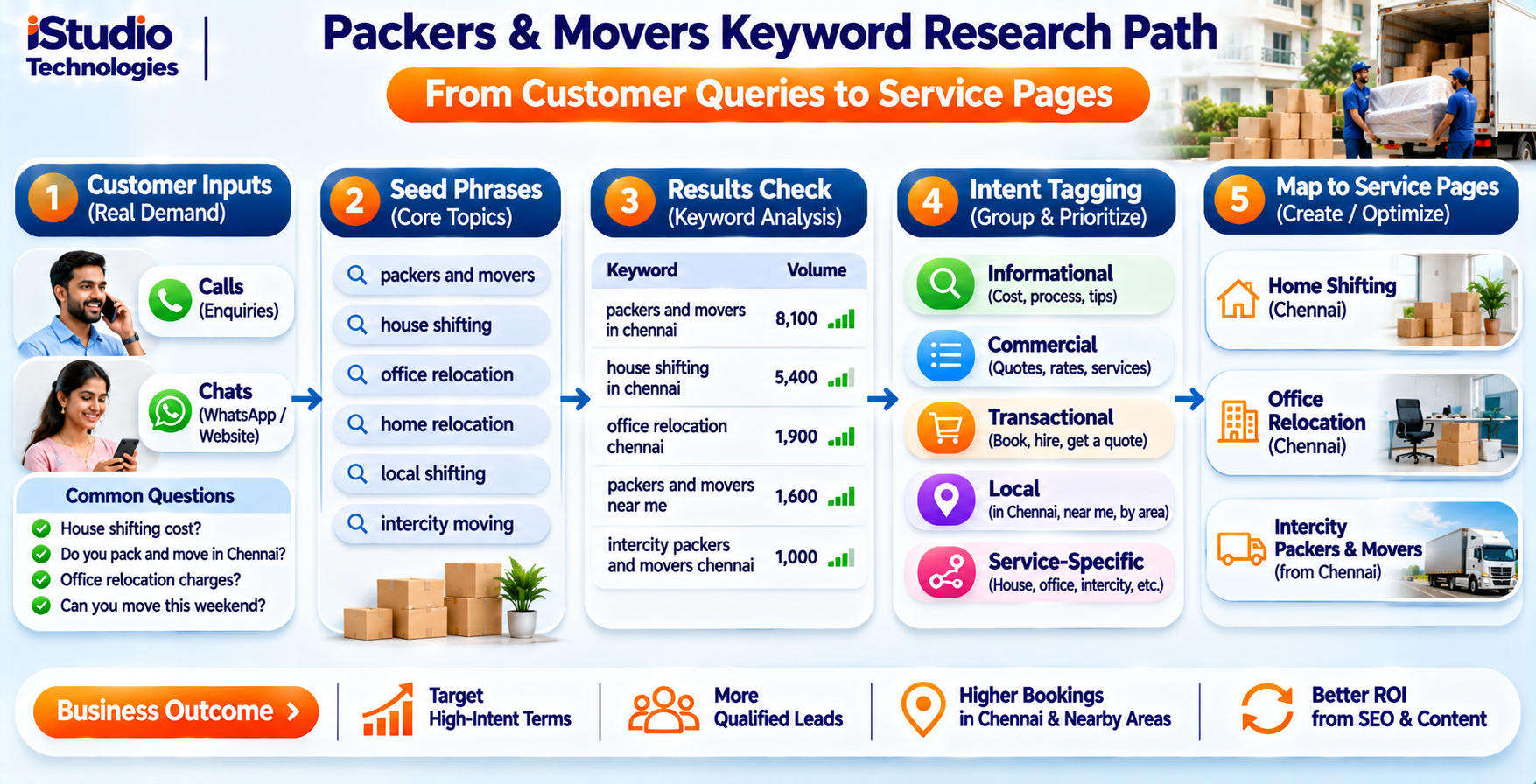
Good local keyword work starts with your own customers, not a tool. This guide gives seven steps for finding the searches that lead to booked moves, sorting them by intent and giving each one a single page.
What Does Packers Movers Keyword Research Involve?
This work means finding the exact words people type or say when they need a move, deciding which of those words lead to paid jobs, and giving each chosen phrase one page on your site or one place in your Google Business Profile. The words that matter are usually local, specific and a little urgent. A tool helps you check them, and your own customers are the best place to start.
This guide is for a local mover, and for the marketer working for one. It does not need paid software. It does need patience, because the work is mostly sorting, comparing and cutting.
One honest limit: we have not measured search volumes for any phrase in this article. Every example is a phrase to test in your own tools and not a claim about how often it is searched.
Why Are Mover Searches Different from Other Local Searches?
A person who needs a mover is rarely browsing. They have a date, a place and a list of things to move, and they want a price they can trust. That shapes the searches in four ways, and it is why packers movers keyword research differs from other local keyword work.
- Place matters twice. There is the area you collect from and the place you deliver to. Inter-city routes are separate searches from local moves.
- Price is the first question. Many searches ask for charges or rates before they ask for a company.
- The load changes the service. A one-bedroom flat, an office, a two-wheeler and a few boxes are different jobs, and customers describe them differently.
- Directories crowd the results. In many Indian cities, search results for this business show directory and aggregator pages beside the map listings. Check yours, because it decides which phrases you can realistically win.
The Seven Steps for Finding Searches That Bring Jobs
Follow these seven steps in order. Each one builds the list that packers movers keyword research needs.
Step 1: List Every Service and Place You Cover
ScopeWrite down what you really do: home shifting, office shifting, vehicle transport, packing only, storage, local moves and each inter-city route you serve often. Then list the areas you can reach in a day, by neighbourhood and by city.
Output: a services list and a places list. Do not target a service or area you cannot deliver well, because those enquiries cost time and earn bad reviews.
Step 2: Collect the Words Your Customers Actually Use
Customer languageOpen the last three months of enquiry calls, WhatsApp chats and forms. Copy the exact wording of what people asked for, such as how they named the move, the places and the items. Ask each new customer how they searched before they found you, and note the answer.
Output: a list of real phrases. This list is more useful to packers movers keyword research than any tool suggestion, because it holds the language of people who really hired a mover.
Step 3: Expand the List with Free Google Tools
ToolsType your seed phrases into Google and note the suggestions that appear as you type and the related searches at the bottom of the results. Then use Google's Keyword Planner. Google's Keyword Planner help says it shows keyword ideas, estimated monthly searches and cost estimates. It also notes that real campaign performance depends on many other factors, so treat its numbers as estimates and not promises. Access to the basic features requires completing a Google Ads account setup with billing details.
If you already have a website, open the Performance report in Google Search Console. Google's Performance report help explains how to see which queries led people to your site, with clicks and impressions. Real queries from your own site often show phrases you did not think of.
Output: a long list of candidate phrases with any estimates you could find. Keep the source for each phrase.
Step 4: Sort Every Phrase by Intent
IntentPut each phrase into one of five groups. The group tells you which page or profile section it belongs to and how ready the searcher is to book.
| Intent | Example phrases to test | Best home for it |
|---|---|---|
| Local and ready to hire | packers and movers in Chennai, movers near me, packers and movers Velachery | Main service page, area pages, Google Business Profile |
| Specific service | office shifting Chennai, bike transport Chennai, home storage service | One page per service |
| Route | Chennai to Bangalore packers and movers, Chennai to Coimbatore household shifting | One page per frequent route |
| Price research | house shifting charges Chennai, cost of packers and movers for a 2BHK | A charges guide that explains what changes the price |
| How-to and checklists | how to pack a fridge for moving, house shifting checklist | Blog posts that link to your service pages |
Example phrases to test in your own tools. They are not verified searches and we give no volumes for them.
Step 5: Check What Google Shows for Each Phrase
CompetitionSearch your top phrases in a private window, from a phone, at the location you serve. Note what appears: the map listings, directory pages, other movers' service pages, videos or articles. Then ask whether a page like yours could fairly be among them.
Output: for each phrase, a label such as "map listing", "service page", "guide" or "skip for now". A phrase where only large directories rank is a poor first target for a new site. A phrase where small movers' pages rank is a better one.
Step 6: Choose One Primary Keyword for Each Page
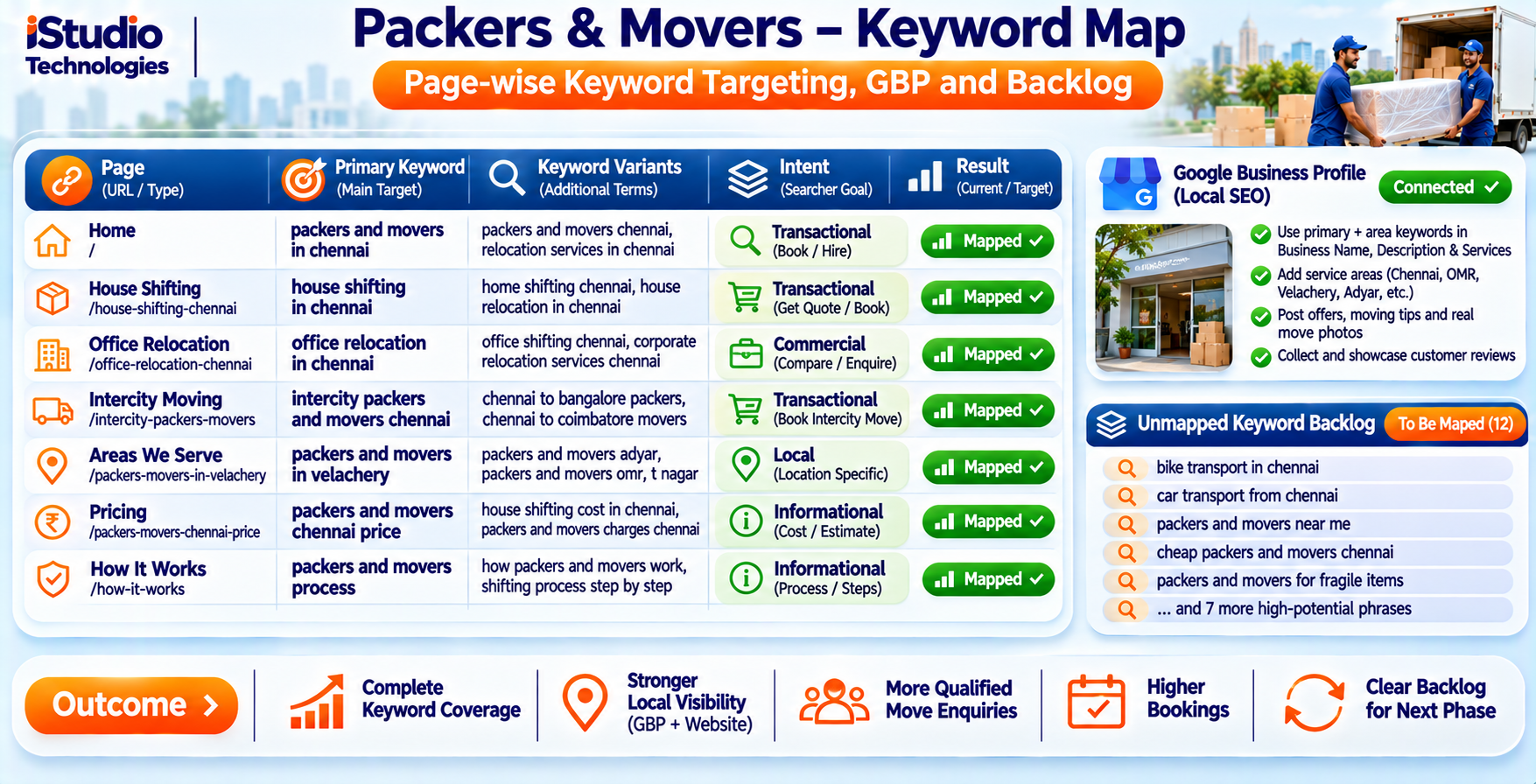
SelectionPick the most natural phrase for each page, the one a customer would actually say. Add two or three close variants that fit the same intent. Do not put two pages on the same primary phrase, because they will compete with each other.
Output: a table with one row per page: URL, primary keyword, variants, intent and the Google Business Profile service or description it supports. Write for people first, and use the phrase where it reads naturally. Repeating it again and again does not help.
Step 7: Track Results and Prune Every Month
ReviewEach month, look at the queries in Search Console, the calls and chats you received, and which of them became booked moves. Keep and expand the phrases that produce jobs. Merge, rewrite or drop the pages that bring only clicks.
Output: a short monthly note: what grew, what did not, and one change to make next month. Searches also change with the season, so compare similar months across years once you have the data.
iStudio Engineering Note: Keep a One-Page Keyword Map
The most common mistake we see in local SEO plans for service businesses is a keyword list with no home for each phrase. A keyword map is a simple sheet that fixes this. It is the main output of packers movers keyword research, and it can live in a spreadsheet.
- One row per page. Columns: page URL, primary keyword, two or three variants, intent, status (planned, live, needs work) and the person responsible.
- Check for duplicates before you write. If a new phrase has the same intent as an existing row, add it as a variant and do not create a new page.
- Mark unmapped phrases. Phrases with no page go into a backlog. They are the next pages to write, sorted by how close they are to a booking.
- Link the map to your profile. The same service names should appear in your Google Business Profile, so the website and the profile tell one story. Follow Google's guidelines for representing your business when you name the business and describe what you offer.
- Add the result column. Each month add clicks, calls and booked moves for that page, so the next decision uses your numbers.
This keeps the site tidy as it grows. It also helps with route and area pages, which can look alike if nobody checks them, and our guide on service-area pages in Chennai covers how to build them without copying text.
What Mistakes Should You Avoid?
These errors waste the most time in packers movers keyword research.
- Chasing only high-volume phrases. A short, popular phrase is often dominated by directories. A narrower phrase with a clear job behind it is usually a better target for a local business.
- Copying a competitor's keyword list. Their list reflects their services and areas. Use it as a check, and build yours from your own customers.
- Creating a page for every locality. Pages that differ only in the place name are thin. Build an area page only where you have something real to say, such as how you handle narrow lanes, apartment lifts or parking rules there.
- Ignoring Tamil and mixed-language searches. Some customers type in Tamil or in English letters. Test those spellings yourself in suggestions and in Search Console, and add pages or text only if you see real demand.
- Stopping at traffic. A phrase that brings visits and no calls is not working. Judge every phrase by enquiries and booked moves.
What to Do in the First Month
This plan fits packers movers keyword research into four weeks of part-time work.
| Week | Task | Result |
|---|---|---|
| Week 1 | Steps 1 and 2: services, places and real customer phrases | Seed list from enquiries |
| Week 2 | Step 3: suggestions, Keyword Planner and Search Console | Long list with sources |
| Week 3 | Steps 4 and 5: intent groups and a look at the results | Phrases marked as target, later or skip |
| Week 4 | Step 6 and the keyword map: one primary phrase per page | Page map and a writing order |
If you would rather have a team do it, our local SEO services in Chennai include keyword research, page mapping and Google Business Profile work.
Run a packers and movers business in Chennai or Tamil Nadu? Send us your services, areas and top routes, and we will suggest which pages to build first.
Discuss Your Keyword PlanCommon Questions
Do I need a paid tool for this research?
How many keywords should one page target?
Should I build a page for every area of Chennai?
Is "movers near me" worth targeting?
How long until keyword work shows results?
Get Your Keyword Map Started
Send us your services, areas and top routes. We will suggest the phrases to target first and the pages to build.
Discuss Your Keyword Plan