
Textile Ecommerce Website Chennai: Features, Pricing and Process for Saree and Fabric Brands
A saree is bought by touch, drape and colour, and a website has none of them. The store has to make up for that with honest photography, rich product details, careful stock handling and clear policies. Here is what the site should include, what we estimate it costs in three tiers and what to ask any developer.
Textile Ecommerce Website Chennai: What Does a Saree Brand's Store Need?
A saree or fabric store needs product pages that show true colour, weave and drape, filters that match how people shop for textiles, stock handling that copes with single pieces, and policies that reduce the fear of buying unseen. We estimate a starter store at about ₹1.5 lakh to ₹4 lakh, a growth build with custom design and live stock at about ₹4 lakh to ₹12 lakh, and a full custom build linked to your billing and showroom stock at about ₹15 lakh to ₹30 lakh and up.
This guide is for owners of saree houses, fabric merchants, handloom brands and showrooms in Chennai planning an online store. It explains what makes textile pages different, the features that matter, the pricing tiers, one design problem that general stores get wrong, and the rules on origin and handloom claims.
An honest limit: these are iStudio's own estimates for typical projects, not market data and not a quote. We list no client stores or sales results here and we cannot promise orders. Your price depends on your catalogue, your photography, how stock is managed today and the systems the site must connect to.
What Makes Textile Product Pages Different?
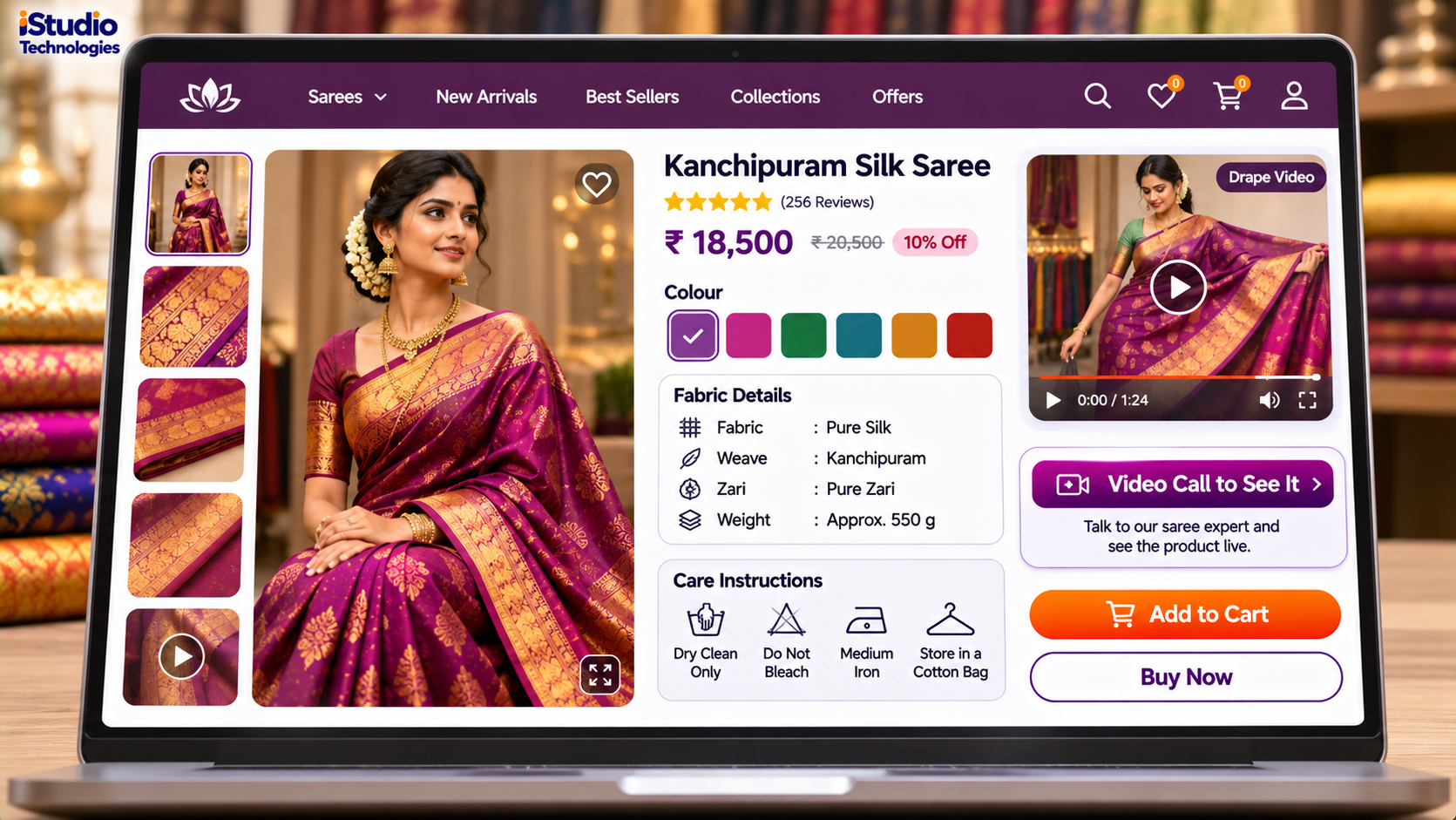
A textile ecommerce website chennai buyers trust gives each piece the details a shopper would check in the shop. A generic fashion template has fields for size and colour and little else.
| Detail | Why it matters |
|---|---|
| Fabric and weave | Silk, cotton, linen and blends feel and wear differently, and the weave is part of the product's identity |
| Border, body and pallu | Buyers choose by the pallu and border design as much as the body colour |
| Zari and embellishment | The type of zari or work affects price, weight and care |
| Length and blouse piece | Saree length, whether a blouse piece is included and its measurements are frequent concerns |
| Colour in more than one light | Shoppers worry that the colour on screen is not the colour at the door |
| Drape and fall | A short video of the piece being worn or draped answers what a still image cannot |
| Care and handling | Dry clean, hand wash and storage guidance reduce returns and complaints |
| Origin and making | Handloom or powerloom, region and maker, stated only as far as you can prove it |
| Lead time | Made-to-order pieces need a clear time to dispatch |
Photograph each piece the same way, with consistent light, a neutral background and close-ups of the weave and border. Consistency also helps the shopper compare pieces.
Which Features Matter Most for Saree and Fabric Stores?
Not every feature is needed at launch. These are the ones we would plan first for a textile ecommerce website chennai brands can grow from.
- Filters that match how people shop. Fabric, weave, occasion, colour family, border type, price and whether a piece is ready to ship or made to order.
- Zoom, video and colour swatches. High-quality zoom, a drape video for each piece and swatches that show colour variants clearly.
- Live stock and single-piece handling. A one-of-a-kind saree can be sold only once, and the site must never sell it twice.
- Video call or showroom visit. Let a buyer book a live video view of a piece or a visit to the showroom, with a simple booking step. Our guide to WhatsApp marketing cost in Chennai explains how chat can support this.
- Payments, delivery and returns for high-value orders. UPI, cards and cash on delivery with risk checks, insured shipping, careful packaging and a clear returns page.
- Tamil and English content. Product names, descriptions and policies that read naturally in both languages.
- Fast mobile pages. Most shoppers will browse on phones, and image-heavy pages need care. See our guide to large catalog ecommerce performance.
- Search-ready product data. Structured product data helps search engines read each page. Google's guide to product structured data says it can help product details such as price and availability appear in richer ways in search results. It does not guarantee any display.
- Wholesale option, later. If you also sell to retailers, plan a private catalogue with trade prices. We cover that in our guide to a B2B order booking app for textile wholesalers.
Pricing Tiers: What Each Level Buys
| Tier | What it includes | One-time cost (2026) | Typical timeline |
|---|---|---|---|
| Starter | Template-based store customised to your brand, product pages with textile fields, basic filters, payments, delivery rules, basic search setup | ₹1.5 lakh to ₹4 lakh | 4 to 8 weeks |
| Growth | Custom design, richer filters, drape video and swatches, made-to-order handling, live stock with single-piece reservation, video call booking, Tamil and English, stronger search setup | ₹4 lakh to ₹12 lakh | 8 to 14 weeks |
| Scale | Growth plus links to your billing and showroom stock, multi-store or multi-city stock, wholesale catalogue with trade prices, marketing and loyalty integrations, tighter audit controls | ₹15 lakh to ₹30 lakh and up | 14 to 24 weeks |
iStudio estimates for 2026, one-time, excluding GST, photography, content and third-party running costs. Not market data and not a quote. This is how we see textile ecommerce website chennai pricing for a typical project.
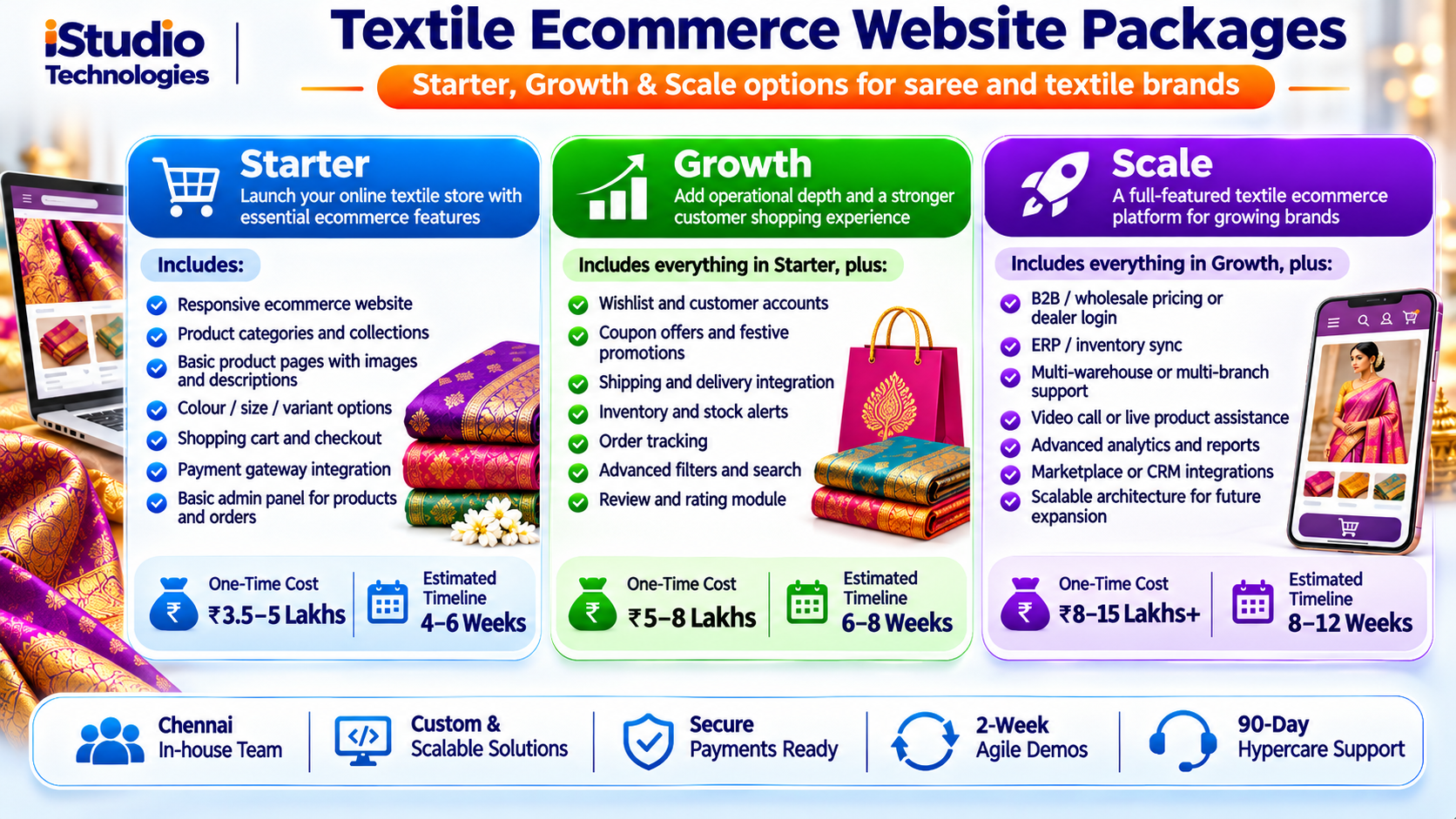
The tiers follow the same shape as our guide to the cost of an ecommerce website for a Chennai jewellery store. A textile store usually needs less on pricing logic, since sarees are priced per piece, and more on photography, filters and stock handling.
What Moves the Price
- Catalogue size and photography. Hundreds of unique pieces need an efficient upload process, and good photographs cost money and time.
- Stock method. Single pieces, repeat designs and made-to-order each need different handling.
- Links to showroom billing. A connected showroom needs an interface to your billing or stock software.
- Custom design versus a template. A design made for your brand costs more and looks less like other stores.
- Languages and content writing. Tamil and English descriptions for every piece take time to write and check.
iStudio Engineering Note: Handle One-of-a-Kind Stock and Colour Accuracy
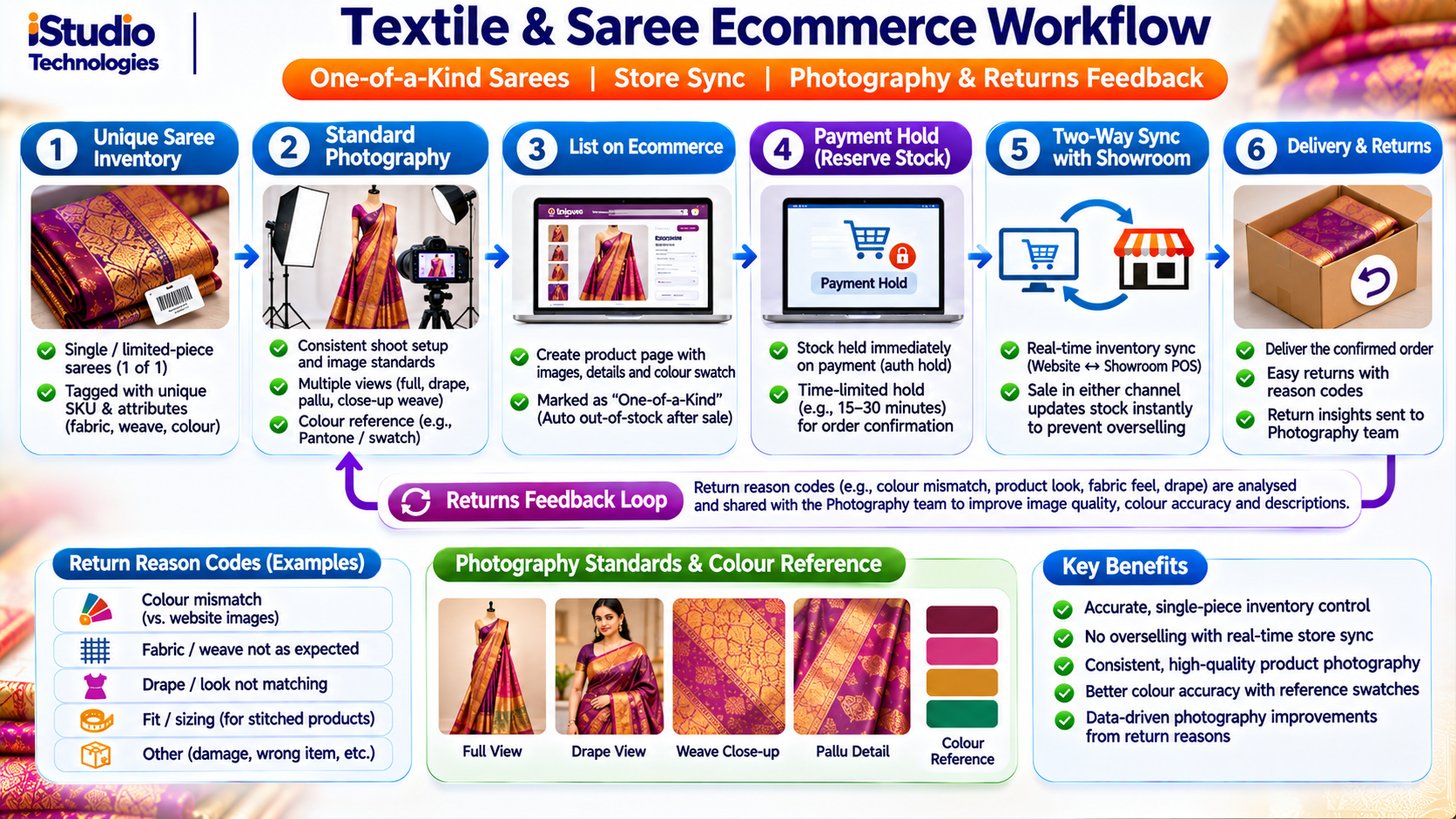
The most common problem we see in a textile ecommerce website chennai project is that a store built for repeat items is used for one-of-a-kind sarees. Two buyers add the same piece to their carts, and one of them is disappointed after paying. A second problem is colour, which drives returns and complaints.
- Model the piece, not just the design. For unique pieces, each saree is its own item with a quantity of one. For repeat designs, stock is a count by colour. Mark each item as unique, repeat or made to order.
- Reserve at payment, not only at cart. When a buyer starts payment, hold the piece for a short, fixed time. If the payment fails or the time ends, release it. Show a clear message to anyone who tries to buy a piece that is on hold.
- Sync with the showroom. A piece sold in the shop must disappear from the website at once, and the reverse. Use one stock record, or a frequent sync with a clear owner, and log every change.
- Standardise photography. Shoot under the same light with a neutral background and a colour reference card in a sample frame. Add at least one daylight image and a short drape video.
- Say how colour may vary. A plain line that screens can show colour slightly differently, and a link to the video call option, reduces disappointment. Do not edit photographs to make colour richer than the piece.
- Record the return reason. Give returns reason codes such as colour difference, fit, damage or changed mind, and review them monthly to improve photographs and descriptions.
- Handle made-to-order openly. Show the lead time on the page and in the cart, and send status updates, because a buyer who waits weeks needs to know what is happening.
This takes more design than a generic store, and it prevents the double sales and colour disputes that damage a saree brand's name.
Which Authenticity and Selling Rules Apply?
Words like handloom, pure silk and regional weave names carry weight with buyers, so a textile ecommerce website chennai sellers rely on must use them only when true. This is general guidance and not legal advice. Rules change, so confirm each point with an adviser.
- Handloom claims. The government's Handloom Mark site describes the mark as a sign of authenticity, loom origin and market linkage, and labelling and display regulations for the mark were issued in 2025. Describe a piece as handloom only if it is, and use the mark only if you are entitled to it and follow its rules.
- Geographical indication names. According to a Lok Sabha reply, registered users of GI handloom products have rights under the Geographical Indications Act to approach the police against illegal making or marketing of those products. Use a protected regional name only if the piece truly qualifies and you may use it.
- Fabric and content claims. State fibre content, zari type and other claims as your supplier documents support, and keep proof. Do not call a blend pure.
- Online selling rules. India's Consumer Protection (E-Commerce) Rules, 2020 set duties for online sellers, such as showing seller details and handling complaints. Publish clear seller, returns and grievance details, and show only genuine reviews.
- Customer data and tax. India's Digital Personal Data Protection Rules were notified in November 2025 and are being phased in, so collect only the details you need and keep addresses and phone numbers secure. Ask your accountant how GST applies to each product and to delivery charges. We state no rate here.
If you want a team to scope this for your brand, our web development team in Chennai can map your catalogue, photography and stock method to a tier.
Questions to Ask Any Developer
- How does the site stop a one-of-a-kind saree being sold twice?
- Can our staff upload many pieces at once, with video and colour swatches?
- Who owns the code, the content and the domain?
- What are the yearly costs for hosting, payment fees, messages and support?
Planning an online store for your saree or fabric brand? Share your catalogue size, stock method and showroom billing, and we will suggest a tier.
Get a Scoped EstimateCommon Questions
How much does an ecommerce website for a saree brand cost in Chennai?
How do we show the true colour of a saree online?
Can we sell both retail and wholesale?
Do we need our own site, or can we sell on marketplaces?
How long does it take to build?
Get a Scoped Estimate for Your Textile Store
Share your catalogue size, stock method and showroom billing. We will suggest a tier, a timeline and the running costs to plan for.
Get a Scoped Estimate