

CASE STUDY
Redefining Airport
Mobility with the World’s
First Autonomous Smart
Airport Trolley
How iStudio Technologies Transformed the Ordinary
Airport Trolley into a Fully Autonomous Mobility System
Introduction: The Airport Mobility Challenge
Airports worldwide handle millions of passengers daily, yet one thing remained unchanged for decades — the manual luggage trolley.
Travelers still push, pull, and struggle with heavy bags through long corridors and crowded terminals.
While airports invested in automation for check-in, security, and boarding, passenger mobility assistance lagged behind.
Manual trolleys caused:
- Frequent congestion in walkways.
- High labor costs for retrieval and maintenance.
- Poor passenger experience during long transfers.
The question we asked was simple:
“What if the airport trolley could move on its own — intelligently and safely — just like a personal travel assistant?”
This question marked the beginning of a revolutionary journey that led to the creation of the world’s first Autonomous Smart Airport Trolley.
The Vision: Building the Next Generation of Airport Trolleys
Our vision was to redefine airport mobility by designing a trolley that could sense, think, and move autonomously — blending robotics, artificial intelligence, and human-centered design.
We wanted to create a contactless, hands-free luggage experience that enhances convenience for passengers and operational efficiency for airports.
Thus, we began developing a next-generation airport trolley, one that operates as a self-driving intelligent assistant instead of a simple mechanical carrier.
Technology Overview: The Science Behind the Smart Airport Trolley
At the heart of our Autonomous Smart Airport Trolley lies a combination of advanced technologies engineered for precision, safety, and scalability.

AI-Powered Computer Vision
The trolley uses onboard cameras and deep-learning algorithms to identify and follow passengers automatically.

Sensor Fusion System
By combining LiDAR, ultrasonic sensors, and IMU data, the system ensures obstacle detection and path correction with centimeter-level accuracy.

Autonomous Navigation (SLAM)
Using Simultaneous Localization and Mapping, the trolley maps its environment dynamically and navigates independently through terminals.

Embedded Control Systems
Powered by microcontrollers and edge processors, the trolley performs instant decision-making

IoT & Cloud Connectivity
Every unit connects to a central dashboard via IoT communication protocols
Design & Engineering: From Concept to Prototype
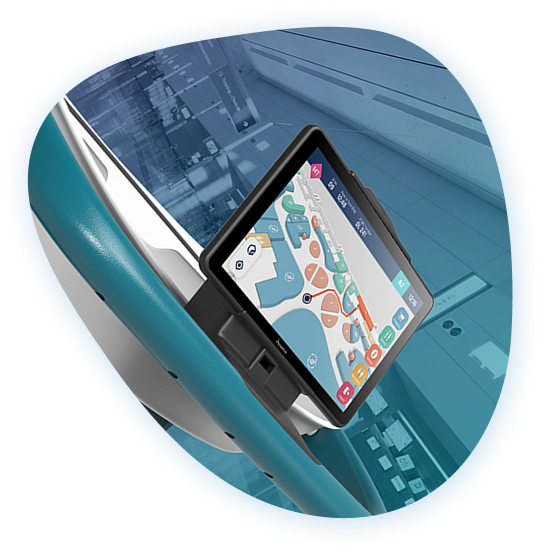
Mechanical Design
Our mechanical engineering team created a lightweight, durable chassis using aluminum alloy.
The design ensures stability even when carrying heavy luggage.
Electronics & Embedded Systems
Advanced embedded circuitry ensures seamless power management and sensor integration.
Our team optimized PCB architecture for compact spaces.
Software Integration
We integrated custom firmware for efficient data flow, UI, and hardware optimization.
Stable communication protocols ensure high system reliability.
User Experience Design
Our UX team crafted clean workflow interactions and user-friendly interface layouts.
Every element is designed for real-world usability and comfort.
Implementation: Real-World
Testing and Results
The first pilot deployment was conducted in a controlled airport-like environment in Chennai. Here's what we achieved:
These numbers proved the concept was not only functional but commercially scalable.
Challenges Faced During Development
Every groundbreaking innovation faces real challenges — ours included:
- Indoor GPS limitations required vision-based tracking instead of satellite navigation.
- Crowd unpredictability demanded advanced real-time path planning
- Battery optimization was crucial for full-day operation.
- Safety validation needed multi-layer fail-safe mechanisms.
Through multiple iterations and field tests, we solved each challenge using AI-driven adaptability and robust mechanical engineering.
Challenges Faced During Development
Every groundbreaking innovation faces real challenges — ours included:
- Indoor GPS limitations required vision-based tracking instead of satellite navigation.
- Crowd unpredictability demanded advanced real-time path planning
- Battery optimization was crucial for full-day operation.
- Safety validation needed multi-layer fail-safe mechanisms.
Through multiple iterations and field tests, we solved each challenge using AI-driven adaptability and robust mechanical engineering.
How the Autonomous Smart Airport Trolley Works
iStudio Technologies, is leading digital marketing company in India. We empower businesses in the digital landscape with cutting-edge marketing solutions to enhance online presence, drive targeted traffic, and boost ROI. Explore our expertise to elevate your brand.
Passenger Identification
The passenger pairs their trolley via mobile app or proximity sensor.
Automatic Following
Using AI vision, the trolley locks onto the passenger's position.

Obstacle Detection
LiDAR and ultrasonic sensors detect objects within 360°, ensuring safe navigation.

Smart Path Planning
The onboard AI constantly calculates the most efficient path.
Docking & Charging
When idle, the trolley autonomously returns to its dock for recharging.
Advantages for Airports and Passengers
For Passengers
- Hands-Free Travel Move effortlessly without pushing a trolley.
- Contactless Safety Ideal for post-COVID travel environments.
- Personalized Experience AI adapts to walking speed and direction.
- Multilingual Voice Support AI assistant communicates in various languages.
For Airports
- Operational Efficiency Reduce manpower for trolley collection.
- Fleet Management IoT dashboard for real-time trolley status.
- Predictive Maintenance Automatic alerts for servicing and battery health.
- Brand Differentiation Position airport as a technology leader in passenger comfort.
Business & Environmental Impact

Operational Cost Reduction
Airports can save up to 40% in annual operational costs by replacing manual collection with autonomous fleet management.

Enhanced Passenger Flow
Automated navigation reduces crowding and improves passenger throughput by up to 25%.

Sustainability
Our trolleys use rechargeable lithium batteries, producing zero emissions, supporting airports’ green initiatives and carbon-neutral goals

Global Scalability
The modular design allows airports of varying sizes to implement the system easily — from regional to international terminals.

Hands-free, contactless mobility
40% reduction
Real-time IoT management
Zero-emission system
Positioned as innovation leader
The Autonomous Smart Airport Trolley has transformed how airports perceive mobility, automation, and passenger satisfaction.
Future Roadmap
We continue to innovate by adding:
- Voice-based control using NLP
- AI-driven crowd analytics
- Integration with autonomous baggage handling systems
- Self-healing AI modules for adaptive performance
Our goal is to make fully autonomous passenger assistance the global standard across all airports.