
Human Resource Information System
AI has fast emerged as a most valuable ally to HR professionals across all sectors of business
Although AI has been changing lives for over a decade now, business leaders have just about come to realise the potential of AI-powered tools upon business and productivity
Human Resource Information System Modules
Self-Onboarding
HRMS
Payroll
Attendance Management
Performance Management
Mobile Apps
Leave Management
Travel Expense Management
Online Training
Recruitment
Disciplinary Tracking
Employment Compliance
The 3 pillars of AI-powered HRIS systems stands thus
Short-term Benefit
Automate tedious, time-consuming tasks to simplify and make HR hassle-free
- Save cost
- Improve on UX/UI
- Ensure Quality & Accuracy
Example: Robotic Process Automation that expedite HR tasks without human intervention
Medium-term Benefit
Augment Human Capabilities in HR functions through tools that help organize, analyse, and execute strategies, gain insights by applying people analytics needed for strategic planning.
- Self-learning
- Accurate predictions & Pattern Detection
- End-user Interaction
Example: Chatbots, Predictive Analytics etc. that employ Machine Learning to reduce attrition rates, increase efficiency, and streamline HR tasks
Long-term Benefit
Amplify Human functions through enhanced workflows re-designed by AI/ML that help boost accurate decision
- Decision-Making
- Boost human functions
Example: Cognitive Analytics that positively impact recruiting, on-boarding etc.
Current Status of AI in HR
Growing number of service providers, start-ups, large conglomerates are targeting their HR capabilities with AI-based solutions for HR tasks such as sourcing, interviewing, on-boarding, online coaching, employee self-service portals etc. These are more like data-driven analytical data.
The main application of AI in HR currently is Analytics application – using algorithms & data to help the system become smarter with time. AI provides for a bridge between people analytics interface and human proficiency.
The market for AI is to become worth $46billlion in 2020 as it continues to business practices across all verticals. It’s time you joined the club too.
Digital Transformation of HR
The What
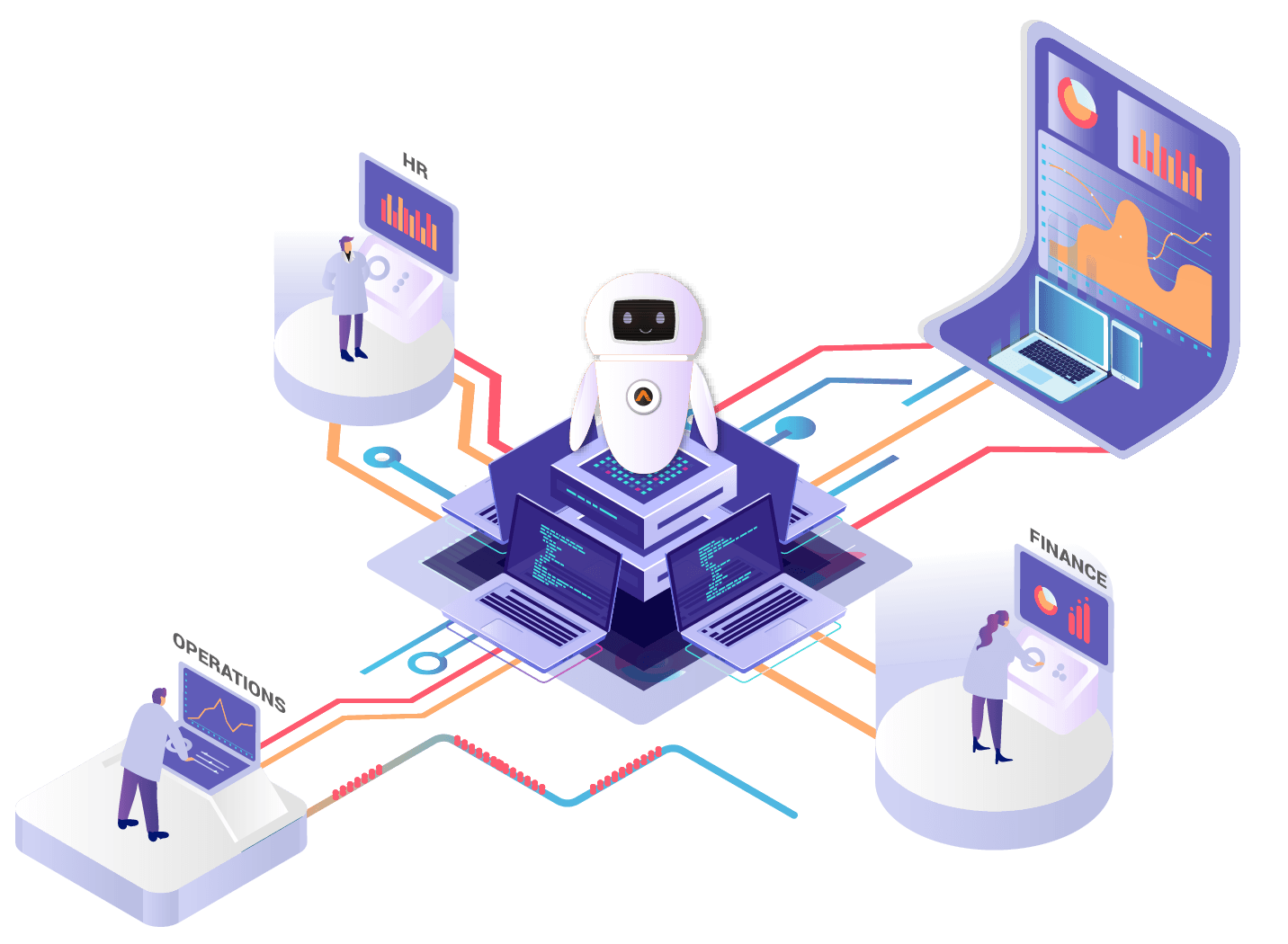
The need for AI and automation in HR comes from the need to adopt digital transformation of HR functions. It necessitates the changing of HR tasks to become more data-driven, automatic, seamless, and error-free.
HR teams have to now, more than ever, take up the dual task of transforming operations and transforming workforce. HRIS aids in the digital transformation that is but a metamorphosis of the organization as a whole.
The Why
HR transformation should be with a clear objective in mind and not because you are giving in to peer pressure. Take this route only if it makes business sense to you in your long-term plans for your company. Digitising must lead to implementing expensive technologies that meet actual human needs, else it defies the purpose of it.
Examples
Countless examples exist of which just a few would be:
The Factors Necessary
- You need to be in this for the long haul as technology is ever-evolving
- The understanding that anyone cab adapt to technological innovations
- Be data-driven to dish out a personalized experience; gauge consumer expectations and strategise upon it.
- Look at the bigger picture. HR transformation is a small component of workforce transformation
- Make your data easily accessible to end-users, i.e employees who require o special training to access, understand, and analyse the information
- Humans are not dispensable post digital transformation. Expensive technologies make no difference without the necessary human touch.
- It should be of use to the end-consumer – in simplifying things, save time & money; secondly it should make sense to business sponsor – in cost savings, revenue generations, budget costs, employee satisfaction. It has to have a business impact, and be engaging.
- Try new things, be inventive for innovations to make sense to employees or HR managers. Accept failure to work on it and refine it further
Unilever – The company is radically changing its hiring procedures through effective use of social media, online games, AI-HRIS integrations etc.
Cisco – It not only organizes hackathons to encourage building new HR products but also invents on voice technologies that can give quick answers to daily HR queries.
IBM – Keeps launching digital learning platforms that gives a fully customized experience to its employees.
AI and HR
General Uses of AI in HR
When the correct algorithms are deployed in HR, Artificial Intelligence can help to:
- Analyse resumes
- Shortlist potential candidates
- Scrape social media feed and other sources to build on extensively a candidate profile - make it data-rich
- Interact with applicants in real-time to enhance the overall experience; engage innovations such as chatbots to provide quick responses and feedback options
- Collect myriad of information through text/ picture/ video etc
- Conduct real-time telephonic or video interviews
- Analyse in detail vocal tone, facial expressions, and other body language variables to detect patterns.
How HRIS Applications Enhance Business Operations
Core HR
Core HR is responsible for overseeing the traditional HR operations – personnel tracking, payroll processing, and benefits administration. Bigger the business operations, more such daily tasks are bound to pile up and overwhelm the best of HR leaders.
Challenges
- AI features should help businesses that have become too big to handle through manual means. The challenge is to streamline Core HR functions and integrate on an easily accessible single platform that simplifies and forms categories.
- Upgrade of system operations to oversee payroll, day-to-day administrative tasks like employee tracking.
AI Solutions
Range of functionality on offer amongst various HRIS differs from vendor to vendor according to the business solution it is meant for. Hence, a complete understanding of the basics is a must before allocating or investing budgets. AIs targeted at Global Enterprises natural tend to be more feature-rich as compared to those designed for local operations.
- Employee Database - HRIS applications are able to store employee data such as past employment details, social security numbers, contact information etc.
- Administrative Benefits - Features to manage employee benefits such as life insurance policies, medical & dental plans etc. made easy on the core platform.
- Self-Service Portal - Employees access personal information – edit & update according to convenience.
- Payroll Management - HR managers can streamline tasks such as generating employee salaries, healthcare deductions, facilitate tax payments or direct deposits.
Workforce Management
Workforce management revolves around supporting all daily aspects of managing employees of an organization.
Challenges
- To bridge the gap that exists between core HR and strategic HR functionalities.
- Workforce management needs to finely blend in both the goals of focusing on processes as well as on people.
- Juggling dozens of workers on a daily basis with a manual approach is time-consuming and often overwhelming even for well-trained professionals.
AI Solutions
AI-powered workforce management will help in better scheduling, tracking employee hours. HR professionals would be able to focus more on strategy as they examine various possible scenarios and how to combat them. This results in proper optimization of the workers.
- Scheduling - Particularly important for countries that schedule shift workers, AI-HRIS features include automatic scheduling & schedule optimization, employee alerts of schedule changes & notifying management of insufficient staffing levels etc.
- Attendance - Hourly clock-in and clock-out data gets collected to form reports for payroll and billing purposes.
- Tracking Paid Time Off - Managers are notified about all goals accomplished or missed during an employee’s sick leaves or paid time off. It helps to calculate accruals and year-end leave balance better.
- Compliance - Preset workflow helps maintain standard records of reports/audits and other necessary compliance documentation. HRIS systems can handle even the most complex tasks like tax compliance, following privacy law, and healthcare regulations.
- Measuring Performance - Supervisors/ HR managers get to conduct 360-degree employee reviews on monthly, quarterly or annual basis, track defined goals through dashboards visualisations that simplify and streamline managing performance metrics.
Strategic HR
Apart from the day-to-day activities of an organization that keep it running, it is a crucial role of HR leaders to help CEOs define and execute key strategic targets for long-term success of any company.
Strategic HR centers on people – to attract and develop correct talent – for immediate and future company growth. Thus, acquisition of top talent is a component of strategic HR.
Challenges
- Platforms engaged for this purpose must possess a blend of recruiting and analytical tools that help recruit the best candidates.
- The platform should be integrated with other core components to ensure employee satisfaction, retention rates, enhanced brand image etc. though consistent employee growth & development.
AI Solutions
Strategic HR functionality that HRIS need support varies according to the type of business. Large corporates usually require succession planning in the event of loss of a top talent, global support for better execution of branching out plans, and sophisticated data analysis to track performance metrics better.
- ATS - AI tools help with social recruiting, scheduling interviews, creating applicant information database, define performance metrics, do background checks etc.
- Onboarding - Onboarding requires developing strong relationships with new hires – thus a critical phase that is aided by AI features which create digital forms that support e-signatures, establish online training courses that support automatic placement – to name just a few.
- Learning Management System - AI lets managers oversee training programs means to equip new hires gain critical job skills & certifications, gain access to career development & sustained learning opportunities through online assessments, libraries, customized courses and social learning made highly engaging via gamification and microlearning modules.
- Analytics - HRIS solutions help analyse KPIs with visual tools such as dashboards and charts that contain performance metrics such as top performers, headcounts, budget forecasts, payroll summaries etc.
Key Areas of Impact by AI - HR
Employee Experience
Deloitte’s recent survey shed a light on how poorly equipped HR departments are in providing differentiated experience to its employees. Only 22% of executives interviewed believed in their organizational capability in providing such experience, though 805 deemed it important.
Uses of AI in Employee Experience
- AI-HR will help overcome future business frontiers as personalised engagement take center stage. Consumers are used to smart assistants 7 recommendation engines when they shop or surf. Thus, they develop an expectation of personalized 7 engaging experience at their workplace too.
- AI & Machine Learning through tools like Chatbots are known to drive more productivity and craft a modern employee experience.
- AI-enabled consumer technology solutions will effectively get weaved into employee lifecycle, encompassing recruitment, onboarding, service delivery, career pathing et al – a true bespoke experience
- Voice technology is at right at the top of wish lists of employees where 30% want “Google-like” options that help answer work questions.
Data-driven Decision Making
HR agility defines how well a company fares in talent acquisition. The agility, in turn, is decided by how HR leaders can think on their toes to make sound business decisions. But in most organisations, data-to-decision workflow is lengthy, the steps of which are:
Data Collection > Data Analysis > Insights > Decision
Although automation in data collection is a norm now, manual methods are still in use to draw insights from the collected data. This bottleneck can be done away with AI.
Uses of AI in Decision Making
- HR teams are able to extract data and deliver recommendations in real-time thanks to AI.
- Natural Language Generation (NLG) software can transform data into data-driven texts – a valuable asset across industries.
- AI can remove many potential human biases or inconsistencies
- AI-powered decisions can help industries scale faster, stay data-informed, and be more consistent & unbiased.
Intelligent Automation
Intelligent Automation is when AI combines with automation to form machines that are capable of sensing, understanding, learning and acting independently without human assistance.
AI in HR opens door to numerous possibilities – for an employee to learn new skills that match the technological advances. Such experiential learning helps many to gain control over their career and HR managers are able to let business performance take centre stage in long-term HR strategies.
Uses of Intelligent Automation
- Perform manual tasks, make intelligent & informed decisions akin to that of a human.
- Deployed in place of humans to do manual work, Intelligent Automation aids in increasing efficiency, productivity, and drives forth innovation.
- Understand processes, their variations within and analyse patterns it detects.
Technology is not the one-stop solution for enhances employee experience. HR tools modelled through AI only help leverage this concept and foster an environment of innovation. The sooner you embrace automation and go digital, the more shall you be able to enhance the human performance of your organization.