
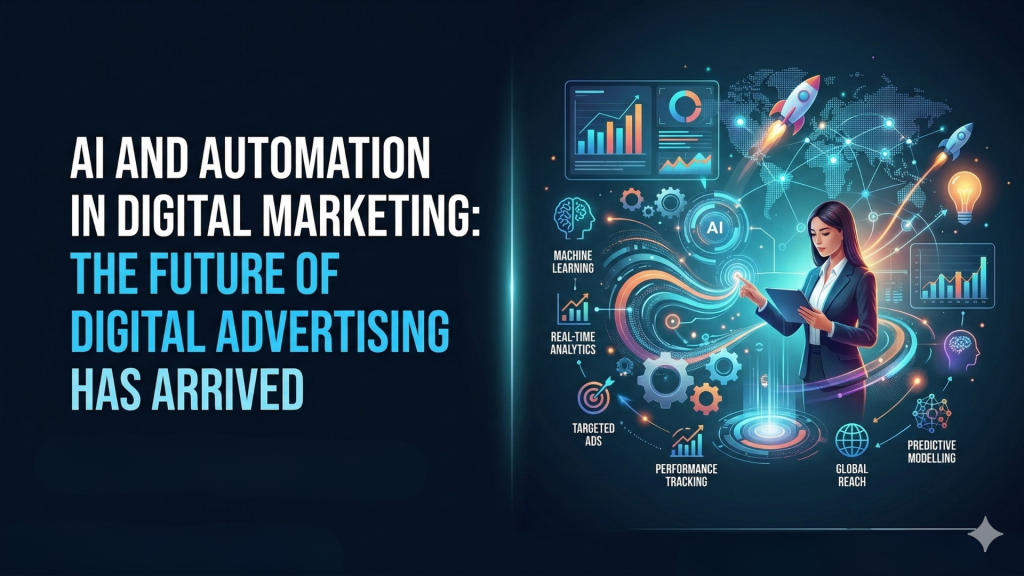
Introduction:
AI in digital marketing 2026 – A paradigm shift in digital marketing. Digital marketing has crossed a defining threshold. What once depended strongly on intuition, manual execution, and isolated tools has now evolved into a highly intelligent, and interconnected ecosystem. The rise of Artificial Intelligence (AI) and automation has fundamentally changed how brands are communicating, analysing, and growing in digital environments. Marketing is no longer about reacting to trends; it is all about anticipating them.
Consumers today generate numerous volumes of data with every interaction: searches, clicks, purchases, and conversations across multiple devices and platforms. Managing this challenge manually will no longer be feasible. AI and automation step in as powerful enablers, transforming the raw data into strategic intelligence and automating execution with high speed and precision. The convergence of AI and Marketing automation tools is not a distant innovation waiting to happen. It is already shaping marketing strategies across industries.
Right from predictive analytics and hyper-personalized content to real-time Ad optimization and conversational AI, intelligent systems have already started redefining how brands attract, engage, convert, and retain customers. For organizations looking for sustainable growth, adopting AI in digital marketing 2026 is no longer a competitive advantage, it is a strategic necessity! This blog will let you explore how AI and automation are reshaping the digital marketing ecosystem, the technologies driving this digital evolution, and why this transformation defines the future of digital advertising.
Understanding AI and Automation in Digital Marketing
Before exploring their impact, it is important to understand the distinction and synergy between AI and automation.
a. What is Artificial Intelligence in Marketing?
Artificial Intelligence refers to systems that are capable of learning from data, recognizing patterns, making predictions, and continuously enhancing results without any human intervention. In digital marketing, AI will enable marketers to move beyond static campaigns toward adaptive, and self-optimizing strategies.
AI-powered marketing capabilities include:
- Predictive customer behavior analysis
- Behavioural and intent-based targeting
- NLP for content and chatbots
- Image, voice, and video recognitions
- Real-time personalization and decision-making
By analysing wide range of datasets rapidly than any human team, AI will empower marketers to make smarter, and data-backed decisions at every stage of the customer journey.
b. What Is Marketing Automation?
Marketing automation tools focuses on executing repetitive and rule-based tasks efficiently and consistently. While automation alone follows predefined workflows, modern systems increasingly integrate AI to become intelligent and adaptive.
Common automation functions include:
- Email campaign execution
- Lead nurturing workflows
- CRM data synchronization
- Social media scheduling
- Performance tracking and reporting
Today’s marketing automation tools are no longer just operational aids, they are strategic engines that drive scalability, consistency, and measurable growth.
Why AI and Automation Have Become Non-Negotiable?
The digital marketing ecosystem has evolved into a complex, fast-moving, and highly competitive environment. Modern consumers interact with brands across multiple channels: websites, mobile apps, search engines, social platforms, email, messaging apps, and even offline touchpoints often at the same time. This multi-channel behavior has made traditional, manual marketing approaches inefficient and unsustainable.
AI and automation have moved from being “nice-to-have” enhancements to essential strategic tools. They enable brands to manage complexity, scale personalization, and remain competitive in an increasingly data-driven landscape.
Key challenges AI and automation help solve include:
- Overwhelming volumes of customer data generated across platforms
- Fragmented and non-linear customer journeys
- Rising advertising costs and intensified market competition
- Growing demand for real-time, hyper-personalized experiences
- Increasing pressure to prove measurable ROI and performance accountability
Brands leveraging AI in digital marketing 2026 gain a significant competitive advantage by reducing operational inefficiencies, improving targeting accuracy, and delivering relevant, timely experiences at scale without increasing manual workload.
AI-Powered Data Analysis: From Data to Decisions
Data is the backbone of digital marketing, but raw data alone has little value without interpretation. AI in digital marketing 2026 excels at processing massive, complex datasets and transforming them into actionable insights that directly inform marketing strategy and execution.
a. Predictive Analytics
AI uses historical patterns and real-time signals to forecast outcomes such as:
- Purchase likelihood and buying intent
- Customer lifetime value (CLV)
- Churn risk and retention opportunities
- Campaign performance, revenue impact, and ROI
These predictive insights allow marketers to act proactively rather than reactively. Budgets can be allocated more efficiently, high-value audiences can be prioritized, and campaigns can be optimized before performance begins to decline.
b. Advanced Customer Segmentation
Traditional segmentation relies on static attributes such as age, gender, or location. AI-driven segmentation is dynamic and continuously evolving, incorporating:
- Browsing behavior and engagement patterns
- Transaction and purchase history
- Demographic and psychographic data
- Device usage, timing, and geographic signals
This advanced segmentation enables brands especially those leveraging artificial intelligence marketing Chennai to deliver highly relevant, context-aware messaging in competitive local and global markets.
Personalization at Scale: The New Marketing Standard
Personalization has shifted from being a differentiator to a baseline expectation. Today’s consumers expect brands to recognize their preferences, anticipate their needs, and communicate at the right moment with the right message.
a. AI-Driven Content Personalization
AI customizes marketing assets in real time, including:
- Website banners and landing page content
- Email subject lines and body copy
- Product and service recommendations
- Push notifications and in-app messages
Each interaction is dynamically shaped by user behavior, intent signals, location, and historical engagement data creating more meaningful customer experiences.
b. Dynamic Customer Journeys
Marketing automation enables personalized actions across the entire funnel: welcome emails, abandoned cart reminders, loyalty rewards, upsell campaigns, and re-engagement flows without manual intervention.
This seamless orchestration of touchpoints is a defining characteristic of the future of digital advertising, where experiences adapt automatically to customer behavior.
Marketing Automation Tools: The Engine of Modern Campaigns
Today’s marketing automation tools operate as integrated ecosystems rather than standalone platforms. They unify customer data, communication channels, and performance analytics into a single operational framework.
Key Capabilities of Advanced Automation Platforms
- AI-powered lead scoring and intelligent nurturing
- Smart email optimization and personalization
- Omnichannel campaign execution
- CRM and sales pipeline integration
- Multi-touch attribution and advanced performance analytics
Strategic Benefits of Automation
- Faster campaign launches and iteration
- Consistent and cohesive brand messaging
- Reduced manual errors and operational friction
- Higher lead-to-customer conversion rates
- Stronger alignment between marketing and sales teams
Automation frees marketers from repetitive execution tasks, allowing them to focus on strategy, creativity, and long-term growth.
AI in Search Engine Optimization (SEO)
Since search engines themselves rely heavily on AI in digital marketing 2026 algorithms, AI-driven SEO strategies are no longer optional.
AI-Based Keyword and Intent Research
AI tools uncover deeper insights such as:
- User search intent and behavior patterns
- Semantic keyword clusters
- Long-tail and voice search queries
- Content gaps and ranking opportunities
Content Optimization and Continuous Improvement
AI evaluates content for relevance, readability, engagement, and ranking potential helping marketers refine SEO strategies continuously as algorithms and user behavior evolve.
For businesses using artificial intelligence marketing Chennai, AI-powered SEO delivers sustained visibility and a competitive edge in both local and global search results.
AI and Automation in Paid Advertising
Paid advertising is one of the areas most dramatically transformed by AI and automation. Traditional paid campaigns relied heavily on manual bid adjustments, limited audience targeting, and delayed performance analysis. AI has replaced this reactive approach with continuous, real-time optimization.
Smart Bidding and Budget Optimization
AI-powered advertising platforms automatically:
- Adjust bids in real time based on intent, device, location, and behavior
- Redistribute budgets dynamically across campaigns and channels
- Optimize for conversions, revenue, and lifetime value not just clicks or impressions
This data-driven approach ensures ad spend is allocated where it delivers the highest impact, improving ROI even in highly competitive markets.
Creative and Audience Optimization
AI simultaneously tests multiple creative variations, audience segments, and ad placements. It quickly identifies winning combinations by analyzing engagement, conversion patterns, and contextual signals far faster and more accurately than manual A/B testing.
This continuous, autonomous optimization is a defining feature of the future of digital advertising, where campaigns evolve intelligently with minimal human intervention.
Chatbots and Conversational Marketing
Conversational AI has fundamentally reshaped how brands communicate with customers, shifting interactions from delayed responses to instant, personalized conversations.
Always-On Customer Interaction
AI chatbots manage a wide range of interactions, including:
- Product and service inquiries
- Lead qualification and nurturing
- Appointment scheduling and reminders
- Order tracking and post-purchase support
By operating 24/7, chatbots improve response times, reduce support costs, and enhance customer satisfaction.
Context-Aware Conversations
Powered by natural language processing (NLP), chatbots understand user intent, context, and sentiment allowing them to respond in a human-like, relevant manner. Conversational marketing has become a core pillar of AI in digital marketing 2026, enabling scalable yet personalized engagement.
AI in Email Marketing: Smarter, Not Harder
Email continues to deliver one of the highest returns on investment, and AI has significantly elevated its performance and relevance.
AI-Optimized Email Campaigns
AI analyzes user behavior to determine:
- Optimal send times for each individual
- Personalized subject lines and content variations
- Ideal messaging frequency to avoid fatigue
This ensures emails reach users when they are most likely to engage.
Lifecycle Automation
From onboarding and lead nurturing to retention and reactivation, AI-driven email workflows adapt dynamically based on user behavior. This intelligent Marketing automation tools maximizes engagement, conversions, and long-term customer value with minimal manual effort.
Social Media Marketing Powered by AI
AI has simplified and strengthened social media marketing by turning vast engagement data into actionable insights.
Intelligent Scheduling and Content Insights
AI analyses trends, platform algorithms, and audience behavior to recommend:
- Optimal posting times for maximum visibility
- High-performing content formats and creatives
- Relevant topics, hashtags, and themes
Sentiment Analysis and Brand Listening
AI continuously monitors brand mentions, sentiment changes, and emerging conversations across platforms. This allows brands to manage reputation proactively, respond quickly to feedback, and stay aligned with audience expectations.
Ethical Considerations and Challenges of Artificial Intelligence Marketing Chennai
Despite its advantages, AI-driven marketing requires thoughtful and responsible implementation.
Data Privacy and Transparency
Brands must comply with data protection regulations and clearly communicate how customer data is collected, stored, and used. Transparency builds trust and strengthens long-term relationships.
Avoiding Over-Automation
Excessive automation can feel impersonal or disconnected. Successful brands balance AI efficiency with human creativity, empathy, and judgment to maintain authentic customer connections.
The Role of Human Marketers in an AI-Driven World
AI enhances marketing capabilities but does not replace human expertise. Human marketers remain essential for:
- Strategic planning and long-term vision
- Creative storytelling and brand voice development
- Upholding brand values and ethical standards
- Emotional intelligence and relationship-building
AI executes with speed and precision; humans provide purpose, direction, and meaning.
Why AI Is the Future of Digital Advertising?
The future of digital advertising will be:
- Predictive rather than reactive
- Personalized rather than generic
- Automated rather than manual
- Insight-driven rather than assumption-based
Brands that adopt AI early will define industry standards while late adopters risk losing relevance and market share.
AI in Digital Marketing 2026: What Lies Ahead?
As AI technologies continue to mature, 2026 will mark a shift from assisted automation to deeply intelligent, self-evolving marketing ecosystems. The next phase of AI innovation will go beyond efficiency and move toward immersive, anticipatory, and autonomous customer engagement.
Key advancements expected to shape digital marketing include:
- Voice and visual search optimization, enabling brands to be discovered through conversational queries, smart assistants, and image-based searches with greater accuracy
- Hyper-personalized and interactive video marketing, where content dynamically adapts in real time based on viewer behavior, preferences, and context
- Autonomous, self-optimizing campaign management, allowing AI systems to independently test, refine, and scale campaigns across channels with minimal human intervention
- Advanced predictive customer modeling, helping marketers forecast intent, lifetime value, churn risks, and purchasing behavior before customers take action
For businesses exploring artificial intelligence marketing Chennai, this is not a future trend, it is a present opportunity. Brands that invest early, upskill their teams, and integrate AI into their core marketing strategy will gain a decisive competitive edge. Those who adapt now will not only keep pace with change but will also lead the digital transformation shaping the next era of marketing.
Final Thoughts
AI and automation are no longer experimental technologies or emerging trends; they have become the foundation of modern digital marketing. From intelligent data analysis and predictive insights to real-time personalization, automated campaign execution, and performance optimization, AI is fundamentally reshaping how brands attract, engage, and retain customers across digital channels. Organizations that embrace AI in digital marketing 2026, adopt advanced marketing automation tools, and align their strategies with the future of digital advertising gain a clear competitive advantage.
They operate with greater efficiency, make smarter data-driven decisions, and deliver consistently relevant experiences that today’s customers expect. In an increasingly crowded and fast-evolving digital landscape, success will belong to brands that combine AI-driven intelligence with human creativity and strategic vision. Those who invest early, adapt continuously, and innovate responsibly will not just survive market disruption but lead it. The future is intelligent. The future is automated. And the future of digital marketing has already arrived!