
7 Grocery Delivery App Ideas for Tier 2 Cities Worth Building in 2026
Seven app ideas built for how tier 2 India actually shops: kirana trust, cash on delivery, vernacular screens and ONDC. Each with its core features and the money angle.
- Why tier 2 is the opportunity
- 1. Vernacular kirana aggregator
- 2. WhatsApp-first ordering
- 3. Community group-buying
- 4. Milk, veg and staples subscription
- 5. Mandi-direct fresh produce
- 6. ONDC open-network app
- 7. Single-city micro quick-commerce
- What the ideas share
- How to validate one
- Turning an idea into an app
- FAQs
Why Tier 2 Cities Are the Real Grocery App Opportunity
The best grocery delivery app ideas for tier 2 cities are not smaller copies of Blinkit. They are different animals, shaped by kirana trust, cash on delivery, patchy data and a buyer who reads Tamil or Telugu before English. Metros are crowded and expensive to win. The grocery delivery app ideas for tier 2 cities below start from that gap.
Here is the market in one line. Kirana stores still hold close to 90 percent of India's grocery retail, and most of those shops sit in tier 2 and smaller towns. The quick-commerce giants burn cash fighting over a handful of metros while Coimbatore, Madurai, Trichy, Salem, Vizag, Kochi and Nagpur wait with rising smartphone use and almost no serious local app. The Economic Times has tracked how a new crop of hyperlocal startups is now building for exactly these markets, betting on demand the metros ignore. That is the opening.
A tier 2 grocery app wins on things a metro app treats as afterthoughts. The buyer trusts the shop on the corner, not a faceless warehouse. She pays cash at the door. Her phone drops to 2G on the wrong street. She would rather tap a Tamil button than parse English. Build for that reader first and a hyperlocal grocery delivery app stops competing with Zepto and starts owning a town. What follows is seven ideas, each with who it serves, why it fits a small city, the features that matter, and how it makes money.
Short on time? Tell our Chennai team which tier 2 city and which idea interests you on WhatsApp or +91 88070 03902, and we will sketch a lean build and a number.
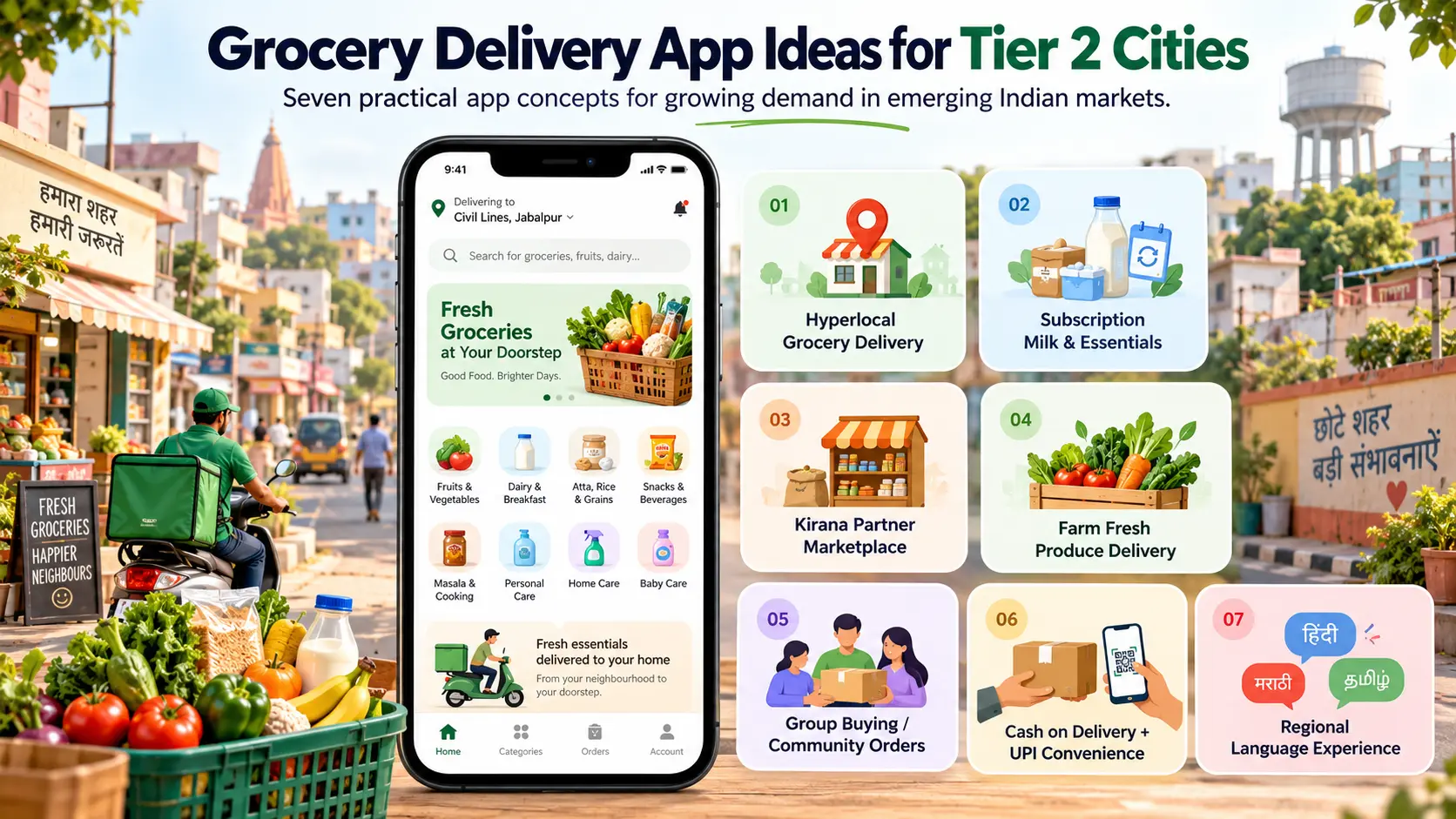
A Vernacular Kirana Aggregator That Puts Local Shops Online
The simplest tier 2 city grocery app does not replace the kirana store. It carries it online. You onboard the trusted neighbourhood shops a town already buys from, give each one a dead-simple seller screen, and let customers order from the shop they know by name.
Who It Serves, and Why It Fits a Small City
This serves the household that already has a favourite provision store and the shopkeeper who is losing younger customers to the idea of ordering on a phone. In a tier 2 city the brand is the shop, not the app. A kirana grocery app that leans into that trust, rather than fighting it with a dark store the buyer has never heard of, gets its first thousand orders far faster.
The Features That Actually Matter
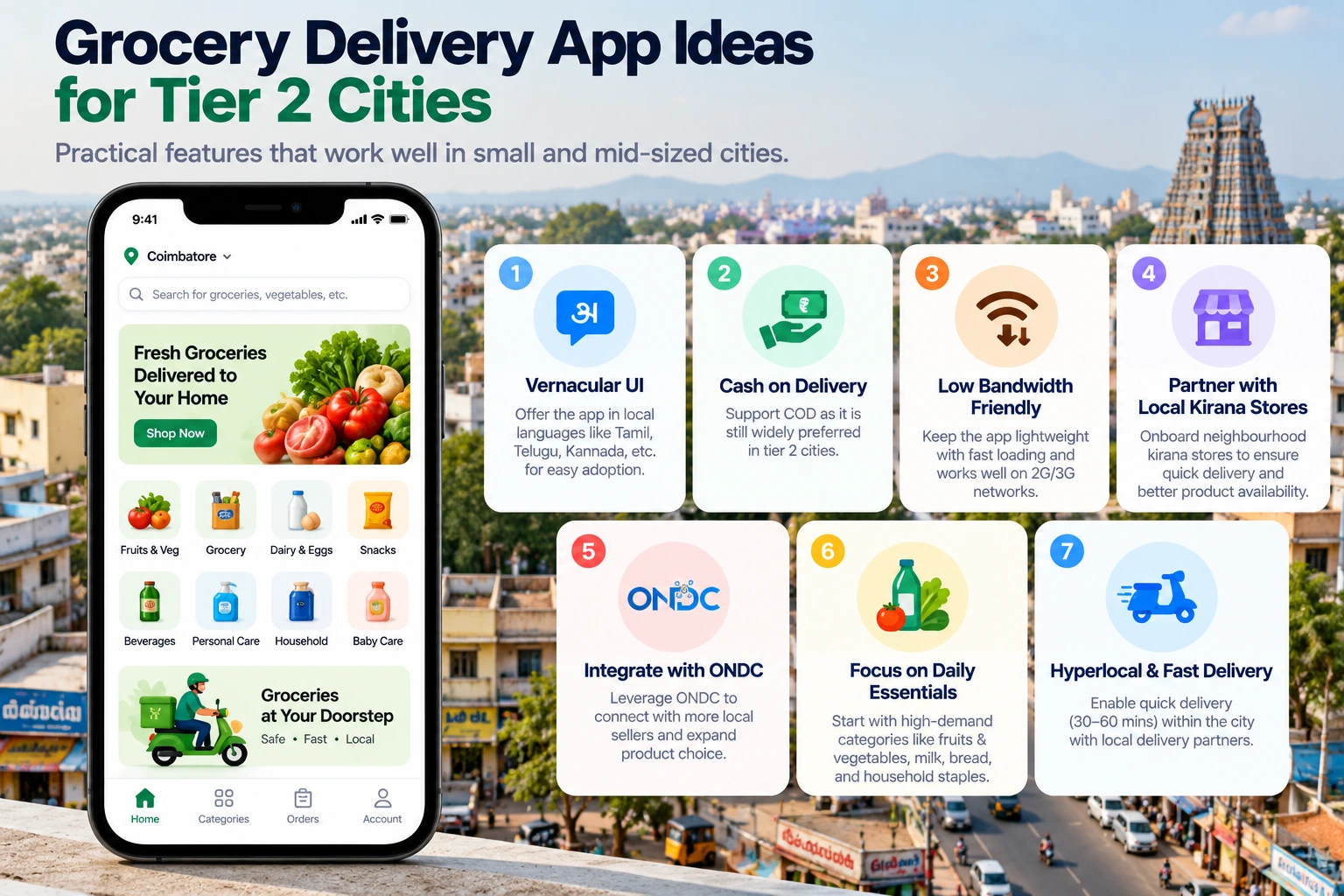
- A vernacular interface, Tamil, Telugu, Hindi or Kannada first, English second.
- A shopkeeper app plain enough to run on an old Android phone, with accept, pack and ready buttons.
- Cash on delivery as the default, with UPI as a quiet option.
How it earns: a thin per-order fee to the store, or a flat monthly subscription the shop pays to stay listed. Keep the cut small. A tier 2 kirana will walk the moment it feels like the aggregator tax that pushed restaurants off food apps.
A WhatsApp-First Grocery Ordering App for First-Time Smartphone Shoppers
Some of your best tier 2 customers will never install an app from the Play Store. They live inside WhatsApp. So meet them there. The order starts as a chat or a tap on a catalogue, and your backend turns that into a real, structured order your packers can read.
This idea serves the first-time smartphone buyer, often older, often not comfortable with a cart-and-checkout flow. It fits a small city because WhatsApp is already the default app on nearly every phone, so there is no install friction and no onboarding tutorial to abandon. A WhatsApp grocery ordering app also behaves well on a weak signal, since a text thread survives a dropped connection where a heavy app screen stalls.
- A WhatsApp catalogue and a light bot that confirms items, address and a delivery slot.
- An admin dashboard where staff see clean orders, not a mess of chat screenshots.
- Cash on delivery, repeat-order shortcuts, and a saved list for the monthly staples run.
The money works through a small margin on the basket or a subscription paid by the stores you supply. The build is cheap to start, which makes this a strong first grocery app idea for a founder testing a town before committing to a full app.
A Community Group-Buying Grocery App for Apartment Blocks and Streets
Last-mile delivery is what quietly kills tier 2 unit economics. One scooter, one order, five kilometres, thin margin. Group buying flips that. One street or apartment block orders together, you deliver once, and the maths finally closes.
How the Model Works
A local captain, often a resident or a shopkeeper, gathers the orders for a block or a lane. The app bundles them into a single bulk order at a better price, and you make one consolidated drop instead of fifteen scattered runs. The buyer saves money, you save fuel and rider hours, and the captain earns a small cut for organising.
This serves price-sensitive households that plan their shopping and live close together, which describes most tier 2 neighbourhoods. The core features are a group cart with a cut-off time, transparent per-person splitting, and captain tools for collecting cash on delivery across the group. It earns through the margin on bulk purchasing plus a delivery fee that shrinks per head as the group grows. Community group buying grocery app models already work in parts of China and India precisely because they turn the weakest part of the business, the last mile, into the strongest.
A Subscription App for Milk, Vegetables and Monthly Staples
Not every grocery order is an impulse. A lot of a household's spend is boringly predictable: milk every morning, a vegetable box each week, rice and oil and pulses once a month. A subscription grocery delivery app turns that rhythm into recurring revenue and routes you can plan days ahead.
This fits tier 2 cities because small-town households plan. They know Thursday is the veg day and the first of the month is the staples run. Predictable demand means you are not scrambling riders for random orders. You are running a tidy morning milk route and a scheduled weekly drop, which keeps cost per delivery low.
- Flexible plans with pause, resume and skip-a-day, so a trip home does not mean wasted milk.
- A prepaid wallet plus cash top-ups, since many buyers still think in cash.
- Route-planned morning and weekly deliveries instead of on-demand chaos.
Revenue comes from the subscription itself and from a growing basket, since a household on a milk plan easily adds eggs, bread and curd over time. Retention is the quiet superpower here, because a subscriber who trusts the morning delivery rarely churns.
A Mandi-Direct Fresh Produce App That Cuts Out the Middleman
Tier 2 cities sit close to the farms and the mandis that feed the metros. That proximity is an edge no Bengaluru app can copy. A mandi-direct fresh produce app sources vegetables and fruit straight from the local mandi or from farmers nearby, so produce arrives fresher and often cheaper than what travels through three layers of traders.
It serves health-minded and value-minded households that care where their produce comes from, and it serves farmers who want a fairer price than a commission agent leaves them. The fit with a small city is geographic and plain: the supply is next door. Models built on local, traceable, farm-fresh sourcing, such as the KissanKonnect approach, show the demand is real when the story is honest.
- Daily mandi price feed and next-morning harvest ordering.
- Source traceability, the farm or mandi a batch came from, shown on the product.
- Loose-quantity ordering, half a kilo of this, 250 grams of that, the way people actually buy sabzi.
The margin lives in the gap you remove between farmer and family. Fewer hands between the field and the door means you can pay the farmer better, charge the buyer less, and still keep a healthy slice.
An ONDC-Powered Open-Network Grocery App You Do Not Have to Scale Alone
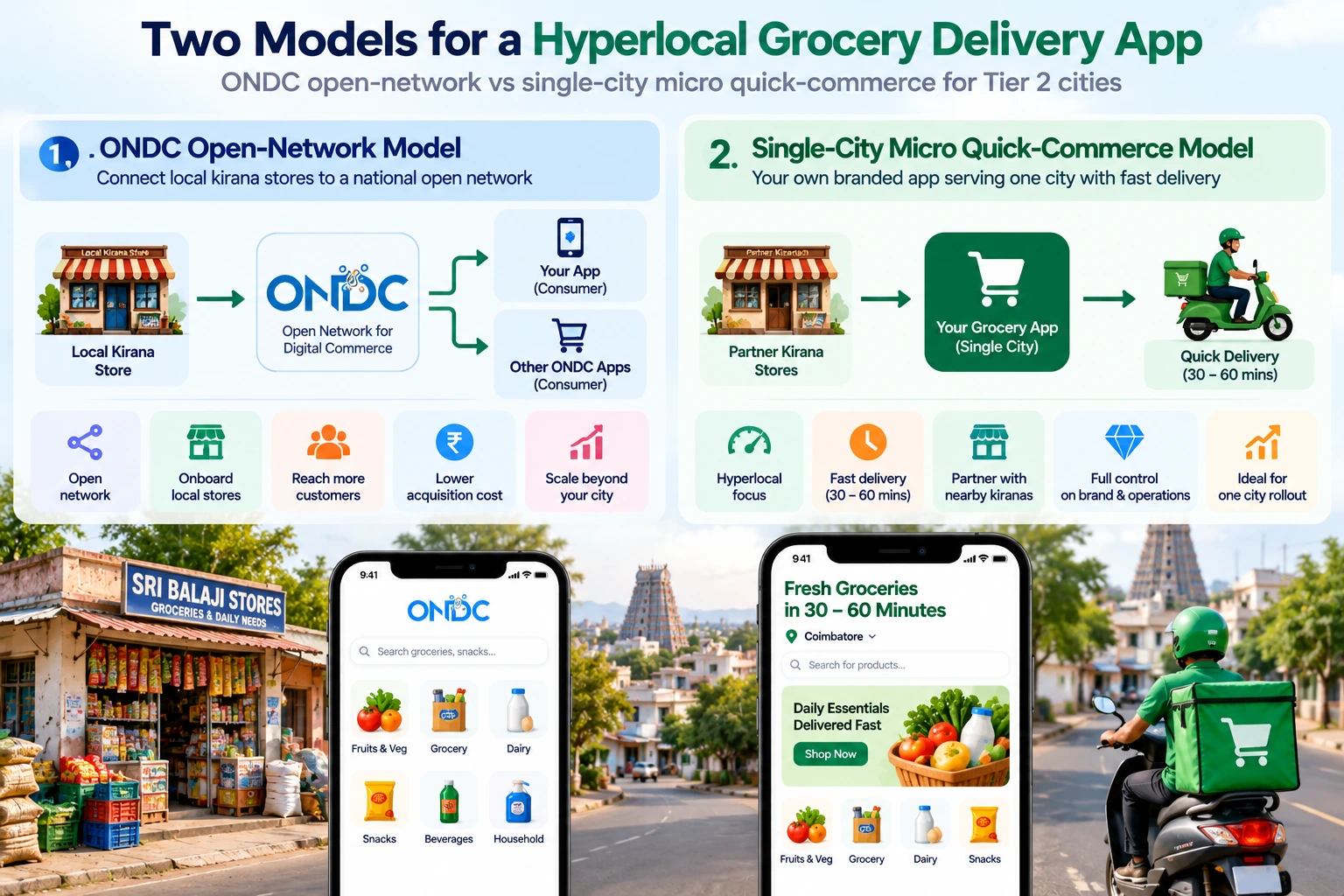
Building a closed marketplace means you carry the whole burden: every store, every rider, every buyer, in every city, by yourself. An ONDC grocery app flips that. You build a buyer app or a seller app that plugs into a shared national network, and you ride infrastructure you did not have to fund.
The Open Network for Digital Commerce, ONDC, is a government-backed initiative that lets buyers and sellers transact across a common network instead of inside one company's walled garden. You can read what it is on the official ONDC site. For a tier 2 operator with limited capital, this is the lightest way in. You do not need to onboard a thousand stores before day one, because the network already has sellers, and you do not pay the heavy take rate a big aggregator charges.
This serves the solo founder or the small retailer who wants to be in grocery delivery without building the entire stack. It fits a small city because a lean ONDC buyer app can launch for one town, then reach others on the same network without a fresh build each time. The features that matter are clean catalogue mapping to ONDC, order and fulfilment status sync, and a checkout that keeps cash on delivery and UPI side by side. It earns through a modest margin or convenience fee, with far less commission bleeding out than a closed platform demands.
A Single-City Micro Quick-Commerce App With a Small Dark Store and Rider Network
You can do a focused version of quick commerce in a tier 2 city, as long as you drop the metro theatre. Forget 10-minute promises. One small dark store, a tight list of fast-moving items, a lean rider network, and an honest 20 to 40 minute window is a business a single town can actually sustain.
Why Small and Focused Beats Fast and Everywhere
The giants lose money chasing speed across dozens of cities. You win by going narrow. One dark store stocked with the 800 or so products a town actually reorders, placed to cover the dense part of the city, served by a handful of riders you know. A dark store grocery app for tier 2 like this is defensible precisely because it is too small and too local for a national player to bother fighting over.
- A curated fast-mover catalogue, not fifteen thousand SKUs you will never turn over.
- A picker app for the dark store and a simple rider app with the delivery address and a cash-collected toggle.
- Geofenced delivery zones so you never promise a drop you cannot make on time.
Money comes from the basket margin plus a small delivery fee, and the unit economics only work if you resist the urge to expand the catalogue and the radius too soon. Quick commerce for tier 2 cities is a discipline, not a land grab.
Pick the idea that fits your town and we will scope a lean first version, no twenty-city fantasy attached.
WhatsApp +91 88070 03902What These Grocery Delivery App Ideas for Tier 2 Cities Share
Seven different ideas, one common foundation. Whichever grocery delivery app ideas for tier 2 cities you back, the same hard realities decide whether it survives contact with a real small-town user. Get this layer right and the idea on top has a chance. Skip it and even a clever concept stalls.
- Vernacular first. A regional-language interface is not a nice-to-have in tier 2. It is the difference between a user who finishes a cart and one who gives up.
- Cash on delivery, done properly. COD is still how a large share of small-city buyers pay, so you need clean cash reconciliation for riders, not just a payment button.
- Low-bandwidth tolerance. The app has to behave on 2G and recover from a dropped signal mid-order, because that is the real network in half the lanes you will deliver to.
- Kirana partnership over kirana replacement. The local shop is an ally and a supply point, not the enemy. The ideas that work with kirana scale faster than the ones that try to bulldoze it.
- ONDC as a shortcut. Even if you build a closed app, keeping it ONDC-ready leaves a cheaper growth path open later.
A hyperlocal grocery delivery app that respects all five reads as local. One that ignores them reads as a metro app dropped into a town that did not ask for it.
How to Validate One Idea Before You Build the App
Do not build all seven. Pick one, prove the town wants it, then write code. The cheapest validation needs almost no app at all.
- Choose one locality and one category. One neighbourhood, one clear basket, say staples or fresh veg. A whole city and a full catalogue on day one is how budgets die.
- Run it manually first. Take orders on WhatsApp, deliver with one rider, collect cash. If people reorder for three weeks without an app, you have a business. If they do not, you just saved a build.
- Then ship a thin app. Build the smallest version that removes your worst manual bottleneck, usually order capture and rider assignment, and nothing else yet.
- Add features the demand asks for. Subscriptions, group buying or ONDC come once real usage points at them, not because a feature list said so.
On cost, a lean tier 2 grocery MVP, one customer app, a basic admin panel and a rider app, typically lands somewhere around four lakh to twelve lakh rupees in 2026 depending on the idea and the integrations. Payments, live tracking, subscriptions and multi-language all move that figure. Treat it as a market range, not a quote. For a fixed number against your exact scope, message our Chennai team on +91 88070 03902.
Turning a Grocery App Idea Into a Real Product
An idea is the easy part. The build, the sourcing, the riders and the first hundred repeat customers are where tier 2 grocery apps are won or lost. This is the work we do.
We are iStudio Technologies, a mobile app development company in Chennai based in Valasaravakkam, with 17+ years behind us, 500+ projects delivered, and an in-house team that runs discovery, design, development, QA, store release and support under one roof. We build on native Kotlin and Swift, or cross-platform Flutter and React Native when one codebase makes sense, and we wire up UPI, Razorpay, maps and the vernacular and offline handling a small-city app needs. We have built grocery, quick-commerce and on-demand delivery apps, so we can tell you which of these grocery delivery app ideas for tier 2 cities fits your capital and which features to leave for phase two.
We will not promise you rankings, downloads or a particular revenue number, because nobody honest can. We will give you code you own, an honest scope, and a team that picks up the phone when a rider app misbehaves during a Saturday rush. Start lean, prove one town, then grow.
Frequently Asked Questions
Is there real scope for grocery delivery apps in tier 2 cities?
How much does it cost to build a grocery delivery app in India?
What is ONDC and how does it help a tier 2 grocery app?
Do tier 2 city users prefer cash on delivery?
Which grocery app idea is cheapest to start with in a small city?
Do I need vernacular or regional-language support for a tier 2 grocery app?
Can one app serve multiple tier 2 cities?
Who builds hyperlocal grocery delivery apps for tier 2 businesses?
Explore More From iStudio
More of our work and pages that connect to building a grocery app for a tier 2 city, grouped by service, industry and topic.
By service
- Mobile app development company in Chennai, the home for every app we build.
- Flutter app development company in India, the cross-platform route for a lean two-store launch.
By industry
- Grocery delivery app development company in Chennai, our dedicated grocery build page.
- Grocery ecommerce mobile app development in India for single stores, chains and farmer-direct models.
By topic
- Grocery customer app features, the building blocks of the customer side.
Build the Grocery App Your Tier 2 City Is Waiting For
Tell us your town, the idea that fits it, and your budget. We will scope a lean first version honestly and put the number in writing. No twenty-city fantasy, no template quote.
WhatsApp or call +91 88070 03902